



Beijing
Beijing has been China's political and cultural capital for more than 800 years. Wide modern boulevards and Olympic-era stadiums sit next to quiet hutong alleys where daily life has barely changed in decades. The old imperial center still anchors the whole city.
A visit here works well as a first stop before exploring the rest of China. The major sights sit close together, an extensive subway connects them, and English signage is common at tourist sites. Come for the history, but leave time for the food and the neighborhoods too.

Beijing – Planning a Trip?
Build your day-by-day itinerary in the Tripomatic app.


When to visit
Spring (April–May) and autumn (September–October) are the most comfortable times to visit, with mild days and clearer skies. Summers are hot, humid, and bring frequent afternoon downpours, while winters are cold and dry, sometimes with light snow.
Late March into early April brings cherry blossom season at city parks and palace grounds, with pink and white blossoms across the city.
Best time to visit: April, May, September, October
Avoid the week around National Day (October 1) if you can. It is China's busiest domestic travel holiday, and major sights get packed.
Top sights
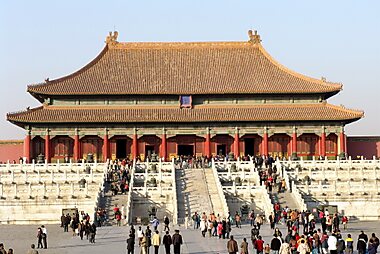



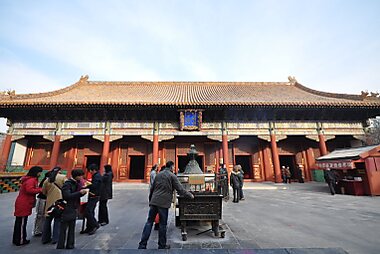
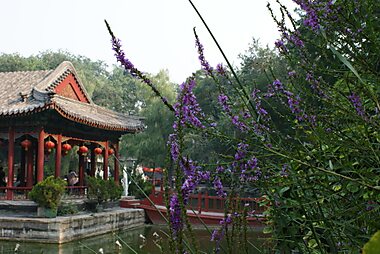

Start at Forbidden City, the walled palace complex where China's emperors lived for almost 500 years, with nearly 1,000 buildings to explore.
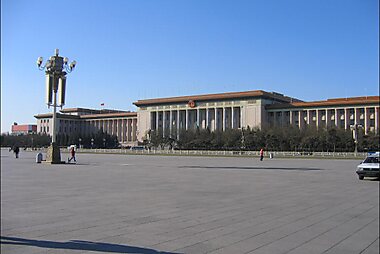
Just outside its southern gate, Tian'anmen Square is one of the largest public squares in the world and the symbolic heart of modern China.
South of the center, Temple of Heaven is where emperors once prayed for good harvests. Its round, blue-roofed main hall is one of the most photographed buildings in the country.
Summer Palace is a vast lakeside garden built as a summer retreat for the imperial court. Covered walkways, temples, and a marble boat line the shore of Kunming Lake.
Lama Temple is Beijing's largest Tibetan Buddhist temple, filled with incense smoke and a giant sandalwood Buddha statue.
For a quieter side of the city, wander the lanes around Shichahai, a cluster of lakes lined with old courtyard homes, cafes, and bars.
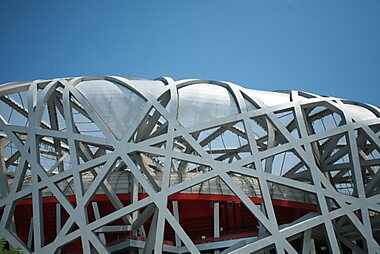
Built for the 2008 Olympics, National Stadium, nicknamed the Bird's Nest, is still used for major events and lit up at night.
For contemporary art, head to 798 Art District, a former military factory complex now packed with galleries, studios, and design shops.
Featured Lists


Museums & Art
Beijing’s museum landscape spans millennia of imperial history and the pulse of modern creativity. This collection features the Forbidden City, the world’s largest ancient palace complex, alongside the National Museum of China on Tiananmen Square. Specialized sites include the 798 Art District, housed in repurposed military factories, and the Prince Gong Mansion, a preserved Qing Dynasty residence. From the ancient bells of Dazhong Temple to the revolutionary history at the Military Museum and the diverse heritage at the China Ethnic Culture Park, these institutions showcase the breadth of Chinese civilization.
12 places


What to experience
Beyond the big sights, these are the things that make a visit to Beijing memorable.
- Sip tea on a lakeside terrace around Shichahai in the evening, when the area lights up.
- Take a rickshaw or bike ride through the hutong alleys to see courtyard life up close.
- Watch a Beijing opera performance. The elaborate costumes, painted faces, and acrobatics are worth seeing at least once.
- Join locals for morning tai chi or fan dancing in a city park, a daily ritual here regardless of the season.
- Browse a weekend antique and curio market, where vendors lay out everything from old coins to vintage posters.
Tours & Activities
Beijing — Map

 Open the interactive map
 Day trips
The mountains around Beijing hold some of the best-preserved sections of the Great Wall, plus a scattering of imperial tombs. You can visit each of these and return within a day.
- The Ming Tombs, ≈1 hour by car or bus: the burial site of 13 Ming-dynasty emperors. A long approach lined with stone animal statues leads into a quiet valley.
- Badaling Great Wall, ≈1.5 hours by bus or car: the most visited and most restored section of the Great Wall. It has a cable car and an on-site museum. Visit early in the day to avoid the largest crowds.
- Mutianyu Great Wall, ≈1.5–2 hours by car: a less crowded, more scenic alternative to Badaling, with a toboggan ride down from the wall.
- Gubei Water Town and the Simatai section of the Great Wall, ≈2.5 hours by car: a rebuilt canal town below a wilder, unrestored stretch of wall. Worth an overnight if you have the time.
Where to explore
Beijing's central districts each have a distinct character worth knowing about.
Dongcheng is the eastern half of the historic core, home to the Forbidden City and Tian'anmen Square.
Xicheng is the western half of the old city, with quiet hutong lanes and lakeside parks.
Haidian lies northwest of downtown and is known for its university campuses and the Summer Palace.
Getting there
- By air: Most international flights land at Beijing Capital International Airport (PEK), about 25 km northeast of downtown; the Airport Express train reaches the city center in about 25 minutes, or a taxi takes 40–60 minutes depending on traffic. Some flights, especially budget and domestic carriers, use Beijing Daxing International Airport (PKX), about 50 km south, connected to the center by a 20-minute express train.
- By train: Beijing is the hub of China's high-speed rail network. Trains from Beijing South station reach Shanghai in about 4.5 hours, and other lines connect to major cities across the country.
- By bus: Long-distance coaches serve nearby cities and towns from several terminals, but the train is faster and more comfortable for most routes.
Getting around
- Public transit: The subway network covers most of the city and is the easiest way to get around. Buy a rechargeable transit card at any station, or simply tap a contactless bank card or phone directly at the gate. Beijing Subway
- Taxi / ride-hailing: Didi is the dominant ride-hailing app; drivers rarely speak English, so have your destination written in Chinese characters.
- On foot / cycling: The historic core around the Forbidden City and the hutongs is best explored on foot or by bike-share — dockless bike-share bikes are everywhere and need only a phone to unlock.
- Internet & payments: Google, Gmail, WhatsApp, and Facebook are blocked — install a VPN before you arrive if you need them. Alipay and WeChat Pay are the default way to pay for almost everything; both now accept a linked foreign card, so set one up before your trip.
Driving
- Is a car worth it?: No — traffic and parking make driving in the city impractical, and the subway and taxis cover it well. For the day trips above, most travelers use a bus, a hired car with driver, or an organized tour instead of a self-drive rental.
- Parking: If you do drive, most hotels and malls have paid underground parking; street parking is metered and hard to find in the center.
- Restrictions: A license-plate rotation system bars private cars, including some rentals, from central roads on certain weekdays. Check the current rules before driving in the city.
Food & drink
Peking duck is the dish to seek out here — order it at a specialist restaurant rather than a general one, since the roasting and carving take real skill. Beyond duck, look for street food like jianbing (savory crepes) from a cart, and hand-pulled noodles or dumplings at a neighborhood spot.
For a concentrated food scene, head to the stalls and small restaurants around Shichahai, or wander the alleys near Nanluoguxiang, where cafes and modern Chinese kitchens sit next to old courtyard homes.
Safety & health
Beijing is a safe city for tourists — violent crime against visitors is rare. The main risks are pickpocketing in crowded tourist spots and overpriced taxi or rickshaw rides, so agree on a rickshaw fare before getting in, and use a ride-hailing app or metered taxi instead of hailing on the street near major sights.
Tap water is not safe to drink — stick to bottled or boiled water, which is what most hotels provide.
History
Regional dynasties made Beijing a capital as early as the 10th century, long before it became the seat of a unified China. The Mongol Yuan dynasty took that step in 1271. The Ming emperors who followed began building Forbidden City in 1406 and moved into their new walled palace in 1420. The Qing dynasty kept the same palace and added retreats like Summer Palace. That palace was burned by British and French troops in 1860, and again during the Boxer Rebellion, and rebuilt both times.
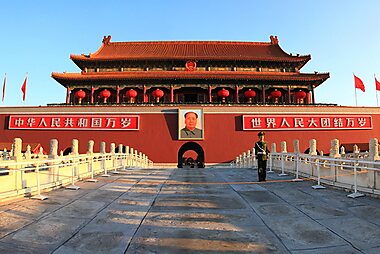
The 20th century brought dramatic change. Mao Zedong proclaimed the founding of the People's Republic of China from Gate of Heavenly Peace, above Tian'anmen Square, in 1949. The square remains the symbolic center of the state today. More recently, the 2008 Olympics reshaped the city's skyline, leaving landmarks like National Stadium behind.
Country facts
Quick practical facts for China at a glance:
- Currency
- Chinese Yuan CNY ¥ · Card payments · Cash preferred
- Emergency numbers
- 110 Police
- Electricity
- 220 V · 50 HzType A / Type C / Type I
- Languages
- Chinese
- Tap water
- Not safe to drink
- Driving side
- Right
- Calling code
- +86


Beijing – Plan Your Days
Turn the places from this guide into a real itinerary, with smart routing, time estimates, and everything you need for a perfect trip.




