



Göreme Historical National Park
Göreme Historical National Park is the heart of Cappadocia, a landscape of cone-shaped rock towers, honeycombed cliffs, and valleys carved from soft volcanic stone. People have carved homes, chapels, and whole underground towns into this rock for over a thousand years, and many of those spaces are still open to walk through today. The park and its rock sites became a UNESCO World Heritage Site in 1985, recognizing both the geology and the Byzantine-era churches cut into it.
This is a destination for slow, curious travel: wandering valley trails between fairy chimneys, ducking into cave chapels covered in faded frescoes, and watching dozens of hot air balloons drift over the rock formations at sunrise. It suits travelers who want a landscape unlike anywhere else, paired with a few nights sleeping in an actual cave room carved into the hillside.

Göreme Historical National Park – Planning a Trip?
Build your day-by-day itinerary in the Tripomatic app.


When to visit
Spring (April–June) and autumn (September–November) bring mild days, cooler nights, and the calmest winds — the best conditions for a hot air balloon flight to actually go ahead. Summer (July–August) is hot and dry, with the valleys offering little shade. Winter is cold and occasionally snowy, which makes for striking photos over the fairy chimneys but grounds balloon flights more often.
Plan around BalonFest, Cappadocia's hot air balloon festival, held over a few days in late July or early August. Dozens of specially shaped balloons from around the world fly in formation over the valleys, drawing much bigger crowds than the everyday sunrise flights. Balloon flights themselves run year-round, weather permitting, so a trip at any time of year can usually include one.
Best time to visit: May, June, July, September, October
Top sights

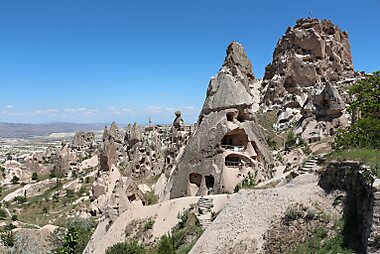


Göreme Open Air Museum is the single best introduction to the region: a cluster of rock-cut monastery churches with Byzantine frescoes still visible on the walls and ceilings. Give it at least two hours, and expect narrow stairs and low doorways.
Perched on the region's tallest rock outcrop, Uçhisar Castle is honeycombed with old cave dwellings and tunnels, and the climb to the top rewards you with a panoramic view over the whole valley network — a good stop for orientation before exploring further.
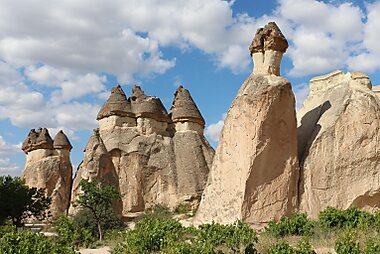
Pasabag valley is famous for its multi-headed fairy chimneys, tall rock cones capped with a harder stone layer that has stopped erosion at the top. It is one of the most photographed spots in Cappadocia.
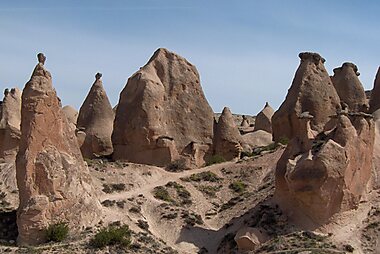
The pale, moon-like cones of Devrent Valley have earned it the nickname Imagination Valley — locals and guides point out shapes in the rock, from camels to a rendition of Napoleon's hat.
Zelve Open-Air Museum was inhabited until the 1950s, when the last residents were relocated because the rock had become unstable. Its rock-cut churches, dovecotes, and tunnels give a real sense of a once-living cave village.
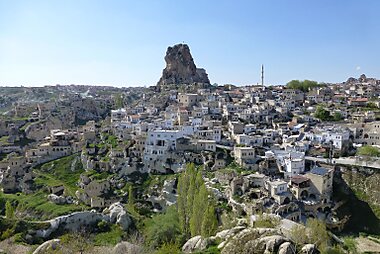
The fortified rock of Ortahisar Castle rises from the middle of its village and can be climbed for sweeping views, with far fewer crowds than the more famous castle nearby.
Göreme Valley runs between rows of fairy chimneys and cave dwellings and is one of the easiest, most scenic valley walks in the park, connecting toward the open-air museum.
Rose Valley takes its name from the pink and red tones the cliffs turn at sunset, and its trail is a popular way to end a day of hiking with a view.
Featured Lists


What to experience
- Fly over the valleys at sunrise. A hot air balloon flight is Cappadocia's signature experience: dozens of balloons lift off together just before dawn and drift low over the fairy chimneys as the light changes. Book with a licensed operator and expect flights to be canceled or rescheduled when winds are too strong.
- Ride or walk through a valley at golden hour. Horseback riding is a popular way to cover ground between the rock formations, especially through Rose Valley and Love Valley, with the low evening light turning the cliffs red.
- Sleep in a cave hotel. Many hotels in Göreme are built into the hillside itself, with rooms carved directly from the rock — worth choosing over a standard hotel room at least once.
- Try the pottery wheel in Avanos. The riverside town has made pottery from local red clay for centuries, and several workshops let visitors sit down and shape their own piece.
- Watch the sunset from a valley viewpoint. Several hills around town fill with locals and travelers alike as the fairy chimneys turn pink and gold in the last light.
Tours & Activities
Göreme Historical National Park — Map

 Open the interactive map
 Day trips
Cappadocia rewards a car or a day tour beyond Göreme itself — several worthwhile stops sit within an hour's drive.
- Uçhisar: about 10 minutes by car or a walkable trail from Göreme through Pigeon Valley. A hilltop village built around a natural rock castle, with cave hotels and views over the whole region.
- Avanos: roughly 20 minutes by car, on the banks of Turkey's longest river. Known for centuries of pottery-making using local red clay — several workshops let visitors try the wheel.
- Urgup: about 25 minutes by car. A relaxed town surrounded by vineyards, with several wineries open for tastings of Cappadocia's distinctive high-altitude wines.
- Derinkuyu and Kaymaklı underground cities: roughly 45–60 minutes by car. Multi-level underground settlements carved to shelter thousands of people, with tunnels, stables, churches, and ventilation shafts. Derinkuyu is the deeper of the two, reaching about 85 meters with eight levels open to visitors; Kaymaklı is shallower but wider and easier for families.
- Ihlara Valley: about 1.5 hours by car, a dramatic green gorge with a river running along its floor and rock-cut churches tucked into the cliffs — a good contrast to Göreme's drier, open valleys.
Where to explore
Urgup makes a good base if you want a quieter, more local feel than Göreme's town center, while staying just a short drive from the same valleys and museums. It is also the center of Cappadocia's wine country, with several vineyards open to visitors.
Getting there
- By air: Nevşehir Kapadokya Airport is the closest, about 35 km (roughly 40 minutes by transfer or taxi) from Göreme. Kayseri Erkilet Airport is farther, about 80 km (roughly 1 hour 15 minutes), but has more international connections. Most hotels and tour companies run shuttle transfers from both airports; book ahead since public transport does not serve either one directly.
- By bus: overnight coaches connect Nevşehir's main bus station with Istanbul, Ankara, and other major Turkish cities. From the bus station, a short taxi or shuttle ride reaches Göreme.
- By car: Cappadocia sits on Turkey's D300/D765 highway network, a comfortable multi-hour drive from Ankara or a longer one from the coast; a car is the easiest way to reach Göreme independently and to explore the wider region afterward.
Getting around
- Dolmuş (shared minibus): local minibuses run between Göreme and nearby towns like Uçhisar, Avanos, and Ürgüp, with tickets bought in cash from the driver. They are cheap but run on a loose schedule, so build in extra time.
- Taxi: widely available in Göreme's center and useful for reaching trailheads or sights without a direct dolmuş route.
- Guided valley tours: many visitors join a half- or full-day minibus tour ("Red Tour" or "Green Tour" are the common local names) that links several valleys and villages in one trip, since distances between sights are short but the terrain isn't always walkable.
Driving
- A car isn't essential for Göreme itself — the town center is walkable and dolmuş minibuses cover the nearby villages. It pays off once you want to reach the underground cities or Ihlara Valley on your own schedule.
- Parking: Göreme's center has free street parking and a small public lot near the bus station; cave hotels often have their own limited parking, so confirm when booking.
- Roads: village roads and some valley access roads are narrow and unpaved in places — take it slowly, especially after rain.
Food & drink
Cappadocia's signature dish is testi kebab: meat and vegetables slow-cooked in a sealed clay pot, then cracked open at the table, a bit of theater that most restaurants in Göreme offer. The region is also one of Turkey's oldest wine-growing areas, thanks to the volcanic soil, and local reds and whites appear on most menus.
For eating, head to the streets around Göreme's small central square and bus station, where cave-carved restaurants and cafés cluster within easy walking distance of most hotels. For wine specifically, the wineries around Urgup are worth the short drive for a tasting.
Safety & health
Göreme is very safe for travelers, with petty theft and scams no more common than anywhere else in Turkey. The main practical risks are physical: valley trails cross loose gravel and soft rock, so wear closed shoes with grip, and be careful near unguarded cliff edges and viewpoints, especially at sunset when the light is low. The landscape offers little shade, so carry water and sun protection when hiking in summer.
Only book hot air balloon flights with a company licensed by Turkey's civil aviation authority — operators sometimes fly in marginal conditions, and a flight should be rescheduled rather than flown if winds are too strong.
History
Cappadocia's rock is volcanic tuff, soft enough to carve by hand but sturdy enough to hold its shape, and people have exploited that for millennia. Early Christian communities fled persecution here, and later Arab raids. They carved entire monasteries and chapels into the cliffs from around the 4th century onward. The churches now open at Göreme Open Air Museum date mostly from the 10th to 12th centuries, their frescoes painted directly onto the rock and still visible today despite centuries of exposure and, later, use as stables and storerooms.
Communities also built upward as well as underground: Uçhisar Castle was inhabited and fortified for centuries, its rock riddled with tunnels that connected homes, storage rooms, and lookout points. Beneath the surface, the region's underground cities served as refuges during periods of invasion, letting entire towns disappear into the rock for weeks at a time.
Country facts
Quick practical facts for Turkey at a glance:
- Currency
- Turkish Lira TRY ₺ · Card payments · Widely accepted
- Emergency numbers
- 112 Ambulance
- Electricity
- 230 V · 50 HzType C / Type F
- Languages
- Turkish
- Tap water
- Drink with caution
- Driving side
- Right
- Calling code
- +90


Göreme Historical National Park – Plan Your Days
Turn the places from this guide into a real itinerary, with smart routing, time estimates, and everything you need for a perfect trip.

