



Grindelwald
Grindelwald sits in a wide green valley directly beneath the north face of Eiger, at the heart of the Jungfrau region in the Bernese Oberland. Cable cars and cogwheel trains climb straight out of the village toward high alpine stations, so within an hour a visitor can go from the valley floor to glaciers, panoramic ridges, and permanent snow. This closeness to real high-mountain terrain, reached without technical climbing, is what sets Grindelwald apart from most alpine villages.
Despite its fame, Grindelwald has stayed a working mountain community rather than a purpose-built resort. It suits travelers who want several days of hiking or skiing, with the option of one big-ticket day trip up to Jungfraujoch Railway Station, the highest railway station in Europe. Early British mountaineers put the village on the map in the 19th century, and climbers still come for the Eiger's legendary north face, nicknamed the Nordwand.

Grindelwald – Planning a Trip?
Build your day-by-day itinerary in the Tripomatic app.


When to visit
Summer (June to September) is warm and the best time for hiking, with long days and the high trails free of snow. Winter (December to March) brings reliable snow for skiing and sledging. Spring and late autumn are quieter but many cable cars and mountain trails close for maintenance, so check opening dates before planning a trip.
If skiing, time a visit around the World Snow Festival in January, when teams carve elaborate snow sculptures in the village center over several days — a good excuse to combine sightseeing with a ski trip.
Grindelwald's weather changes fast at altitude: a clear valley morning can turn cloudy on the high stations by midday, so build flexibility into any plan that depends on a mountain view.
Top sights

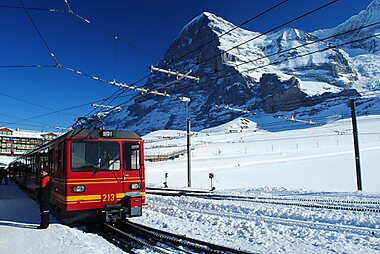



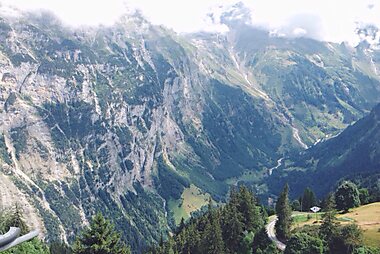
Eiger dominates every view from the village. Its nearly 1,800-metre north face, the Nordwand, is one of the great walls of the Alps and was first climbed in 1938 after several fatal attempts.
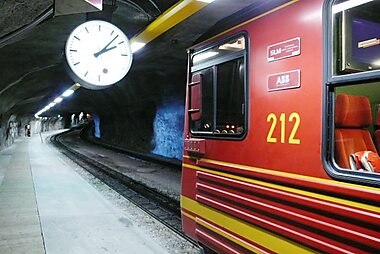
Jungfraujoch Railway Station, marketed as the "Top of Europe," is the highest railway station in Europe at 3,454 metres. The cogwheel Jungfrau Railway runs largely through a tunnel bored inside the Eiger and Mönch to reach it. Kleine Scheidegg is the mountain pass and rail junction below the Eiger where trains from Grindelwald and Lauterbrunnen meet before continuing up to the Jungfraujoch.
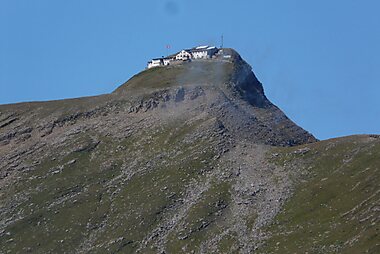
First is the top of the gondola line on the opposite side of the valley, with wide views back across to the Eiger. From there, First Cliff Walk by Tissot is a steel walkway and suspension bridge built onto the rock face, ending in a platform that juts out over the drop.
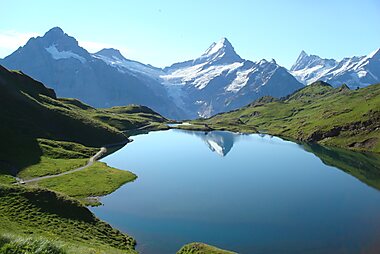
Bachalpsee is a shallow high-alpine lake about an hour's walk from First, famous for reflecting the surrounding snow peaks on a still morning. Below the village, Grindelwald Glacier Gorge is a gorge carved by the retreating Lower Grindelwald Glacier, with a walkway through tunnels and galleries between 300-metre rock walls.
Männlichen, reached by cable car from the valley, is a panorama point looking over the Lauterbrunnen valley to the Eiger, Mönch, and Jungfrau, and the starting point for a well-known ridge walk to Kleine Scheidegg.
Featured Lists


What to experience
- Sledge down from Pfingstegg on its summer toboggan run, or try the adjacent zip-line style Fly-Line above the valley.
- Walk the high ridge route from Männlichen to Kleine Scheidegg, a mostly level panorama trail with the Eiger, Mönch, and Jungfrau in view the whole way.
- Stay overnight at the historic inn on Faulhorn, open since 1830, to watch sunrise or sunset over the Bernese Alps from above 2,600 metres.
- In winter, take a floodlit evening sledge run down from the mountain restaurants above the village — a Grindelwald tradition that turns a daytime ski trail into a night activity.
Tours & Activities
Grindelwald — Map

 Open the interactive map
 Day trips
Grindelwald's own mountain excursions take a full day on their own, but several classic Bernese Oberland destinations are within easy reach.
- Interlaken — about 35 minutes by direct train. The region's transport hub, wedged between two lakes, with paragliding, boat trips, and canyoning outfitters.
- Lauterbrunnen — about 40 minutes by train, changing at Zweilütschinen. This steep-sided valley has dozens of waterfalls, including Staubbach Falls, which drops straight off a cliff above the village.
- Mürren — about 1.5 hours via Lauterbrunnen and a cable car. A small, car-free village with views across to the Eiger trio and the cable car up to the Schilthorn.
- Meiringen — about 1.5 hours by train, changing at Interlaken Ost. Home to the Aare Gorge and the Reichenbach Falls, the setting Arthur Conan Doyle chose for Sherlock Holmes's fictional death.
- Bern — about 2 hours by train, changing at Interlaken Ost. Switzerland's capital has a UNESCO-listed medieval old town with covered arcades and the Zytglogge clock tower, worth a full day if you can spare it.
Where to explore
Grindelwald is one of several villages that make up the Jungfrau region, and it is easy to combine with its neighbors on the same multi-day transport pass. Lauterbrunnen, in the next valley over, is the gateway to the car-free villages of Wengen and Mürren, both reached only by rail or cable car and both looking directly across at the same Eiger-Mönch-Jungfrau skyline from the opposite side. Interlaken is the region's transit hub, useful as a base if you want a wider choice of hotels or a lakeside setting.
Getting there
- By air: Zurich Airport (ZRH) is the main international gateway, about 3 hours away by train, changing at Interlaken. Geneva Airport (GVA) is an option from the west, around 4 hours away with a change in Bern.
- By train: Grindelwald has its own station on the Bernese Oberland Railway, with direct trains to Interlaken in about 35 minutes, and trains to Lauterbrunnen in about 40 minutes, changing at Zweilütschinen. There is no need to book in advance; regional trains run roughly every 30 to 60 minutes in season.
- By bus: PostBus long-distance coaches connect through Interlaken, but the train is faster and more frequent for this route.
Getting around
- Trains and cable cars: Grindelwald's own sights are reached by a network of cogwheel trains and gondolas rather than roads. Buy tickets at the station or a base station, or in advance online; multi-day passes covering several lifts are worth it for a stay of three days or more.
- Local buses: PostBus routes connect outlying hamlets to the village center; buy tickets from the driver by contactless card or through the SBB/PostBus app.
- On foot: The village center is compact and easily walkable, with marked paths continuing into the surrounding meadows.
- Cycling: The valley floor is manageable by bike, but most of the terrain around Grindelwald is too steep for casual cycling; mountain bikers instead take a gondola up and ride marked trails back down.
Driving
- Is a car worth it?: Not for a Grindelwald-only stay. Most of the village's signature sights, including Kleine Scheidegg, First, and Männlichen, have no public road at all and are reached solely by train or cable car. A car helps only if you plan to explore the wider Bernese Oberland at your own pace.
- Parking: Pay parking lots sit at the village entrance near the station; the central streets are largely reserved for pedestrians, guests' shuttle traffic, and delivery vehicles. Pay by app or at the machine.
- Restrictions: The road up the valley narrows past Grindelwald and does not continue over the mountains — return the way you came, or switch to rail.
Food & drink
Mountain-restaurant dining is part of the Grindelwald experience: lunch at a Bergrestaurant near Kleine Scheidegg or First pairs simple Alpine cooking with some of the best views in the region, so book ahead in high season.
In the village itself, the streets around the main Dorfstrasse hold the bulk of the restaurants and cafés, from casual rösti stops to hotel dining rooms. Look for Alpine cheese from Bernese Oberland dairies on local menus alongside the standard Swiss classics.
Safety & health
Grindelwald is very safe, with petty crime rare even in the busiest summer weeks. The main risks are mountain-specific: weather at altitude changes quickly, and trails above the tree line can hold snow and ice well into early summer. Stay on marked paths, especially near glaciers and viewpoints with exposed drops, and check conditions before a high-altitude hike.
Cable cars and trains sometimes stop for high wind or maintenance; build a buffer into any day trip that depends on reaching a specific summit station.
History
Grindelwald grew from a farming community into one of the Alps' first tourist destinations after British mountaineers began arriving in the mid-19th century, drawn by Eiger and its neighbors. Grand hotels followed, and the valley became a base for the golden age of alpine mountaineering.
The Eiger's north face, nicknamed the Nordwand, resisted every attempt for years and killed several climbers before Anderl Heckmair, Ludwig Vörg, Heinrich Harrer, and Fritz Kasparek finally reached the summit on 24 July 1938. The climb remains one of the defining stories in mountaineering history, and the wall is still visible from the village street.
Engineers began building the Jungfrau Railway in 1896, tunnelling through the Eiger and Mönch to reach Jungfraujoch Railway Station in 1912 — a project that took 16 years and was, at the time, one of the most ambitious railways ever attempted. The surrounding Jungfrau-Aletsch area became a UNESCO World Heritage Site in 2001, recognizing it as the most glaciated region in the Alps.
Country facts
Quick practical facts for Switzerland at a glance:
- Currency
- Swiss Franc CHF CHF · Card payments · Widely accepted
- Emergency numbers
- 112
- Electricity
- 230 V · 50 HzType C / Type J
- Languages
- German, French, Italian, Romansh
- Tap water
- Safe to drink
- Driving side
- Right
- Calling code
- +41


Grindelwald – Plan Your Days
Turn the places from this guide into a real itinerary, with smart routing, time estimates, and everything you need for a perfect trip.




