



Jindrichuv Hradec
Jindřichův Hradec grew up around a large medieval pond, Vajgar, and a hilltop castle that once belonged to one of Bohemia's richest noble families. Jindřichův Hradec Chateau is the town's main draw: with its combined Gothic and Renaissance wings, it ranks as the third-largest castle and chateau complex in the Czech Republic, after Prague and Český Krumlov.
Unlike Český Krumlov, its better-known neighbor, Jindřichův Hradec sees far fewer visitors, so its arcaded main square and lakeside paths stay calm even in summer. It suits travelers who want a genuine South Bohemian castle town, a full day at the chateau, and an easy base for exploring the region's fishponds.

Jindrichuv Hradec – Planning a Trip?
Build your day-by-day itinerary in the Tripomatic app.


When to visit
Summers are warm and pleasant for walking around the pond and through the old town; spring and autumn are mild with a good chance of rain. Winters are cold, but the Advent season is worth planning a visit around, when the main square holds a Christmas market and the museum's giant mechanical nativity scene becomes a seasonal highlight.
Best time to visit: June, August, September
July and August are the busiest months; visit in the shoulder seasons for a quieter castle tour.
Top sights
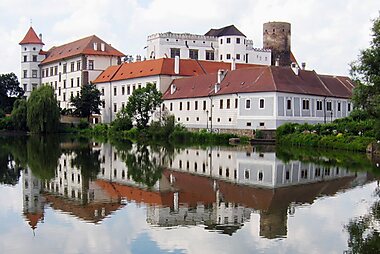




- Jindřichův Hradec Chateau is the headline sight, a combined Gothic castle and Renaissance chateau that ranks as the third-largest castle complex in the Czech Republic. Its highlight is the Rondel, an unusual round Renaissance music pavilion decorated by Italian craftsmen for the Lords of Hradec.
- Černá věž, a 32-meter tower in the historic core, has an observation deck with views across the rooftops toward the pond.
- Náměstí Míru is lined with Renaissance and Baroque townhouses under arcades, anchored by Sousoší Nejsvětější Trojice, an 18th-century Baroque monument at its center.
- Muzeum Jindřichohradecka holds the world's largest mechanical nativity scene, built over sixty years by local stocking-weaver Tomáš Krýza and listed by Guinness World Records since 1998.
- Vajgar is the nearly 50-hectare pond bordering the old town, first built in 1399; a path along its bank makes for an easy walk with castle views across the water.
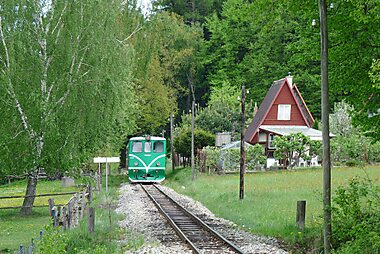
- Jindřichův Hradec Narrow-gauge Railway runs one of the most extensive narrow-gauge rail networks in the Czech Republic from a station just outside town, with heritage trains still running on parts of the line.
- Muzeum fotografie a moderních obrazových médií is a small museum dedicated to photography and modern visual media, a quieter, more contemporary contrast to the castle.
Featured Lists

What to experience
A visit here is as much about the surrounding pond country as the castle itself.
- Rent a rowing or pedal boat on Vajgar in summer and paddle across for a view of the castle from the water.
- Ride a heritage train on the Jindřichův Hradec Narrow-gauge Railway on select summer weekends, past forests and villages on one of the country's most extensive narrow-gauge lines.
- Join the autumn fish harvest, when nearby ponds are drained and fresh carp is sold and grilled right at the water's edge.
Tours & Activities
Jindrichuv Hradec — Map

Day trips
The surrounding countryside is dotted with historic towns and hundreds of medieval fishponds, easily reached by car or regional train.
- Třeboň — about 30 minutes by car or train; a spa town built around its own large pond, with a well-preserved Renaissance square.
- Telč — about 35 minutes by car; a UNESCO World Heritage town famous for its pastel-colored, arcaded main square.
- Hluboká nad Vltavou — about 50 minutes by car; a fairy-tale white chateau set above the Vltava River.
- České Budějovice — about 50 minutes by car or train; the regional capital, with a grand main square and a historic brewery.
- Český Krumlov — about 1 hour 15 minutes by car; South Bohemia's best-known UNESCO World Heritage town, built around a dramatic river bend and castle.
Where to explore
The district around Jindřichův Hradec is South Bohemia's pond country, with hundreds of small lakes built for carp farming centuries ago.
- Lomnice nad Lužnicí is a quiet fishpond town a short drive south, popular with anglers and cyclists.
- Chlum u Třeboně is a small spa village set among ponds and pine forest.
- Slavonice is a Renaissance border town known for the sgraffito decoration on its townhouses, worth the slightly longer drive.
Getting there
- By air: The nearest airports with scheduled flights are Prague (PRG) and Vienna (VIE), both about 2 hours away by car. From Prague, continue by train or bus; from Vienna, drive or take a train via Gmünd.
- By train: Trains from Prague run via Veselí nad Lužnicí, with one change, in about 2.5–3 hours. Regional trains connect from České Budějovice in around an hour.
- By bus: Direct long-distance coaches run from Prague, taking around 2.5 hours.
Getting around
- Public transit: Local buses link the train station and outlying villages to the center; pay the driver directly. For regional and national trains, check Czech Railways.
- On foot / cycling: The old town and castle are compact and easily walkable — the square to the castle gate is about a 10-minute walk. Bicycles are a good way to reach nearby fishponds and villages on quiet countryside roads.
Driving
- Is a car worth it?: Not needed for the old town itself, but it is the easiest way to reach the surrounding fishponds, castles, and day-trip towns.
- Parking: Paid car parks ring the historic center within a short walk of the square; pay by ticket machine or SMS, roughly 20–30 CZK per hour.
Food & drink
South Bohemia is fish-pond country, and freshwater fish — especially carp — appears on menus everywhere, particularly in autumn and around Christmas, when it is the traditional festive dish.
For dinner, look around Náměstí Míru, where restaurant terraces spill onto the square in summer. There is no single standout restaurant to seek out here, just solid Czech cooking in a historic setting.
Safety & health
Jindřichův Hradec is a quiet, low-crime town, and violent crime against tourists is rare. The usual precautions apply: keep an eye on bags around the train station and during the busy Advent season, when the square and museum draw the biggest crowds.
History
The castle at the heart of town began as a stone fortress around 1220, built by Jindřich, founder of the Lords of Hradec — a branch of the powerful Vítkovci family who ruled here for nearly 400 years. Under their patronage the Gothic castle grew into a Renaissance chateau, including Jindřichův Hradec Chateau's unusual round Rondel pavilion. The family line ended in 1604; the estate passed by marriage to the Slavata family in 1602, and later to the Czernins in 1693, who held it until 1945.
In the 19th century, local stocking-weaver Tomáš Krýza spent more than sixty years building an intricate mechanical nativity scene, now on display at Muzeum Jindřichohradecka — recognized by Guinness World Records since 1998 as the largest of its kind in the world.
Country facts
Quick practical facts for the Czech Republic at a glance:
- Currency
- Czech Koruna CZK Kč · Card payments · Commonly accepted
- Emergency numbers
- 112
- Electricity
- 230 V · 50 HzType C / Type E
- Languages
- Czech
- Tap water
- Safe to drink
- Driving side
- Right
- Calling code
- +420


Jindrichuv Hradec – Plan Your Days
Turn the places from this guide into a real itinerary, with smart routing, time estimates, and everything you need for a perfect trip.




