



Karlstejn
Karlštejn is a small market town on the Berounka River, southwest of Prague. It exists because of its castle. Charles IV built the fortress on a hill above the village to guard the royal treasures, and today it is one of the most visited castles in the country.
Most visitors come on a day trip from Prague, walk up through the village, and tour the castle. Stay longer and you find the limestone cliffs, gorges and old quarries of the Bohemian Karst protected area all around. Marked trails link the castle with flooded quarries, a hermit's monastery and quiet villages, so Karlštejn also suits hikers and families who want a castle plus a day outdoors.

Karlstejn – Planning a Trip?
Build your day-by-day itinerary in the Tripomatic app.


When to visit
Spring and autumn are the best time for the castle and the hiking trails: the woods are green or colourful and the crowds are smaller. Summer is warm and the castle is at its busiest, so arrive early or come on a weekday. Winter is cold and quiet. The castle opens only on some days, and the chapels tour does not run from November to April.
The main event of the year is the Karlštejn Wine Festival in late September. The village fills with wine stalls and music, and an entry fee to the village applies on festival days. Note that the castle is closed on Mondays.
Best time to visit: June, August, September
Top sights
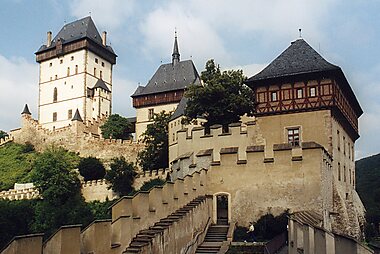


Karlštejn Castle stands on a limestone ridge above the village, a Gothic fortress built by Charles IV to hold the crown jewels and holy relics. The basic tour shows the Imperial Palace with the Knights' Hall and the emperor's bedchamber. A smaller tour of the castle chapels and the painted Great Tower stairway needs a reservation.
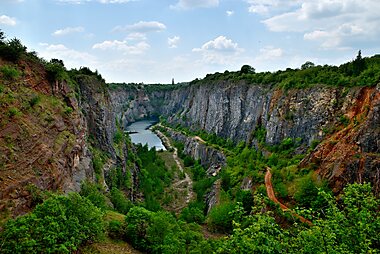
Velká Amerika is a huge abandoned limestone quarry with a lake at the bottom, often called the Czech Grand Canyon. You view it from lookout points on the rim, about an hour's walk from the castle.
Malá Amerika is a smaller quarry on the same trail, with turquoise water and old mining tunnels. Supí lom and the other quarries around it form one connected mining landscape.
Bohemian Karst Protected Landscape Area is the protected landscape that surrounds the town. It covers limestone cliffs, caves, dry grassland and the forested valley of the Berounka.
Church of St Palmatius in the Budňany part of the village is a medieval Gothic church in the old part of the village. Its main altar is now shown in the castle.
Nativity Scene Museum fills an old rectory in the village with Czech nativity scenes. The highlight is the Royal Crèche, a moving mechanical scene with figures from Czech history.
Featured Lists

What to experience
Karlštejn is more than a castle visit. These activities are specific to the place.
- Wine festival weekend: Join the Karlštejn Wine Festival in late September, when the village celebrates the grape harvest.
- Quarry trail hike: Walk the marked trail from the castle to Velká Amerika, about 5 km through forest and past old quarries.
- Film-set spotting: Look for the quarry scenery used in the classic Czech western parody Lemonade Joe.
- Mechanical nativity: Watch the Royal Crèche come to life at Nativity Scene Museum, especially in the Christmas season when it has extended hours.
Tours & Activities
Karlstejn — Map

Day trips
The castle takes half a day, and the country around it rewards the rest. These trips go from closest to farthest.
- Bubovice Waterfalls: small seasonal waterfalls over limestone steps, on the trail west of the village. They can be dry after a long dry spell.
- Svatý Jan pod Skalou: a Baroque monastery under a cliff, tied to the legend of the hermit St Ivan. Reach it on marked trails through the karst, or from Beroun.
- Beroun: the next town up the valley and a short train ride away, with a square, a Renaissance town hall and two medieval town gates.
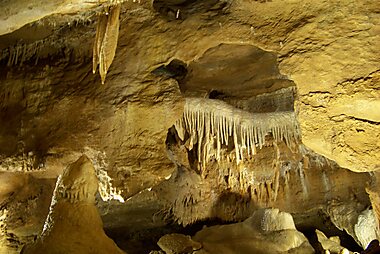
- Koněprusy Caves: the largest cave system in Bohemia, south of Beroun, with a hidden medieval forgers' workshop. Best reached by car.
- Křivoklát: a large royal castle deep in the forests northwest of Beroun, reached by car or by train via Beroun.
- Prague: the capital, with frequent direct trains, if you base yourself in Karlštejn.
Getting there
- By air: The nearest airport is Václav Havel Airport Prague. There is no direct link; take public transport into Prague and change to the train.
- By train: Regional trains run every 30 minutes from Prague and Beroun to Karlštejn station. Plan the trip with Prague Integrated Transport (PID) or České dráhy. The station is across the river from the village.
- By car: Drive southwest from Prague. Cars must stop at the central car park below the castle, because the village is a pedestrian zone.
Getting around
- On foot: Walking is the usual way to reach the castle. From the station, cross the Berounka bridge and follow the main street uphill. The walk is about 2 km and takes about 35 minutes, climbing most of the way.
- Public transport: Regional trains on the Prague–Beroun line stop at Karlštejn every 30 minutes. Check tickets and times with PID.
- Cycling: The Berounka valley is popular with cyclists, but you must not ride a bicycle in the village. There are bike stands at the castle's second gate.
Driving
- Is a car worth it?: Not for the castle alone; the train is easier. A car helps if you want to combine the castle with the caves and other karst sights in one day.
- Parking: Use the central car park in the village below the castle, about 15 minutes' walk from the gate. It is the only public car park in the village.
- Restrictions: The village is a pedestrian zone for cars and bicycles, enforced by the municipal police.
Food & drink
Wine is part of local life here. The Karlštejn Wine Festival in late September celebrates the grape harvest.
For food, the main street between the car park and the castle is lined with restaurants, cafés and snack stalls. Choice is wide but prices are aimed at day visitors. For a quieter meal, eat in the lower part of the village near the river, away from the castle approach.
Safety & health
Karlštejn is very safe. The main nuisance is crowds on summer weekends, when the narrow street to the castle gets packed. Keep an eye on bags in the crowd.
The walk to the castle is steep, so wear good shoes. In the quarries, stay on the marked paths and behind fences. Entry into Velká Amerika itself is forbidden because of the risk of injury. Tap water is safe to drink.
History
Charles IV, King of Bohemia and Holy Roman Emperor, founded Karlštejn Castle in 1348. It was built to store the Imperial Regalia, the Bohemian crown jewels and holy relics. The work ended in 1365 with the consecration of the Chapel of the Holy Cross. Its walls hold 129 panel paintings of saints by the court painter Master Theodoric.
The castle you see today is partly a 19th-century vision. Architect Josef Mocker rebuilt it in Gothic Revival style between 1887 and 1899.
The village below grew from Budňany, founded in 1348 together with the castle. In 1952 Budňany merged with Poučník and took the castle's name. In the 20th century, the nearby hills were cut by limestone quarries. Political prisoners were forced to work there in the early communist years, and a memorial above the quarries remembers them.
Country facts
Quick practical facts for the Czech Republic at a glance:
- Currency
- Czech Koruna CZK Kč · Card payments · Commonly accepted
- Emergency numbers
- 112
- Electricity
- 230 V · 50 HzType C / Type E
- Languages
- Czech
- Tap water
- Safe to drink
- Driving side
- Right
- Calling code
- +420


Karlstejn – Plan Your Days
Turn the places from this guide into a real itinerary, with smart routing, time estimates, and everything you need for a perfect trip.

