Tripomatic

Lithuania

Country ·🇱🇹 Lithuania

Lithuania is the southernmost of the three Baltic states, known for the baroque old town of its capital, Vilnius, dense pine forests, and a Baltic Sea coastline anchored by the Curonian Spit's shifting sand dunes. It borders Latvia, Belarus, Poland, and the Russian exclave of Kaliningrad.

Lithuania suits travelers interested in history, architecture, and nature, and works well as a short city break or combined with a wider Baltic trip. Summers are warm with long daylight hours; winters are cold, dark, and often snowy.

Lithuania

Planning a Trip to Lithuania?

Build your day-by-day itinerary in the Tripomatic app.

Money & payments

Lithuania uses the euro, as a member of the eurozone.

EUR · €
Widely accepted
1 EUR ≈ 1.157 USD 1 USD ≈ 0.8645 EUR

Card and phone payment work almost everywhere in cities and towns, including small cafés and public transport. A little cash is still useful in rural areas and at some markets.

Hotel (double room, per night)mid-range hotel, room for two per night
55 – 110 €$63.62 – $127.24
Dinner (mid-range restaurant)mid-range restaurant, one person, no drinks
12 – 22 €$13.88 – $25.45
Inexpensive mealcasual eatery or lunch special, one person
6 – 10 €$6.94 – $11.57
Local beer0.5L draught
3 – 4.5 €$3.47 – $5.21
Coffeeespresso or cappuccino in a café
2.5 – 3.5 €$2.89 – $4.05
Water0.5L, shop
1 – 1.5 €$1.16 – $1.74
Transit ticketsingle, Vilnius
1 – 1.5 €$1.16 – $1.74
Taxi (per km)per km
0.7 – 1 €$0.81 – $1.16

Explore Lithuania

Lithuania's Unmissable Essentials

Lithuania's Unmissable Essentials

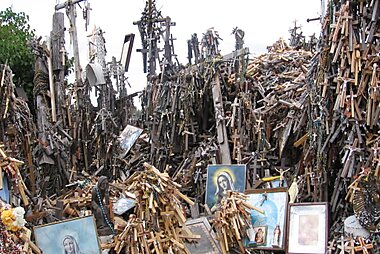
Lithuania’s landmarks span medieval fortifications like Kaunas Castle and the Gothic-Renaissance Raudondvaris Manor to the poignant WWII history of the Ninth Fort. The spiritual Hill of Crosses near Šiauliai and the historic Rasu Cemetery in Vilnius offer unique cultural insights, while the Palanga Amber Museum showcases the Baltic’s "gold." Significant architectural sites include the Kaunas Cathedral Basilica and the Neo-baroque Historical Presidential Palace. The list is completed by the UNESCO-recognized Struve Geodetic Arc, marking a scientific milestone in global mapping.

10 places
Lithuania's Hidden Gems

Lithuania's Hidden Gems

Lithuania’s diverse history and landscape are showcased through these distinct sites. Visit the 17th-century Gothic-Renaissance Raudondvaris Castle and the Hill of Crosses, a unique pilgrimage site near Šiauliai. In Kaunas, explore medical history in a 16th-century building or visit the Ninth Fort, a former stronghold and WWII memorial. The Zarasai observation wheel provides a modern architectural vantage point, standing 17 meters above Lake Zarasas to offer panoramic views of the surrounding islands.

5 places
Lithuanian Hillforts

Lithuanian Hillforts

Lithuania’s landscape is defined by hundreds of ancient hillforts, known as piliakalniai, which served as defensive fortifications and cultural centers from the late Bronze Age until the 14th century. These archaeological sites, often strategically located on high riverbanks or between lakes, offer a glimpse into Baltic tribal history and early defensive architecture. This collection highlights significant mounds including legendary ritual sites, complex defensive systems along the Nemunas river, and the iconic pilgrimage destination of the Hill of Crosses.

20 places
Lithuania's Sacred Sites

Lithuania's Sacred Sites

Lithuania’s religious landscape features a diverse collection of architectural styles, from the rare Brick Gothic of Kaunas’s St. Gertrude’s Church to the Neo-Byzantine design of St. George’s in Šiauliai. This selection includes the country's oldest wooden temple in Stelmužė and significant Catholic cathedrals in Panevėžys and Vilkaviškis. These sites represent centuries of spiritual history, encompassing Catholic, Orthodox, and historical monastic traditions across urban centers and rural villages.

19 places
Lithuanian Fortifications and Towers

Lithuanian Fortifications and Towers

Lithuania's landscape is dotted with defensive structures spanning centuries, from medieval brick castles like Kaunas and Medininkai to ancient hillforts that once served as pagan strongholds. This collection features archaeological sites such as the Birutė Hill in Palanga and the Maišiagalos hillfort, alongside modern observation towers in Mindūnai and Salakas that provide panoramic views of the country's lakes and forests. Many of these sites, like Panemunė Castle, highlight the architectural transition from defensive fortresses to residential manors.

17 places
Lithuanian Lakes and Natural Wonders

Lithuanian Lakes and Natural Wonders

Lithuania's landscape is defined by its post-glacial legacy, featuring over 3,000 lakes and unique geological formations. This collection spans the country’s most significant natural landmarks, including Tauragnas, the deepest lake, and Asveja, the longest. Explore the dense lake clusters of Aukštaitija National Park, the shifting sand dunes of the Curonian Spit, and ancient botanical monuments like the Sapiega Park Lime and the six-trunked Elmė Oak. These sites showcase diverse ecosystems ranging from pristine wetlands and ribbon lakes to significant archaeological hillforts.

48 places
Lithuanian Manor Houses

Lithuanian Manor Houses

Lithuania’s manor houses reflect centuries of architectural evolution, from Neo-Gothic and Classicist estates to Neo-Renaissance palaces. These historical complexes, such as the expansive Pakruojis Manor and the coastal Tiškevičiai Palace, served as cultural and economic hubs for noble families like the Tyszkiewicz and Radziwiłł. Today, many have been restored to house museums, boutique hotels, and concert halls, often surrounded by landscaped English-style parks and traditional agricultural buildings across the Anykščiai, Rokiškis, and Vilnius regions.

20 places
Lithuanian Museums & Galleries

Lithuanian Museums & Galleries

Lithuania’s museums offer a journey through Baltic history, from the Gothic House of Perkūnas and the Neoclassical Palanga Amber Museum to sobering Soviet-era sites like the Ninth Fort and the Atomic Bunker. Specialized collections include the Museum of Ethnocosmology, the unique Cat Museum in Šiauliai, and the secret underground 'ab' printing house. Visitors can explore traditional wooden architecture in Stelmužė, regional heritage in Kėdainiai and Utena, and the history of Lithuanian sports and medicine in Kaunas.

20 places

Tours & Activities

Map of Lithuania

Tipping

Tipping is not mandatory in Lithuania and is less expected than in North America. Leaving around 10% in a restaurant is a common and appreciated gesture for good service, though for a small bill many locals simply round up instead. Check the bill first, since a few restaurants add a service charge already.

RestaurantOptional

~10%, round up for a small bill

TaxiOptional

round up the fare

Electricity

Lithuania uses Type C and Type F plugs (the standard two-round-pin sockets used across most of continental Europe) at 230 V / 50 Hz.

Type C
Type F
230 V · 50 Hz

Language

Lithuanian is the official language and is one of the oldest living Indo-European languages, related closely only to Latvian. English is widely spoken in Vilnius and among younger people; Russian and Polish are also common, especially among older generations.

HelloLabas
Thank youAčiū
PleasePrašau
Excuse meAtsiprašau
YesTaip
NoNe
How much?Kiek tai kainuoja?
CheersĮ sveikatą!
HelpPadėkite!
GoodbyeViso gero
Do you speak English?Ar kalbate angliškai?
SorryAtsiprašau
Where is…?Kur yra...?
I don't understandNesuprantu
The menu, pleaseMeniu, prašau
The bill, pleaseSąskaitą, prašau

Staying connected

Prepaid SIM and eSIM plans from Telia, Bitė, or Tele2 are easy to buy at the airport or phone shops. Mobile coverage and Wi-Fi are reliable in cities and along main roads, with some drop-off in more remote forested or rural areas.

Safety & emergencies

Lithuania is a safe country for tourists, with low rates of violent crime. The main risks are pickpocketing in busy tourist areas of Vilnius's Old Town, and icy pavements and roads in winter. Lithuania has a single emergency number that reaches police, fire, and ambulance services.

General emergency112
Police112
Ambulance112
Fire brigade112

Health

Tap water is safe to drink throughout the country. Pharmacies (vaistinė) are common in towns and cities, with at least one open late in most larger towns. No special vaccinations are required for entry.

Visas & entry

Lithuania is part of the Schengen Area. Citizens of the EU/EEA, the United States, Canada, Australia, and many other countries can enter for tourism without a visa for stays of up to 90 days within a 180-day period. Travelers from countries without a visa-waiver agreement need a Schengen visa, applied for through a Lithuanian embassy or consulate before travel.

Visa and entry requirements change frequently. Verify current requirements with the official immigration authority or your country's embassy before travel.

Etiquette

Lithuanians tend to be reserved with strangers at first, and small talk is less common than in some other cultures; this reflects a cultural preference for personal space, not unfriendliness. Shoes are almost always removed when entering someone's home. Song and folk-craft traditions are taken seriously and are a genuine source of national pride, especially around the nationwide Song and Dance Celebration held every few years.

Holidays & opening hours

Public holidays can affect opening hours in smaller towns more than in Vilnius. Midsummer (Joninės), on June 23-24, is one of the most widely celebrated holidays, with many businesses closing as people head to the countryside.

Jan 1New Year's Day
Feb 16Day of Restoration of the State of Lithuania
Mar 11Day of Restoration of Independence of Lithuania
May 1International Workers' Day
Jun 24St. John's Day / Midsummer
Jul 6Statehood Day
Aug 15Assumption Day
Nov 1All Saints' Day
Nov 2All Souls' Day
Dec 24Christmas Eve
Dec 25Christmas Day
Dec 26Second day of Christmas
movable — Mar/AprEaster Sunday
movable — Mar/AprEaster Monday

Getting around

  • By train: Modernized regional trains connect Vilnius, Kaunas, and Klaipėda; long-distance rail options to other countries are more limited.
  • By bus: Long-distance coaches reach almost every town and are often the most practical way to travel between cities.
  • In Vilnius: The Old Town is compact and walkable; buses and trolleybuses cover the rest of the city well.
  • By air: Vilnius Airport is the main international gateway, with Kaunas Airport serving as a secondary hub for some low-cost routes.

Driving

  • Winter tires: Mandatory from November 10 to March 31, marked with the 3PMSF symbol (an M+S marking alone is not sufficient); studded tires are banned from April 10 to November 1.
  • Tolls: Standard passenger cars are toll-free on Lithuanian roads; the vignette and upcoming e-tolling system apply only to heavier commercial vehicles.
  • Speed limits: 50 km/h in towns, 90 km/h on rural roads, up to 130 km/h on motorways in summer.
  • Headlights: Must be on at all times, day and night, year-round.
  • Fuel: Stations are self-service, with card payment standard at the pump.
Drive on the right
Urban50 km/h
Rural90 km/h
Motorway120 km/h
No motorway vignette needed
Standard passenger cars (M1 category) are toll-free on Lithuanian roads. The vignette system applies only to heavier commercial vehicles, and is being replaced by a nationwide e-tolling system (Via Toll) from January 1, 2027, which likewise does not apply to passenger cars.
Petrol: Bešvinis 95, Bešvinis 98Diesel: Dyzelinas

Food & drink

Cepelinai, large potato-dough dumplings stuffed with meat and served with sour cream and bacon bits, are the national dish and a hearty, filling staple. Šaltibarščiai, a bright pink cold beet soup served with boiled potatoes, is a common summer dish, and kugelis, a baked potato pudding, is common comfort food.

Lithuania has a strong foraging and smoking tradition, with wild mushrooms and berries appearing in home cooking, and skilandis, a smoked and air-dried meat sausage, is a distinctive regional specialty. Šakotis, a tall spit cake with a distinctive spiky exterior, is a traditional centerpiece for celebrations. Craft beer has a long brewing history here, particularly in the northern regions.

Lunch
Cold Beet Soup  ŠaltibarščiaiA bright pink, chilled beet and buttermilk soup, usually served with warm boiled potatoes in summer.
Dinner
Zeppelins  CepelinaiLarge potato dumplings stuffed with minced meat or curd cheese, served with sour cream and bacon bits, Lithuania's national dish.
Potato Pudding  KugelisA dense, baked grated-potato casserole, often with bacon, a staple of Lithuanian home cooking.
Snacks & street food
Dark Rye Bread  Juoda duonaHearty sourdough rye bread that accompanies nearly every meal.
Curd Cheese  VarškėFresh farmer's cheese eaten plain, sweetened, or baked into pastries.
Sweets & desserts
ŠakotisA distinctive spit cake with spiky branch-like edges, traditionally served at weddings and holidays.
Drinks
Mead  MidusA honey-based fermented drink with roots in Lithuania's pre-Christian traditions.

Where to explore

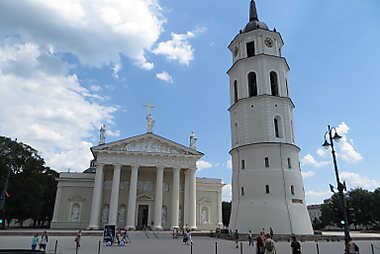
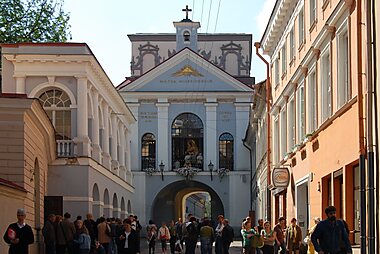
Vilnius is the capital, with a UNESCO-listed baroque Old Town and the bohemian Užupis district. Kaunas, Lithuania's second-largest city and its interwar temporary capital, has a well-preserved old town and a growing street-art scene.

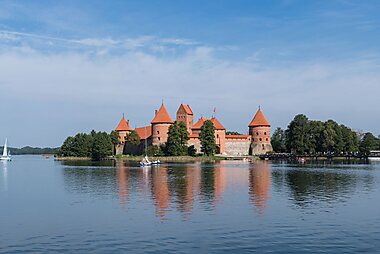
Klaipėda, the main port city, is the gateway to the Curonian Spit's dune landscapes and fishing villages. Palanga, on the Baltic coast, is Lithuania's main seaside resort town, known for its beach and amber museum, and Trakai, a short trip from Vilnius, is home to the red-brick island castle on Lake Galvė.

Vilnius City Municipality
Drive
Kaunas
Drive
Klaipėda City Municipality

Plan Your Trip to Lithuania

Pick the places you want to see and Tripomatic turns them into a day-by-day route, with smart routing, time estimates, and everything you need for a perfect trip.


3M+ downloads · 4.6 stars · 15 years of trip planning
QR code
Scan to download the app

Related destinations