



Madeira
Madeira is a Portuguese island region in the Atlantic, about 1,000 km southwest of Lisbon and closer to Africa than to mainland Europe. It is volcanic and very steep. Peaks above 1,800 m stand only a few kilometres from the sea, and most of the coast is cliff rather than beach. The climate stays mild all year, so the island works as a winter escape as much as a summer one.
This is a walking and driving destination, not a beach one. Centuries-old irrigation channels called levadas carry footpaths deep into forest and mountain valleys that would otherwise be unreachable. A good road network puts most of the island within about 90 minutes of the capital, Funchal, which holds most of the hotels, restaurants and museums. Cristiano Ronaldo was born in Funchal in 1985, and the island's airport carries his name.

Madeira – Planning a Trip?
Build your day-by-day itinerary in the Tripomatic app.


When to visit
Madeira has no bad season, and the gap between winter and summer is small. Spring and early summer are the driest and clearest on the south coast. Most rain falls between October and January. Weather also differs sharply across the island. The north coast and the high peaks are often in cloud while Funchal is sunny, so check conditions the same morning before you commit to a hike. The event worth planning around is the Flower Festival in Funchal, which runs for roughly a month in spring, starting a few weeks after Easter. Its flower carpets, children's "Wall of Hope" ceremony and parade of floats fall mostly on weekends.
Allow four or five nights. That is enough for Funchal, one long day in the mountains and a loop of the north coast.
Top sights
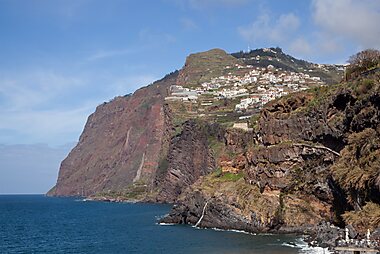

Cabo Girão is the island's signature viewpoint. A glass-floored platform hangs about 580 m above the sea, on one of the highest sea cliffs in Europe.
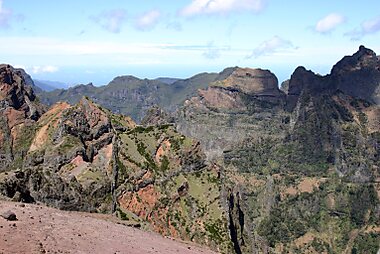
Pico do Areeiro is the one high peak you can reach without a hike, because a road runs almost to the summit. From the car park a paved path leads to the viewing platform in a few minutes.
Pico Ruivo is the highest point on Madeira at 1,862 m, and can only be reached on foot. The classic approach is the ridge path from Pico do Areeiro, with carved steps, tunnels and long drops.
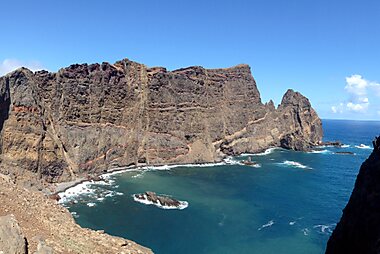
Ponta de São Lourenço is the bare eastern tip of the island, all red and ochre rock with almost no trees. The out-and-back trail along the peninsula is one of Madeira's most popular walks.
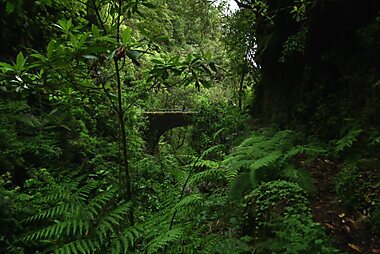
Laurissilva Forest is the ancient laurel forest covering much of the island's north and centre. It is a UNESCO World Heritage Site and the largest surviving forest of its type in the world.
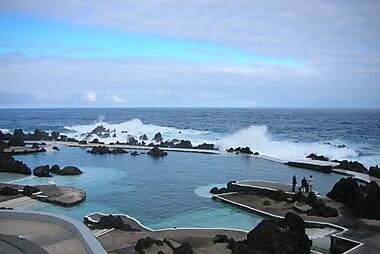
Porto Moniz Natural Pools are seawater pools held in black lava rock on the north-west coast, with the Atlantic breaking just beyond the wall. There is a free natural section and a paid complex with changing rooms.
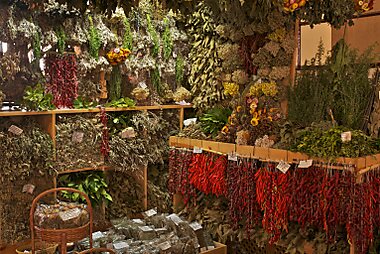
Mercado dos Lavradores is Funchal's covered market, best in the morning for fish, tropical fruit and flowers. Fruit sellers press free samples on visitors and then charge by weight, so agree the quantity first.
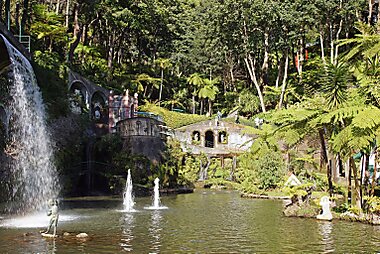
Monte Palace Tropical Garden sits above Funchal at Monte. It combines a steep hillside garden with Portuguese tile panels, African sculpture and Japanese-style water gardens.
Featured Lists


Regional Flavors and Markets
This selection highlights regional food hubs: the Mercado dos Lavradores with its azulejo-tiled halls, daily stalls of fresh fish, fruit and handcrafted goods; coastal eateries serving seafood and European-style desserts; and small inland restaurants focusing on grilled dishes and traditional local recipes. Several venues list Wi‑Fi and relaxed dining hours, while markets operate early with peak fish deliveries in the morning.
10 places
What to experience
A few things here are worth building a day around.
- Madeira Toboggan is the wicker sledge run down from Monte. Two men in straw hats and white uniforms steer a basket on greased wooden runners for about 2 km of public road. It began as transport for people coming down from the hills.
- Walk a levada. The maintenance paths beside the irrigation channels give nearly level trails through forest that would otherwise be closed off. Cascata das 25 Fontes and Caldeirão Verde are the two classics. Both need a paid permit, bought in advance on the regional government's SIMplifica portal. The second route crosses four unlit rock tunnels, so a torch is essential there.
- Drive up for sunrise at Pico do Areeiro. On many mornings the summit stands above an unbroken layer of cloud. Leave Funchal about 90 minutes before sunrise and bring a warm jacket; it is often near freezing up there.
- Go whale and dolphin watching from Funchal marina. Boats sail all year, and bottlenose dolphins and pilot whales live in these waters rather than passing through on migration.
- Watch the New Year fireworks over Funchal bay. The city is built in a bowl around the harbour, so almost every street above the water has a view. Hotels and ferry cabins sell out many months ahead.
Tours & Activities
Madeira — Map

 Open the interactive map
 Day trips
Madeira is small enough to base yourself in one place, usually Funchal, and reach almost anything in a day. Times below are one way by car. Buses serve the same towns, but far less often.
- Câmara de Lobos — 15 minutes west. A working fishing harbour full of painted boats, easily combined with the cliff viewpoint above it.
- Curral das Freiras — 40 minutes north. A village at the bottom of a ring of mountains, reached through a tunnel that opens straight onto the valley. Known for chestnuts.
- Santana — 1 hour north-east. Home to the triangular thatched A-frame houses at Santana Traditional Houses, and the usual starting point for the Caldeirão Verde levada walk.
- Porto Moniz — 1 hour 15 minutes north-west, and the best full-day loop on the island. Pair the lava pools with the misty laurel plateau around Lagoa do Fanal and the dark-sand cove at Praia do Porto do Seixal.
- Porto Santo — about 2 hours 30 minutes by ferry from Funchal. A flat, dry island whose single beach, Porto Santo Beach, runs for 9 km of golden sand, on a scale Madeira's own small dark-sand and pebble beaches cannot match. It works as a long day trip and better as an overnight.
Where to explore
Madeira's municipalities differ a lot in character, and the one you stay in shapes the trip.
- Funchal is the capital and the practical base. The airport transfer, most hotels, the market, the marina and the cable car are all here.
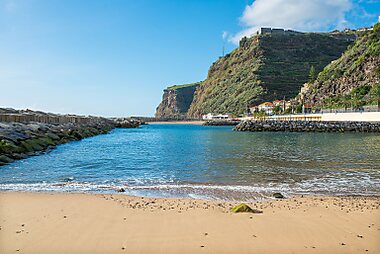
- On the sunny south coast, Câmara de Lobos is a fishing town a short drive from the capital, and Calheta in the south-west has Praia da Calheta, one of the island's few sandy beaches.
- The wilder north coast holds São Vicente, set in a deep green valley where the old cliff road runs out to Véu da Noiva, Santana with the thatched houses, and Porto Moniz at the north-west corner. São Vicente's lava caves, once the area's main draw, have been shut for structural work since 2020.
- To the east, Machico was the site of the first Portuguese landing and has Praia de Machico, a sheltered beach of imported sand. Offshore, Porto Santo is the archipelago's other inhabited island.
Getting there
- By air: Cristiano Ronaldo Madeira International Airport (FNC) is at Santa Cruz, about 18 km east of Funchal. Direct flights link it with Lisbon, Porto and many European cities. The Aerobus reaches Funchal hotels in roughly 30–40 minutes; a taxi takes about 25 minutes and costs around 25–30 €. Official site: Madeira Airport. The runway sits on a platform above the sea, and strong crosswinds occasionally divert flights to Porto Santo or the mainland.
- By sea: there is no regular year-round passenger ferry from mainland Portugal, so nearly everyone flies. Funchal's harbour is a busy cruise stop, and a daily ferry links it with Porto Santo in about 2 hours 30 minutes.
- Onward to Porto Santo: besides the ferry, a short flight from Funchal takes about 15 minutes and lands at Porto Santo Airport (PXO).
Getting around
- Bus: Horários do Funchal runs the yellow city buses, and separate regional operators cover the rest of the island. Since 2024 they all sit inside one network, SIGA, with shared ticketing. Buy tickets from the driver, or load a rechargeable card at a kiosk for a lower fare. Timetables are built around residents rather than day trippers, so check the last return before you plan a bus day out. Horários do Funchal
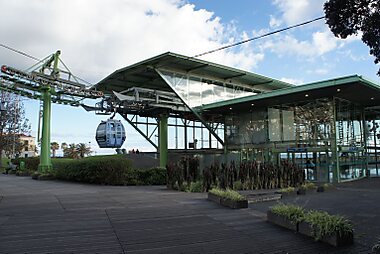
- Cable car: Funchal Cable Car climbs from the old town up to Monte in about 15 minutes. It is a real transport link, not only a ride, and it saves a long uphill drive.
- Taxi: metered yellow taxis wait at ranks across Funchal and are easy to find. Fares to villages outside the city follow a fixed tariff, so ask for the price before you leave.
- Car: the practical way to reach the mountains and the north coast — see the driving section.
Driving
- Is a car worth it? Yes, if you want more than Funchal. Buses reach the main towns but not the trailheads or viewpoints, and the clear window in the mountains is often only a couple of hours long. Rental is cheap and the airport desks are the easiest place to collect one.
- The roads: the VR1 expressway crosses the south coast through a chain of tunnels and makes east–west travel quick. Inland and northern roads are steep, narrow and full of hairpins, so a small car is much easier than a large one. Madeira has no road tolls, unlike the Portuguese mainland.
- Parking: Funchal has paid underground car parks and metered blue-zone street parking on weekdays. Trailhead parking at Pico do Areeiro has been paid since 2025 and takes cards only. Both of its car parks fill around sunrise, and cars left on the approach road are towed.
Food & drink
Madeiran cooking is not the same as the mainland's. The dishes to look for:
- Espada com banana — black scabbardfish, a deep-sea fish, fried with banana.
- Espetada — beef rubbed with garlic and grilled on a laurel skewer.
- Bolo do caco — a flat sweet-potato bread served hot with garlic butter.
- Milho frito — fried cubes of set maize porridge.
- Poncha — the local drink, made from sugarcane spirit, honey and lemon or passion fruit.
Subtropical fruit turns up everywhere, especially passion fruit and custard apple. Madeira wine is fortified and deliberately heated as it ages, which is why an opened bottle keeps for months.
For eating, aim at areas rather than chasing individual restaurants. The Zona Velha in Funchal, along Rua de Santa Maria, is a dense run of small places behind painted doors. The harbour at Câmara de Lobos is the traditional place for grilled limpets and fresh fish. For the wine, Blandy's Wine Lodge in central Funchal runs tours and tastings in its old lodge.
Safety & health
Madeira is one of the safest destinations in Europe. Violent crime against visitors is very rare, and pickpocketing is limited to the usual crowded spots — the market, the cable car queue, the seafront promenade. Organised tourist scams are not really a problem here.
The real risks are outdoors. Levada paths often run beside unfenced drops, and trails close after rockfalls and heavy rain, so check the official status before you set out: Visit Madeira. Several official trails also need a paid permit bought online in advance. Mountain weather turns fast, so carry a windproof layer and a torch even for a short walk. Swimming outside marked beaches and pool complexes is dangerous because of Atlantic swell and rip currents.
History
Portuguese captains reached the uninhabited islands in 1418 and 1419, and settlement began a few years later under Henry the Navigator. Settlers burned off forest to plant sugarcane, and for about a century Madeira was one of Europe's main sugar suppliers. That money paid for Funchal Cathedral, completed in the early 1500s, whose carved cedar ceiling survives from the sugar years.
The wealth also drew raiders. French corsairs sacked Funchal in 1566, and the coastal forts standing today, including Forte de São Tiago, went up afterwards. When Brazilian plantations undercut island sugar, Madeira turned to wine, and British merchant families settled to trade it. Blandy's Wine Lodge is still run by descendants of one of them. Sugarcane never vanished completely: Porto da Cruz Sugarcane Mill still crushes cane with a steam engine each spring.
In the 19th century doctors sent tuberculosis patients to Funchal for the climate, and the island filled with quintas — merchant estates that are now hotels and gardens. Winston Churchill painted the harbour at Câmara de Lobos in 1950, and the spot where he sat is still marked.
Country facts
Madeira is an autonomous region of Portugal, so the country's practical basics apply here:
- Currency
- Euro EUR € · Card payments · Widely accepted
- Emergency numbers
- 112
- Electricity
- 230 V · 50 HzType C / Type F
- Languages
- Portuguese
- Tap water
- Safe to drink
- Driving side
- Right
- Calling code
- +351


Madeira – Plan Your Days
Turn the places from this guide into a real itinerary, with smart routing, time estimates, and everything you need for a perfect trip.




