



Ribe
Ribe is Scandinavia's oldest town, founded around 704 AD as a Viking-age trading settlement on the Ribe River in southwest Jutland. Its river harbor silted up centuries ago, so the town never grew into an industrial center. Its cobbled lanes and leaning half-timbered houses survive almost unchanged around the tower of Ribe Cathedral. The journalist and photographer Jacob A. Riis, whose work on tenement housing helped drive reform in New York, was born here.
A day is enough to see the compact center. An overnight stay means catching Ribe's night watchman on his rounds after dark, a tradition kept alive for centuries. The flat marshland surrounding town belongs to the Wadden Sea National Park. At low tide, the tidal seabed becomes a place to walk.

Ribe – Planning a Trip?
Build your day-by-day itinerary in the Tripomatic app.


When to visit
Summers are mild and the best time to walk the old town, with long daylight hours through June and July. Spring and autumn are quieter and cooler, and winter is short on daylight but atmospheric under snow. Time a visit for the warmer months to catch the night watchman: from spring to early autumn he leads an evening walking tour through the old town, singing the traditional watch songs. The walks pause for the rest of the year.
Rain is common through the year, so pack a waterproof layer regardless of season.
Top sights
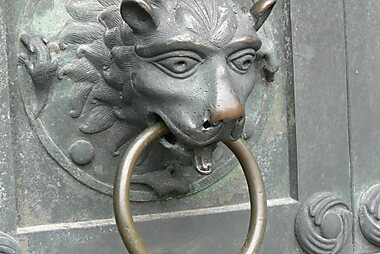

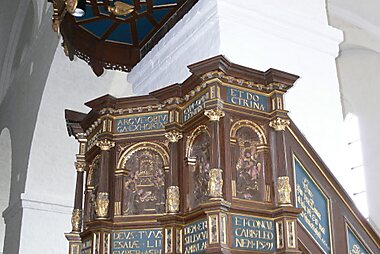

Ribe Cathedral has stood at the center of town since the 12th century and is the best-preserved Romanesque building in Denmark. Look for the carved cat's-head door knocker on the south portal. It's a detail every local child learns to find.
Ribes Vikinger sits on the exact spot where the first Nordic town market began around 700 AD. It traces Ribe's story from the Viking Age through the Middle Ages, using finds from the excavations underneath the museum.
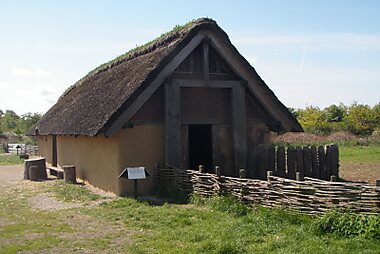
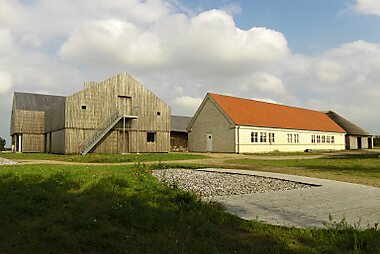
A short trip outside town, Ribe Viking Centre is a reconstructed Viking-age settlement. Costumed craftspeople demonstrate blacksmithing, boat-building, and everyday Viking life.
Det Gamle Rådhus is a Gothic building dating back to 1400, one of Denmark's oldest surviving town halls. It once doubled as a courthouse and prison.
Around the corner, St. Catherine's Priory was a Dominican friary founded in 1228. It is now the most complete monastic building complex left standing in Denmark.
On the western edge of town, the grassy mound of Riberhus Slotsbanke marks the site of a royal castle that once guarded Ribe. A bronze statue of Queen Dagmar stands on the bank.
Ribe Kunstmuseum holds a small collection of Danish art from the 19th and 20th centuries, including works connected to the Skagen painters.
Featured Lists


What to experience
Ribe's setting on the edge of the Wadden Sea gives it a few experiences found nowhere else in Denmark.
- Join the night watchman on his evening rounds through the old town, singing the watch songs he has kept alive since the Middle Ages. Walks run from spring through early autumn, starting at the cathedral square after dark.
- Watch Sort Sol ("Black Sun") at dusk. Hundreds of thousands of starlings gather over the marshes in tight, swirling flocks before roosting, a spectacle best seen in spring and early autumn.
- Walk out onto the exposed seabed at low tide on a guided mudflat walk from Wadden Sea Centre. The tides and soft ground make this unsafe without a guide.
- Cycle the flat marsh roads around town; the dikes and quiet lanes make for easy, scenic riding.
Tours & Activities
Ribe — Map

 Open the interactive map
 Day trips
The flat, low-lying land around Ribe is part of the Wadden Sea, and several rewarding trips are within easy reach.
- Wadden Sea National Park — Wadden Sea Centre is about 15 minutes by car and the best starting point. Exhibits explain the tides and marshland, and guided walks head out onto the exposed seabed at low tide.
- Mandø — this small tidal island is reached by a bus that drives across the seabed at low tide, around 40 minutes each way. Check tide times before setting out, since the crossing only runs around low water.
- Esbjerg — about 25 minutes by train or car, Denmark's fifth-largest city has a lively harbor, the Fisheries and Maritime Museum, and the giant "Man Meets the Sea" sculptures on the waterfront.
- Kolding — around 50 minutes by car, home to the restored royal castle Koldinghus and the Trapholt design museum.
- Legoland Billund — under an hour by car, Denmark's most-visited family attraction, built from Lego bricks.
Where to explore
Getting there
- By air: The nearest airport is Billund (BLL), under an hour's drive, with routes across Europe. Copenhagen Airport (CPH), Denmark's main international gateway, is roughly 3 hours away by car or train.
- By train: Ribe's station sits on a branch line. Change at Bramming, a few minutes away, for the main line to Esbjerg, Copenhagen, and destinations toward the German border.
- By bus: Regional buses link Ribe with Esbjerg and other towns in southern Jutland, useful for day trips that skip the train change.
Getting around
- Public transit: The old town is compact enough to walk everywhere; regional buses run to Esbjerg and nearby villages. Pay directly on board with a contactless bank card, or use the Sydtrafik app.
- Taxi: Available but rarely needed inside the compact center.
- On foot / cycling: Cobbled streets favor walking. The flat marshland outside town has dedicated cycling paths, including a route out to the Wadden Sea Centre.
Driving
- Is a car worth it? Not for the old town itself — everything is within walking distance. A car (or bike) is useful for reaching the Wadden Sea Centre, Mandø, and day trips further afield.
- Parking: Free and paid car parks ring the pedestrianized old town; pay by app or ticket machine at the paid ones.
- Restrictions: The old town center is closed to through traffic. There is no congestion charge or low-emission zone to worry about.
Food & drink
Ribe's food scene centers on hearty, traditional Danish dishes: smørrebrød (open sandwiches), fresh fish from the Wadden Sea, and lamb raised on the salt marshes nearby, a local specialty prized for its distinctive flavor.
For something distinctive, Weis Stue is one of Denmark's oldest inns, serving classic Danish dishes inside a dining room with its original 1704 interior. Otherwise, the streets around Torvet, the cathedral square, hold a cluster of cafés and casual restaurants with outdoor seating in summer.
Safety & health
Ribe is very safe for travelers, with petty crime rare even in busy periods. The usual precautions apply: watch your belongings at bus and train stations.
Tap water is safe to drink everywhere in town.
The main hazard here is natural rather than criminal. The tidal flats around Ribe look walkable but flood quickly and hide soft mud and channels. Only walk out onto the seabed with a guide, and always check tide times before heading toward Mandø or the marshes.
History
Ribe traces its start to around 704 AD, when a seasonal market was laid out on the banks of the Ribe River. This is the earliest known town foundation in Scandinavia. Traders and craftspeople came each summer, and archaeologists have found coins, beads, and combs from across northern Europe beneath what is now Ribes Vikinger. Christianity arrived early: Ribe became one of Denmark's first bishoprics in the 10th century, and construction of Ribe Cathedral in stone began in the 12th century, on the site of the country's first church.
The town grew into a major medieval trading center and royal seat, with the earthwork of Riberhus Slotsbanke marking where a royal castle once stood. Its fortunes declined from the 1600s, as the river harbor silted up and larger ports drew trade away. That decline ended up saving the medieval core from redevelopment. The same century brought a darker chapter: in 1641, Maren Splids was tried and burned as a witch in Ribe, one of the most notorious cases in Denmark's witch trials.
Ribe's night watchman tradition dates back to the town's medieval fire-watch duty, when a nightly patrol checked for fires and unrest in the wooden-and-thatch streets. The custom nearly died out but was revived in the 20th century and continues today.
Country facts
Quick practical facts for Denmark at a glance:
- Currency
- Danish Krone DKK kr · Card payments · Widely accepted
- Emergency numbers
- 112
- Electricity
- 230 V · 50 HzType C / Type E / Type F / Type K
- Languages
- Danish
- Tap water
- Safe to drink
- Driving side
- Right
- Calling code
- +45


Ribe – Plan Your Days
Turn the places from this guide into a real itinerary, with smart routing, time estimates, and everything you need for a perfect trip.




