



Esbjerg
Esbjerg grew from open farmland into one of Denmark's most important ports on the North Sea coast in just a few decades. It still feels like a working city, not a museum piece. Wide, straight streets and solid brick buildings reflect its origin as a planned 19th-century harbor town, built after Denmark lost its main North Sea port to Germany in 1864. Cranes and wind-turbine blades share the skyline with an active arts scene, and the beach and dunes start just minutes from downtown.
This is a good stop for travelers who want an honest, working Danish city rather than a well-preserved old town. It also makes an easy base for day trips: the ferry to Fanø, the Wadden Sea coast, and Denmark's oldest town, Ribe, are all close by.

Esbjerg – Planning a Trip?
Build your day-by-day itinerary in the Tripomatic app.


When to visit
Summer is mild and the best chance for dry, sunny days. Spring and autumn are cooler and often windy, and winter is cold with frequent rain.
Each spring and autumn, huge flocks of starlings swirl over the Wadden Sea marshes at dusk, a phenomenon known locally as Sort Sol, or "Black Sun." Many visitors time a coastal trip around it.
Whatever the season, pack a windproof layer. This stretch of coast rarely sits still.
Top sights
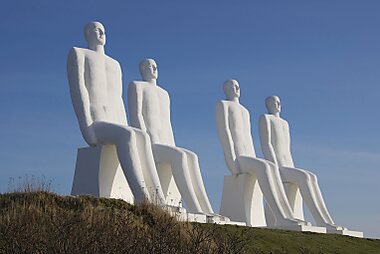


Men at Sea is Esbjerg's best-known landmark: four seated white giants, each 9 meters tall, gazing out to sea from the dunes near the beach. It was raised in 1995 to mark the city's centenary as an independent municipality.
One of Europe's leading ports for shipping offshore wind-turbine components, Port of Esbjerg began as the country's main fishing harbor and still drives much of the city's economy today.
At Fisheries and Maritime Museum, a seal pool and aquarium sit alongside exhibits on the fishing fleets that once made Esbjerg one of Denmark's biggest fishing ports.
Esbjerg Art Museum holds a strong collection of 20th-century Danish and international art in a purpose-built gallery in the city park.
Next door, Esbjerg Performing Arts Centre is a striking concert hall and theatre designed by Jan Utzon and his father Jørn Utzon, the architect behind the Sydney Opera House.
Esbjerg Museum traces the city's short but eventful history, from Iron Age finds to the boomtown years after the harbor opened.
Completed in 1887, Church of Our Saviour, Esbjerg was the first church built for the new town and remains one of its most visible landmarks.
I.C. Møllerparken is a quiet city-center park built over Esbjerg's oldest cemetery, with many original headstones still standing among the lawns.
Featured Lists

Esbjerg Essentials
Esbjerg serves as Denmark’s primary gateway to the North Sea, defined by its industrial port and maritime history. This selection features the 1897 red-brick Water Tower, a landmark overlooking the city, and the modern Musikhuset Esbjerg, designed by Jørn and Jan Utzon. The list includes the historic Vor Frelsers Kirke, the city’s first church, and the Esbjerg Art Museum, known for its contemporary Danish collections. Visitors can also find the ferry terminal for transport to Fanø and the Blue Water Arena stadium.
10 places
Cultural Highlights of Esbjerg
Esbjerg’s cultural landscape features a blend of historic preservation and modern design. The city center houses the Esbjerg Museum, documenting local history since 1941, and the iconic 19th-century Water Tower. Modern architecture is represented by the Performing Arts Centre, designed by Jørn and Jan Utzon. Specialized collections include the Printing Museum and the Spejdermuseum, while the Esbjerg Art Museum focuses on contemporary works. Performing arts venues like Teaterhuset support local youth productions alongside professional stages.
9 places
What to experience
Esbjerg's biggest draws lie just beyond the city, on the tide-swept coast.
- Join a guided seal or oyster safari onto the Wadden Sea's tidal flats — walking tours set out at low tide from villages along the coast.
- Ride the tractor-drawn bus to Mandø across the open seabed, timed to the tide.
- Take the short ferry to Fanø and cycle its beaches — bikes can be rented right by the ferry terminal on both sides.
- On a clear evening in spring or autumn, head toward the coast at dusk to watch Sort Sol: vast, swirling flocks of starlings over the marshes.
Tours & Activities
Esbjerg — Map

 Open the interactive map
 Day trips
Esbjerg sits at the edge of some of Denmark's most distinctive coastal scenery, and several worthwhile trips are within reach of a single day.
- Fanø (12-minute ferry from the harbor) — a sandy island known for wide beaches and villages of thatched captains' houses. Easily done in half a day.
- Ribe (about 30 minutes by train or car) — Denmark's oldest town, with a Romanesque cathedral, cobbled lanes, and a Viking history center on its edge.
- Mandø (about 40 minutes by car to the causeway) — a tidal island reached only by tractor-drawn bus across the seabed at low tide. Check tide times before setting out.
- Wadden Sea National Park (starts within 30 minutes of the city) — this UNESCO World Heritage tidal wetland stretches along the whole coast south of Esbjerg. Guided seal and oyster safaris run from several villages nearby.
- Blåvand (about 45 minutes by car) — Denmark's westernmost point, with a historic lighthouse and the striking Tirpitz Museum, built into a WWII bunker complex.
Where to explore
Esbjerg Municipality stretches well beyond the city itself, taking in Denmark's oldest town and a remote tidal island.
Getting there
- By air: Esbjerg Airport (EBJ) has only a handful of scheduled flights, mostly linked to the offshore energy industry. Most travelers fly into Billund Airport, about an hour away by car or bus, or into Copenhagen and continue by train (around 3 hours).
- By train: Esbjerg is the western terminus of a direct InterCity line from Copenhagen, taking roughly 3 hours, with connections onward from Odense and Fredericia.
- By bus: Long-distance coaches, including FlixBus, connect Esbjerg with Copenhagen, Aarhus, and destinations in Germany.
Getting around
- Public transit: City buses, run by Sydtrafik, cover the wider Esbjerg area. Tap a contactless bank card or phone directly on board — no need to buy a ticket in advance. Sydtrafik
- Taxi / ride-hailing: Uber and similar apps have little presence outside Copenhagen; call a local taxi firm or hail one at a rank instead.
- On foot / cycling: The center is compact and flat, and cycling is the fastest way to reach the beach or harbor. Bike rental is available at several points downtown.
Driving
- Is a car worth it?: Not for the city itself — the center is compact and easy on foot or by bike. A car helps for reaching Mandø on its tidal schedule or exploring Blåvand and the Wadden Sea villages at your own pace.
- Parking: Metered street parking and several car parks cover downtown. Pay by app or a coin meter; free parking is easier to find just outside the very center.
Food & drink
Fresh fish and shellfish are the thing to eat here — Esbjerg's harbor still brings in a daily catch, and menus lean heavily on herring, plaice, and langoustines.
For a casual meal, head to the pedestrian street Kongensgade and the surrounding blocks, where cafés and restaurants cluster. Around the harbor, several seafood restaurants serve the day's catch with a view of the fishing boats.
Safety & health
Esbjerg is a safe city with very little violent crime, and normal city awareness is enough here. The main thing to watch is opportunistic theft from parked cars near the harbor and ferry terminal — keep valuables out of sight.
History
Esbjerg is a young city by Danish standards. There was almost nothing here before 1868, when the Danish state chose the site for a new North Sea harbor after losing its main port to Germany in the war of 1864. Within a few decades it grew from open farmland into Denmark's largest fishing port, and for a time Port of Esbjerg was also a gateway out of Denmark: large numbers of Scandinavian emigrants passed through on their way to America, a link still remembered in the city's old nickname, "Denmark's America."
German occupying forces built coastal bunkers here during the Second World War as part of the Atlantic Wall; one of the best preserved, near Blåvand, now houses the striking Tirpitz Museum. Fishing has since given way to a new industry — Esbjerg is now Denmark's main base for offshore wind and North Sea energy, and cranes loading turbine blades are as much a part of the skyline as any historic building.
Country facts
Denmark is easy to navigate as a visitor, but a few local specifics are worth knowing before you go.
- Currency
- Danish Krone DKK kr · Card payments · Widely accepted
- Emergency numbers
- 112
- Electricity
- 230 V · 50 HzType C / Type E / Type F / Type K
- Languages
- Danish
- Tap water
- Safe to drink
- Driving side
- Right
- Calling code
- +45


Esbjerg – Plan Your Days
Turn the places from this guide into a real itinerary, with smart routing, time estimates, and everything you need for a perfect trip.




