



Denmark
Denmark is a compact Scandinavian kingdom on the northern edge of mainland Europe. It covers the Jutland peninsula and around 400 inhabited islands, with no point in the country more than 52 km from the sea. Denmark is a Schengen member and EU country, though it keeps its own currency.
Most visitors arrive in Copenhagen, one of Europe's most livable capitals, but the rest of the country rewards exploration. Jutland offers wild coastal dunes, Viking burial mounds, and Billund's LEGOLAND. Bornholm is a distinctive Baltic island with smoked-herring traditions and round medieval churches. Odense on Funen is the birthplace of Hans Christian Andersen. Denmark suits travelers who want design, history, excellent food, and reliable infrastructure in a relaxed atmosphere.



Denmark – Planning a Trip?
Build your day-by-day itinerary in the Tripomatic app.


Money & payments
Denmark is not in the eurozone. The local currency is the Danish krone (DKK). Expect roughly 7.5 DKK per euro.
Cards are used for nearly everything — including small purchases at cafés and bakeries — and many venues no longer accept cash at all. ATMs are common in cities and larger towns but scarce in remote rural areas.
Featured Lists


Denmark's Ancient Heritage
Denmark’s archaeological landscape spans from Neolithic megaliths to Viking Age fortifications and medieval ruins. This collection features the massive Viking ring castle at Fyrkat and the well-preserved medieval fortress of Hammershus on Bornholm. Visitors can explore Bronze Age rock carvings at Madsebakke, twin-chambered passage graves like Klekkende Høj, and the remnants of the 10th-century Ravning Bridge. These sites provide physical evidence of Denmark's transition from prehistoric tribal societies to a unified medieval kingdom.
20 places
Historic Danish Churches
Explore Denmark’s architectural evolution through these 19 historic sites, ranging from the 12th-century Romanesque round churches of Bornholm to the massive Gothic cathedrals of Aarhus and Ribe. This collection includes the burial site of King Canute the Saint in Odense and the Lutheran cathedral of Copenhagen. Many of these structures feature red-brick masonry, medieval frescoes, and unique defensive designs, reflecting Denmark’s transition from Catholicism to the Reformation and their enduring role as cultural landmarks.
19 places


Iconic Danish Lighthouses
Denmark’s coastline is defined by historic lighthouses that have guided maritime traffic through the North and Baltic Seas for centuries. This collection features diverse architectural landmarks, from the granite-built Lodbjerg Fyr in Thy National Park to the 19th-century limestone tower at Stevns Klint. These beacons highlight Denmark's navigational history, featuring unique structures like the sector light at Hou and the powerful Hanstholm Lighthouse, which houses the country's most luminous lamp.
14 placesTours & Activities
Denmark — Map

 Open the interactive map
 Tipping
Tipping is not expected. Service charges are included in restaurant bills by law. Most Danes leave nothing or simply round up the total; 10% is a generous gesture for exceptional restaurant service. Rounding up taxi fares (to the nearest 10 DKK) is common. Tipping hotel housekeeping is not customary.
round up to nearest 10 DKK
5-10%
Electricity
Outlets use the Danish Type K plug — a grounded three-pin round connector unique to Denmark, Greenland, and the Faroe Islands. Type C (two round pins) and Type F plugs also fit Danish sockets. Voltage is 230 V / 50 Hz. Most modern chargers and travel adapters work without modification.
Language
Danish (dansk) is the official language. English is spoken to an exceptionally high standard across the whole country, including rural areas and among older generations. No script issues: Danish uses the Latin alphabet with three additional letters — Æ, Ø, and Å. In Southern Jutland near the German border, German is also widely understood.
Staying connected
EU roaming applies for visitors from European countries. Prepaid SIM cards and eSIMs are available at airports, supermarkets (7-Eleven, Netto), and phone shops — no registration requirement. Network coverage is strong nationwide, including most coastal and rural areas.
Safety & emergencies
Denmark is among the safest countries in Europe. Violent crime targeting tourists is rare. The most common issue in cities is bike theft — always use a solid lock, even for short stops. Pickpocketing occurs in crowded areas of Copenhagen: Central Station, Strøget, and Nyhavn are the main hotspots. Tap water is safe and excellent throughout the country.
Health
Tap water is safe and of high quality everywhere in Denmark. Pharmacies (apotek) are common in town centres and staff speak English; they can advise on minor ailments and many medicines available only on prescription elsewhere. EU and EEA citizens with a valid European Health Insurance Card (EHIC) receive emergency treatment at public hospitals under the same conditions as Danish residents. No vaccinations are required or recommended for travel to Denmark.
Visas & entry
Denmark is part of the Schengen Area. EU and EEA citizens have freedom of movement and may stay indefinitely. Citizens of the United States, Canada, Australia, the United Kingdom, and most other Western countries may visit visa-free for up to 90 days within any 180-day period. Nationals of other countries generally require a Schengen short-stay visa before arrival.
Note: Greenland and the Faroe Islands are part of the Kingdom of Denmark but are not in the Schengen Area and have separate entry rules.
Visa and entry requirements change frequently. Verify current requirements with the official immigration authority or your country's embassy before travel.
Etiquette
- Remove shoes when entering a Danish home — this is expected without being asked.
- Queue properly. Many shops, pharmacies, and government offices use a numbered ticket system. Look for a dispenser near the entrance.
- Respect bike lanes. Cyclists have priority. Do not walk in the red-painted cycle tracks, and always look before crossing a cycle lane.
- Danish culture values modesty and egalitarianism (Janteloven). Avoid boasting or singling yourself out as exceptional.
- Punctuality is important for both social and business appointments.
- Recycling is taken seriously. Use the colour-coded bins — they are widely available and clearly labelled.
Holidays & opening hours
Public holidays cluster around Easter (movable, March or April), spring (Ascension, Whit Monday), and Christmas. Banks, government offices, and many shops close on public holidays. Supermarkets typically stay open with shorter hours.
Weekday shop hours are usually Monday–Friday 10:00–18:00 and Saturday 10:00–15:00. Sunday trading is common in larger cities but limited in smaller towns. Bakeries often open from 07:00 on weekdays and weekends.
Getting around
- By train: DSB runs the national rail network. Copenhagen to Aarhus takes about 3 hours; Copenhagen to Odense about 1h 30min. Book tickets at DSB.
- By bus: Regional buses reach most smaller towns. FlixBus connects major cities at lower fares than trains.
- By ferry: Ferries are essential for reaching Bornholm and smaller islands. DFDS operates the overnight Rønne route from Copenhagen (~6 hours); Molslinjen serves routes across the mainland.
- In Copenhagen: the Metro runs 24 hours a day and covers the city including the airport. The S-tog suburban rail extends to towns around the capital. Contactless bank cards are accepted directly on board all public transit in Copenhagen — no ticket machine required.
- Cycling: Denmark has one of Europe's best cycling networks. Bicycles can be taken on most regional trains during off-peak hours.
Driving
- Speed limits: 50 km/h in built-up areas, 80 km/h on rural roads, and 110–130 km/h on motorways (sign-posted per section).
- Motorways: no vignette is required. Motorway use is free, except for the two major bridges.
- Toll bridges: the Great Belt Bridge (Storebælt) charges approximately 235 DKK for a passenger car; the Øresund Bridge to Sweden approximately 470 DKK one-way. Both are cashless — pay by credit/debit card at the toll plaza.
- Alcohol limit: 0.5‰ blood alcohol. Strictly enforced.
- Winter tyres: not legally required but strongly recommended from November to March.
- Fuel: petrol is labelled Blyfri 95 and Blyfri 98; diesel is labelled Diesel. Most stations are self-service; card payment at the pump is standard.
- Parking: blue-zone street parking in city centres requires a parking disc (free at tourist offices and some shops, or use the EasyPark app). Paid car parks in cities.
- Copenhagen LEZ: the inner city has low-emission restrictions for older diesel vehicles.
- EV charging: well-developed national network. Clever and E.ON are the main providers; most stations accept contactless card payment.
Food & drink
Traditional Danish meals are anchored in rye bread (rugbrød). The classic lunch is smørrebrød — open-faced sandwiches piled with pickled herring, roast beef, shrimp, or leverpostej (liver pâté). Lunch is often the main hot meal of the day. Dinner leans toward comforting dishes: frikadeller (pan-fried pork-veal patties), flæskesteg (roast pork with crackling and braised red cabbage), and meatballs with potatoes and gravy. Coastal towns serve excellent fresh fish.
Denmark is serious about pastry. The local term for what English speakers call a Danish pastry is wienerbrød — buttery, layered, and found in every bageri (bakery). Cardamom buns and cinnamon rolls (kanelsnegle) are equally popular. The main local drinks are Carlsberg and Tuborg beer and akvavit (snaps) — a caraway- or dill-flavored spirit served ice-cold at festive meals. Coffee culture is strong; Danes drink some of the most coffee per capita in the world. In the 2000s, the New Nordic food movement — led by Copenhagen chefs — brought Danish and Scandinavian ingredients to global attention. Copenhagen now has more Michelin-starred restaurants per capita than most European capitals.
Where to explore
Denmark's main destinations divide across the Copenhagen area, the island of Funen, the Jutland mainland, and the outlying island of Bornholm.
Copenhagen is the obvious starting point. The capital combines Nyhavn's colourful canal-side buildings, royal palaces, Tivoli Gardens, and a world-class food scene in a compact and very walkable city centre.
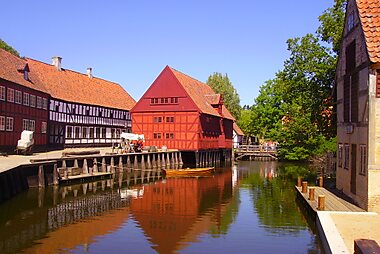
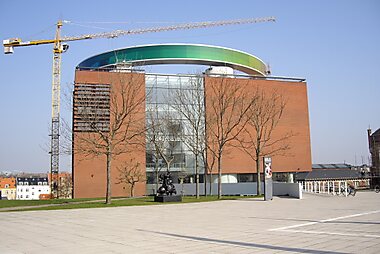
Aarhus, Denmark's second-largest city on the eastern coast of Jutland, has a vibrant cultural scene anchored by the ARoS Art Museum with its famous rainbow panorama walkway, and the The Old Town, Aarhus, an open-air museum of historic Danish buildings.
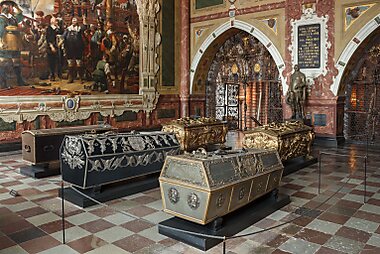
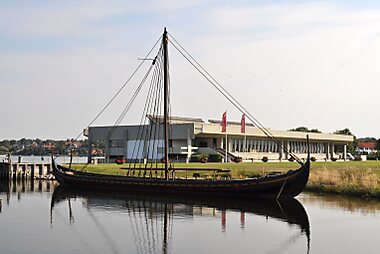
Odense on Funen is the birthplace of Hans Christian Andersen and has a well-preserved old town. Roskilde, 30 km west of Copenhagen, is home to a UNESCO-listed Gothic cathedral — the burial place of Danish monarchs — and the Viking Ship Museum on the harbour.
Helsingør at the northeastern tip of Zealand is dominated by Kronborg Castle, the 16th-century fortress that inspired Shakespeare's Hamlet. Aalborg in northern Jutland has excellent Viking-age heritage and a lively waterfront. Bornholm is a rocky Baltic island reached by overnight ferry or a short flight from Copenhagen, known for its round medieval churches, smoked herring, and the dramatic clifftop ruins of Hammershus.
Denmark – Plan Your Trip
Pick the places you want to see and Tripomatic turns them into a day-by-day route, with smart routing, time estimates, and everything you need for a perfect trip.




