


Seville
Seville is the capital of Andalusia and one of Spain's most visited cities, known for flamenco, tapas bars, and Moorish architecture. Its historic centre packs a Gothic cathedral, a royal palace, and shaded plazas into a walkable core beside the Guadalquivir river.
The city suits travelers who want a few days of concentrated sightseeing mixed with long lunches and evening strolls. Summers are extremely hot, so spring and autumn are the most comfortable times to explore on foot. The painter Diego Velázquez was born here, and the city's mix of Roman, Moorish, and Christian layers gives it a character unlike anywhere else in Spain.

Seville – Planning a Trip?
Build your day-by-day itinerary in the Tripomatic app.
When to visit
Spring and autumn are mild and the best times to visit; summer is very hot and winter is cool but rarely cold.
Plan around Semana Santa (Holy Week), in the week before Easter, when elaborate processions carry religious statues through the streets day and night. It is one of the most striking events in Spain, and hotels fill up months in advance.
Best time to visit: February, March, April, May, October, November
July and August afternoons regularly pass 40°C, so plan outdoor sightseeing for morning or evening during those months.
Top sights

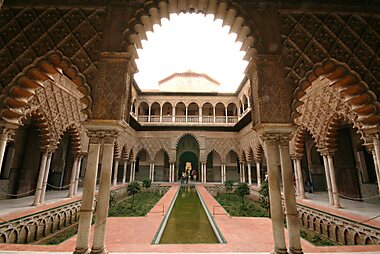
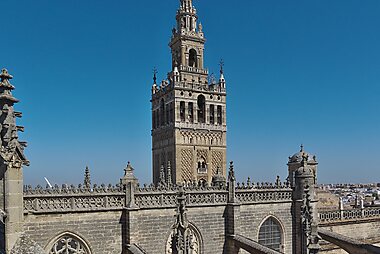
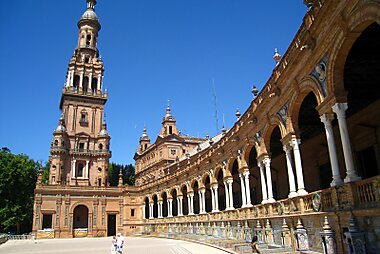
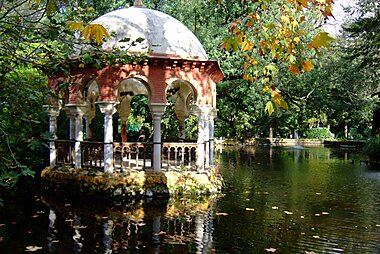
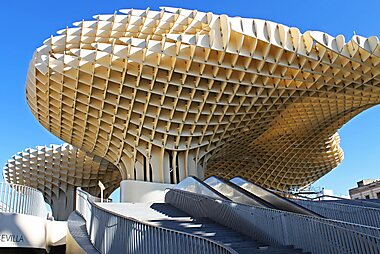
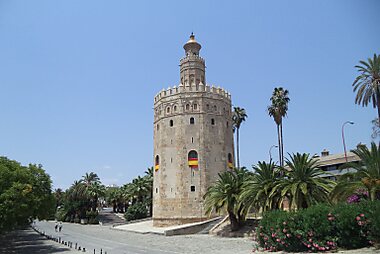
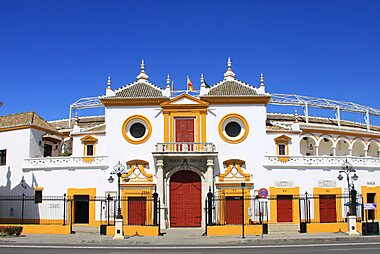
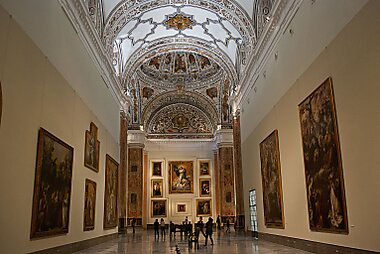
Seville's historic centre is compact enough to see most of its landmarks on foot over two or three days.
Seville Cathedral is the largest Gothic cathedral in the world and the burial place of Christopher Columbus. Its bell tower, La Giralda, began as a Moorish minaret and offers sweeping views from a ramp rather than stairs.
Next door, Alcázar of Seville is a royal palace still used by the Spanish royal family, known for its Mudéjar architecture and lush gardens — and for its appearances in Game of Thrones.
Plaza de España is a vast semicircular plaza built for the 1929 Ibero-American Exposition, with a canal, bridges, and tiled alcoves representing each Spanish province.
For something modern, Setas de Sevilla, known locally as Las Setas ("the mushrooms"), is a striking wooden structure with a rooftop walkway and city views.
Torre del Oro is a 13th-century watchtower on the river that once held a chain across the water to block enemy ships; it now houses a small maritime museum.
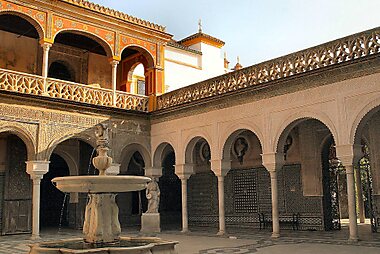
Casa de Pilatos is a 16th-century noble palace mixing Mudéjar, Gothic, and Renaissance styles around quiet courtyards, usually far less crowded than the Alcázar.
For a break from sightseeing, Maria Luisa Park is a shaded park of fountains, tiled benches, and orange trees just south of the centre.
Featured Lists


Theatres & Performance Venues
Seville’s performing arts scene spans from the historic Baroque Revival architecture of the Teatro Lope de Vega, built for the 1929 Ibero-American Exposition, to the modernist venues of the Isla de la Cartuja. The Teatro de la Maestranza serves as the city's premier opera house, while the Teatro Central focuses on contemporary theater and dance. Traditional Andalusian culture is preserved at long-standing venues like Tablao Flamenco Los Gallos, alongside grand open-air spaces used for large-scale international concerts.
6 placesAudio Guides – Seville
Explore on foot with a self-guided audio tour that narrates each stop as you reach it.


Hear Seville's audio tours
1 walk in Audio Guides by Tripomatic


What to experience
- Watch a flamenco show — Museo del Baile Flamenco hosts a small nightly performance pairing guitar, singing, and dance, or look for a tablao in the Triana or Santa Cruz neighbourhoods.
- Cross Puente de Isabel II into Triana in the evening and walk the riverside promenade as the light turns gold over the water.
- If visiting in April, join the Feria de Abril, a week-long fair of striped tents, sevillana dancing, and horse-drawn carriages on the fairground across the river.
- Take a short boat cruise on the Guadalquivir river for a different view of the old town skyline.
Tours & Activities
Seville — Map

 Open the interactive map
 Day trips
Andalusia's other major cities make excellent day trips from Seville, and several are close enough for a relaxed half-day.
- Carmona — about 30 minutes by bus or car; a walled hilltop town with a Roman necropolis and a Moorish Alcázar turned hotel, with far fewer visitors than Seville.
- Itálica — about 30 minutes by bus or car; one of the best-preserved Roman cities in Spain, in the town of Santiponce, with a huge amphitheatre that once seated 25,000 people.
- Córdoba — about 45 minutes by high-speed train; home to the Mezquita, a former mosque with a forest of striped arches and a cathedral built inside it.
- Jerez de la Frontera — about 1 hour by train; the home of sherry wine and Andalusian horse shows, with bodega tours across the town.
- Cádiz — about 1 hour 25 minutes by train; one of the oldest continuously inhabited cities in Europe, set on a narrow peninsula with Atlantic beaches.
- Ronda — about 1 hour 45 minutes by car; a dramatic town split by a deep gorge, crossed by an 18th-century stone bridge. The train is slower and requires a change, so driving or a direct bus is more practical.
Getting there
- By air: Seville Airport (SVQ) is about 10 km from the centre. The EA airport bus runs to the city centre in about 35 minutes for a few euros; a taxi takes around 20 minutes.
- By train: Santa Justa station has frequent high-speed AVE trains to Madrid (about 2 hours 30 minutes) and Córdoba (about 45 minutes), plus connections to Málaga, Barcelona, and other major cities.
- By bus: Plaza de Armas and Prado de San Sebastián bus stations connect Seville to towns across Andalusia and to Portugal.
Getting around
- Public transit: buses (TUSSAM), one metro line, and the MetroCentro tram cover the city; tap a contactless bank card or phone directly on board rather than buying a paper ticket in advance.
- Bike: Seville has one of Spain's largest bike lane networks and the Sevici bike-share system, making cycling a practical way to get around the flat centre.
- On foot: the historic core is compact and mostly pedestrian-friendly, though narrow streets in Santa Cruz get crowded at peak hours.
Driving
- Is a car worth it?: no — the historic centre is largely pedestrianized and narrow, and a car is a liability there. Rent one only for day trips to smaller towns not well served by train.
- Parking: use a paid car park near the centre, such as around Puerta de Jerez or Paseo de Colón, rather than searching for street parking; on-street spaces in the centre are metered and limited.
- Restrictions: Seville has been rolling out a low-emission zone (ZBE) restricting non-resident vehicles in parts of the city, with boundaries expanding — check current rules before driving in.
Food & drink
Seville's food culture centers on tapeo — moving between small bars for a plate and a drink at each stop, rather than sitting down for one long meal. Local specialties include espinacas con garbanzos (spinach and chickpea stew), cola de toro (braised oxtail), and pescaíto frito (lightly fried small fish).
The streets around Calle Feria and the Alameda de Hércules cluster many of the best tapas bars, and the Triana Market, on the site of a former Moorish castle across the river, is a good stop for lunch among locals rather than tourists.
Safety & health
Seville is a safe city for tourists, with violent crime rare. Pickpocketing and bag-snatching happen in crowded tourist spots like the Cathedral area, Plaza de España, and on public buses — keep bags zipped and in view, especially on routes to Santa Justa station.
Summer heat is the main practical hazard: July and August afternoons regularly pass 40°C, so carry water, seek shade, and plan major sightseeing for morning or evening during those months.
History
Seville's history stretches from a Roman river port to the gateway of Spain's American empire. The Romans called it Hispalis; after the Moorish conquest it became Ishbiliya, capital of a powerful Almohad kingdom. The Almohads built La Giralda as the minaret of their great mosque and Torre del Oro as a river watchtower, both still standing today.
After the Christian conquest in 1248, Alcázar of Seville became a royal palace, rebuilt by Christian kings in the Mudéjar style that blends Islamic and European decoration. When Christopher Columbus returned from the Americas, Seville won a royal monopoly on trade with the New World, and the General Archive of the Indies still holds the archives from that era.
Centuries later, the 1929 Ibero-American Exposition reshaped the south of the city, leaving behind Plaza de España and the gardens of Maria Luisa Park.
Country facts
Quick practical facts for Spain at a glance:
- Currency
- Euro EUR € · Card payments · Widely accepted
- Emergency numbers
- 112
- Electricity
- 230 V · 50 HzType C / Type F
- Languages
- Spanish
- Tap water
- Safe to drink
- Driving side
- Right
- Calling code
- +34


Seville – Plan Your Days
Turn the places from this guide into a real itinerary, with smart routing, time estimates, and everything you need for a perfect trip.




