



Suriname
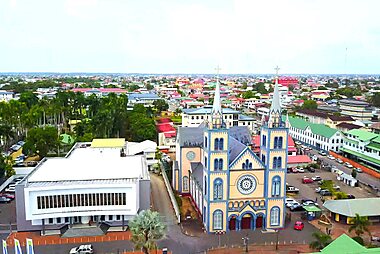
Suriname is South America's smallest independent country. It is also one of the most forested countries on Earth — rainforest covers most of the land. Its history set an unusual path: in 1667 the Dutch traded New Amsterdam, today's New York, to the English for this small colony on the Guiana coast. Enslaved Africans, Dutch planters, and later indentured workers from India, Java, and China all settled here. The result is a mix found nowhere else in South America. Paramaribo, the capital, mixes wooden Dutch colonial buildings, mosques, synagogues, and a Hindu temple on the same streets, anchored by Fort Zeelandia and the wooden Saint Peter and Paul Cathedral.
A few days in Paramaribo cover the colonial history and a mixed food scene. Heading upriver by boat reaches Maroon villages and rainforest reserves. Suriname suits independent, adventurous travelers more than beach-and-resort visitors. Distances are long and infrastructure is basic outside the capital. Most of the interior is reached only by river or small plane.




Suriname – Planning a Trip?
Build your day-by-day itinerary in the Tripomatic app.
Money & payments
Check the current exchange rate before you travel — it has moved a lot in recent years, so old guidebook figures are unreliable.
Carry cash for markets, minibuses, and anywhere outside the capital. ATMs are common in Paramaribo but scarce once you leave the city, so withdraw enough before heading upriver or into the interior.


Featured Lists


Hidden Gems of Suriname
Suriname’s interior holds remnants of colonial history and dense tropical landscapes. This collection features Jodensavanne, the ruins of the first autonomous Jewish settlement in the Americas, alongside the diverse waterfalls of Brownsberg Nature Park, including the Irene and Leo falls. Further west, the Blanche Marie Falls on the Nickerie River represent one of the country's largest cascades. The list also includes industrial ruins like the abandoned palm oil factory and secluded natural sites accessible via 4x4 trails.
11 places
Tours & Activities
Suriname — Map

Tipping
Tipping is not deeply rooted in Surinamese culture, but it is becoming more common in Paramaribo's restaurants and with tour guides. Round up taxi fares rather than working out a percentage. River and jungle guides on multi-day trips especially appreciate a tip at the end.
round up or ~10%
small tip for porters and housekeeping
round up the fare
10-15%, especially for river and jungle guides
Electricity
Suriname's power runs at a lower voltage than most of South America, so check your device before plugging in without a converter.
Language
Dutch is the official language, used in government, schools, and media. Most Surinamese also speak Sranantongo, a Creole lingua franca, at home. Sarnami (Hindustani), Javanese, and Maroon languages are common too. English is understood in Paramaribo's tourist businesses but far less so upriver.
Staying connected
Prepaid SIM cards from Telesur or Digicel are sold at their shops, at electronics stores, and at the airport. Bring your passport in case it is asked for. Coverage thins out fast once you leave Paramaribo and disappears in most of the rainforest interior — plan trips upriver assuming you will be offline.
Safety & emergencies
Paramaribo is generally safe to walk during the day. Take normal city precautions after dark and watch your belongings in markets and bus stations. The most common issues are pickpocketing, taxi overcharging, and inflated souvenir prices — agree on a taxi fare before you get in.
Health
Tap water is treated and generally safe to drink in Paramaribo. Stick to bottled or purified water once you head into rural areas or the interior. Pharmacies are well stocked in the capital; outside it, bring what you need. Yellow fever vaccination is strongly recommended for any trip into the interior. Cover up and use repellent against mosquito-borne illness, especially near rivers at dawn and dusk.
Visas & entry
Most travelers, including from the EU, US, UK, and Canada, can enter Suriname visa-free for up to 90 days, but must pay an entry fee online before arrival. A handful of nationalities need an e-visa or a regular visa arranged in advance.
Visa and entry requirements change frequently. Verify current requirements with the official immigration authority or your country's embassy before travel.
Etiquette
A handshake and a little small talk are expected before getting to business, even in shops. Dress modestly when visiting mosques, synagogues, or Hindu temples. Ask before photographing people, especially in Maroon and Indigenous villages. Bargaining is common at markets but not in shops with marked prices.
Holidays & opening hours
Suriname's calendar reflects its mix of cultures. Christian, Hindu, Muslim, and Chinese holidays are all observed nationally. Shops and government offices close on public holidays, and many businesses also close on Sundays.
Getting around
- By air: Small planes connect Paramaribo's Zorg en Hoop airfield to airstrips near Brownsberg Nature Park and the Central Suriname Nature Reserve, home to Voltzberg and Suriname's highest peak, Julianatop. This is often the only practical way to reach the deep interior.
- By boat: Dugout canoes and motorized boats connect villages along the Suriname, Marowijne, and Coppename rivers, including across the wide reservoir behind Afobaka Dam. Arrange trips through a tour operator or local guide.
- By bus and minibus: Shared minibuses cover Paramaribo and routes to towns like Nieuw Nickerie and Albina. They leave when full, not on a fixed schedule.
- By taxi: Taxis in Paramaribo rarely use meters — agree on the fare before you get in.
Suriname drives on the left, unlike its South American neighbors — a genuine adjustment if you normally drive on the right.
Driving
- Roads: Paved highways connect Paramaribo to the coastal towns, but most of the interior has no roads at all. Reaching villages upriver or the Central Suriname Nature Reserve means traveling by boat or small plane instead.
- Rental cars: A 4x4 helps on unpaved stretches outside the capital, especially in the rainy season.
- Fuel: Stations are attended, not self-service, and accept cash. Card payment is not guaranteed outside Paramaribo.
- Ferries: The Canawaima ferry crosses the Corantijn River to Guyana. A ferry links Albina to French Guiana across the Marowijne River. Check current schedules before planning a border crossing by road.
Food & drink
Suriname's food reflects its mix of cultures more than anywhere else in South America. A single day might include Javanese soto soup, an Indian roti, and Creole moksi alesi. These dishes sit side by side on the same street, not in separate neighborhoods.
Street food is a big part of eating out. Fried snacks like bara and bakabana are sold from carts and small stalls across Paramaribo, especially in the evening. Pom, a baked casserole built around a starchy local root, is the dish most Surinamese would call their national favorite. It is usually served at celebrations and Sunday lunches.
Locals eat at warungs (small Javanese eateries), Chinese restaurants, and roadside stalls as often as at sit-down restaurants. Parbo, the local lager, is the default beer everywhere. Fresh tropical fruit juices are widely available and worth trying over imported soft drinks.
Where to explore
Paramaribo, the capital, is where most visits begin. Its wooden colonial inner city is a UNESCO World Heritage Site, anchored by Waterkant and the shaded Palmentuin.
Across the river, Commewijne is former plantation country. Old estates like Plantage Peperpot sit a short ferry ride from the capital, making it a popular half-day trip. Nearby, Jodensavanne and Fort Nieuw-Amsterdam preserve Suriname's Jewish and Dutch colonial history.
Toward the coast, Nieuw Nickerie is one of Suriname's largest towns outside the capital. It is a quiet agricultural center near the Guyana border, close to the Bigi Pan wetlands and known for birdwatching. On the opposite side of the country, Albina sits on the Marowijne River across from French Guiana. It is the usual gateway for river trips to Maroon villages and Galibi Nature Reserve.
Suriname – Plan Your Trip
Pick the places you want to see and Tripomatic turns them into a day-by-day route, with smart routing, time estimates, and everything you need for a perfect trip.




