

Tabor
Tábor is a walled medieval town in South Bohemia, built on a rocky spur above the Lužnice river. Hussite reformers founded it in 1420 and named it after the biblical Mount Tabor. Their military leader Jan Žižka based his campaigns here. The old town still follows its original defensive layout: narrow, deliberately crooked streets designed to confuse attackers, opening onto one of Bohemia's largest Gothic and Renaissance squares.
Tábor suits travelers who want genuine medieval history without the summer crowds of nearby Český Krumlov. A single day covers the walled core and its underground passages. A second, more relaxed day adds the Jordán reservoir and the walking paths below the town walls.

Tabor – Planning a Trip?
Build your day-by-day itinerary in the Tripomatic app.
When to visit
Spring and autumn are mild and the best time to see the old town without crowds. Summers are warm and busy around the Jordán reservoir, and winters are cold with occasional snow.
Plan around Táborská setkání, a Hussite-themed historical festival held every September, with costumed processions, a medieval market, and battle re-enactments filling the old town — worth timing a visit around if you enjoy living history.
Best time to visit: June, August, September
Top sights




Tábor's old town is compact enough to see on foot in a few hours, but its underground history takes another. Start at the arcaded main square, Žižkovo náměstí, ringed with Gothic and Renaissance townhouses. It's named after the Hussite general who defended the town.
Husitské muzeum occupies the old town hall on the square and tells the story of the radical Hussite movement that founded Tábor. Its ticket also covers around 500 meters of medieval underground passages carved beneath the streets, originally dug as cellars and later linked into a hiding network.
Kotnov is the only surviving tower of the town's original 13th-century fortress, later converted into a brewery. Climb it for a view over the old town and the Lužnice valley.
For a wider panorama, climb Babina, a wooden lookout tower north of the center with views toward the surrounding hills.
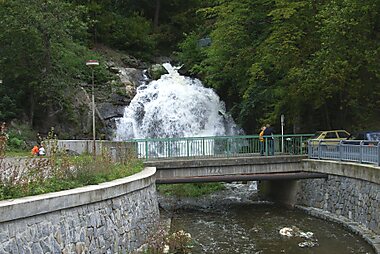
Jordán Reservoir, just below the walls, is the oldest dam lake in Central Europe, built in 1492 to secure the town's water supply. Today it's a favorite spot for a swim, with Jordánský vodopád spilling over the dam below it.
The Renaissance Vodárenská věž once pumped water up from Jordán to fountains across the old town; today it's a small art gallery.
For something unusual, Housův mlýn, an old watermill outside the walls, holds a costume and weapons collection used in historical films, plus a sword-fighting school.
Featured Lists

Tábor Essentials
Tábor showcases the architectural legacy of the Hussite movement within its labyrinthine medieval streets. This selection includes the 15th-century Kotnov tower, the Gothic Church of the Transfiguration, and the Jordán reservoir, established in 1492 as Central Europe's first dam. The list also features the Baroque pilgrimage complex at Klokoty, the Babina observation tower, and an extensive chocolate and marzipan museum housed in historic townhouses near the central Žižka Square.
7 placesAudio Guides – Tabor
Explore on foot with a self-guided audio tour that narrates each stop as you reach it.


Hear Tabor's audio tours
1 walk in Audio Guides by Tripomatic


What to experience
A few things to do here that go beyond sightseeing:
- Join a lantern-lit guided walk through the underground passages beneath Husitské muzeum — reservations are recommended, and the costumed-guide tours run separately from ordinary daytime visits.
- Swim or rent a pedal boat on Jordán Reservoir in summer, then walk the shoreline path back toward the old town walls.
- Take a swordsmanship lesson at the historical fencing school inside Housův mlýn.
Tours & Activities
Tabor — Map

Day trips
Tábor sits in the middle of the Hussite heartland, with good day trips close by and a few flagships worth the longer drive. Ordered from closest to farthest:
- Sezimovo Ústí (≈10 min by car or bus): Tábor's riverside neighbor, and the older settlement the Hussites burned in 1420 before founding Tábor itself. Today it's a quiet town known for its 1930s functionalist architecture.
- Kozí hrádek (≈15 min by car): a ruined castle where the reformer Jan Hus lived in hiding through 1413–1414. He wrote several of his major works here before his final journey to the Council of Constance.
- Bechyně (≈30 min by train or car): a small spa and pottery town with a Renaissance chateau and a striking rainbow-shaped concrete bridge over the Lužnice.
- Soběslav (≈30 min by train or car): a smaller, quieter historic town with a Gothic church and a well-preserved Renaissance square.
- Orlík nad Vltavou (≈1.5 hours by car): a Romantic castle above a long reservoir on the Vltava river, with boat trips running in summer.
Where to explore
Getting there
- By air: the nearest airport with scheduled passenger service is Václav Havel Airport Prague (PRG), about 100 km north. From the airport, take a bus or the metro into central Prague, then a train to Tábor (around 1 hour).
- By train: Tábor sits on the main line between Prague and Vienna. Fast trains from Prague take around 1 hour, and trains from České Budějovice take around 50 minutes.
- By bus: long-distance coaches link Tábor to Prague and other South Bohemian towns from the bus terminal next to the train station.
Getting around
- On foot: the walled old town is small and easy to walk; a loop of the center takes about 20 minutes. Steep lanes lead down to the river and the reservoir.
- Public transit: local buses connect the old town to the train station and outlying neighborhoods; buy tickets from the driver or at machines near the main stops. Most visitors won't need them inside the historic core.
- Cycling: marked cycling routes follow the Lužnice river and the Jordán shoreline, a good way to reach the reservoir and the surrounding countryside.
Driving
- Is a car worth it?: not inside the old town — it's compact and best explored on foot. A car helps for day trips to Bechyně, Soběslav, or farther into the South Bohemian countryside.
- Parking: leave the car in one of the paid lots or street zones just outside the walls (pay by app or ticket machine); a few free lots sit a short walk further out.
- Restrictions: there's no congestion charge, but the medieval core's lanes are narrow and mostly one-way — park outside and walk in rather than trying to drive up to the square.
Food & drink
Restaurants here serve the same hearty South Bohemian classics as the rest of the region: roast pork with bread dumplings and cabbage, goulash, and fish from the region's ponds, especially carp in winter.
For something different, Muzeum čokolády a marcipánu near the main square runs tastings and workshops on the history of chocolate and marzipan — a good stop for something sweet. Otherwise, the lanes around Žižkovo náměstí hold the town's best concentration of cafés and traditional pubs, some in cellars that were once part of the underground passages below the square.
Safety & health
Tábor is a safe, low-crime town; petty theft is rare, though keep an eye on belongings in the crowds during the September festival. Tap water is safe to drink, the same as the rest of the Czech Republic. The lanes and stone steps down to the river and reservoir can be slippery when wet, so wear grippy shoes if you plan to walk down from the walls.
History
Tábor's story starts with fire and religion. Jan Hus, the reformer whose teachings inspired the Hussite movement, was burned at the stake for heresy in 1415. Five years later, his most radical followers abandoned the nearby settlement of Sezimovo Ústí and built a fortified new town on this hilltop, naming it after the biblical Mount Tabor. For a few extraordinary years, the Táborites lived as a religious commune, holding property in common and rejecting noble titles. Their general Jan Žižka, blind in one eye and later completely blind, led their army to an unbroken string of victories.
The movement's radical wing was crushed at the Battle of Lipany in 1434, and Tábor gradually rejoined the mainstream Utraquist church. In 1452, the Hussite regent Jiří z Poděbrad — later king of Bohemia — brought the town peacefully under his control. What remained was a wealthy, self-governing town. It rebuilt itself in Renaissance style after a fire tore through it in 1532, including Kotnov, which was rebuilt decades later as a brewery rather than restored as a fortress. Today Husitské muzeum, in the old town hall the Táborites once governed from, tells that story in detail. The medieval cellars beneath it are among the few things in town that still look much as they did in the 15th century.
Country facts
Quick practical facts for the Czech Republic at a glance:
- Currency
- Czech Koruna CZK Kč · Card payments · Commonly accepted
- Emergency numbers
- 112
- Electricity
- 230 V · 50 HzType C / Type E
- Languages
- Czech
- Tap water
- Safe to drink
- Driving side
- Right
- Calling code
- +420
Tabor – Plan Your Days
Turn the places from this guide into a real itinerary, with smart routing, time estimates, and everything you need for a perfect trip.