



Tbilisi
Tbilisi sits where Europe and Asia meet, and the city feels like it. Persian bathhouse domes, Georgian Orthodox churches, Art Nouveau balconies, and Soviet-era blocks all stand within a few streets of each other along the Kura River. Legend says King Vakhtang Gorgasali founded the city in the 5th century after his falcon fell into a hot sulfur spring while hunting — Tbilisi means "warm place" in Old Georgian, and those same springs still heat the bathhouses in the Old Town today.
The city suits travelers who want a compact, walkable historic core with steep lanes, hidden courtyards, and easy access to Georgia's mountains and wine country beyond it. A few days here is enough to see the highlights on foot, eat well, and use Tbilisi as a base for day trips into the rest of the country.

Tbilisi – Planning a Trip?
Build your day-by-day itinerary in the Tripomatic app.


When to visit
Spring and autumn are mild and the most comfortable seasons for walking the Old Town's hills. Summer turns hot, with July and August regularly above 30 °C, while winter is cold and damp with occasional snow.
Time a visit around Tbilisoba, the city's founding-day festival held over a weekend in early October: streets fill with folk music, dancing, craft stalls, and free wine tastings across the Old Town.
Best time to visit: April, May, September, October
September and October bring warm, mostly dry days and clearer skies than the wetter spring months, making them the best window for sightseeing.
Top sights



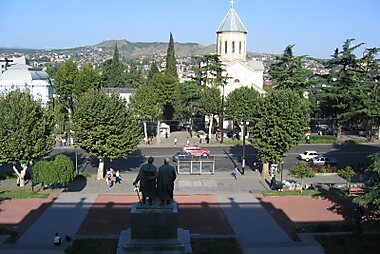

Holy Trinity Cathedral is Tbilisi's largest church and the seat of the Georgian Orthodox Church, standing on a hill above the city since 2004. Its gold dome is visible from almost anywhere in central Tbilisi.
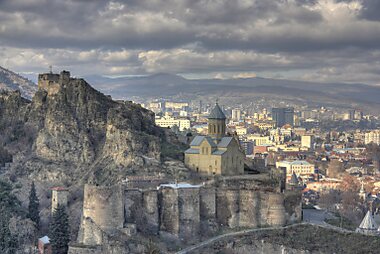
Narikala is a hilltop fortress dating back to the 4th century, rebuilt many times by the empires that ruled the city. Reach it by cable car from the river for sweeping views over the Old Town's rooftops.
Bridge of Peace is a curved glass-and-steel footbridge over the Kura River, built in 2010 and lit at night in a pattern meant to echo Morse code. It links the Old Town to Rike Park.
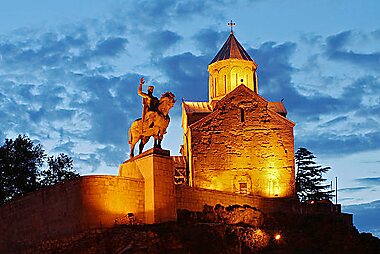
Metekhi perches on a cliff above the river, marking the site of a former royal palace. The small church inside dates to the 13th century and is one of the city's most photographed viewpoints.
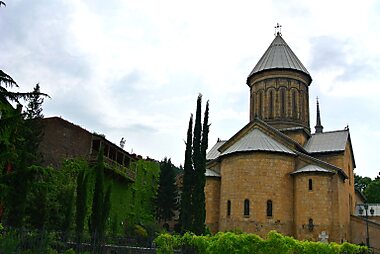
Sioni Cathedral is one of Tbilisi's oldest working cathedrals, at the heart of the Old Town. Georgian kings were once crowned here, and it still holds services daily.
Anchiskhati is the oldest surviving church in Tbilisi, first built in the 6th century. Its plain stone exterior hides a richly decorated interior.
Freedom Square is the city's central square, topped by a gilded statue of Saint George. It marks the boundary between the Old Town and the modern city along Rustaveli Avenue.
Chronicle of Georgia is a striking monument of 16 bronze pillars, each around 35 metres tall, on a hilltop outside the centre. Its reliefs depict scenes from Georgian history and Christianity, and the views over the Tbilisi Sea reservoir make the short trip worthwhile.
Featured Lists


Religious Sites in Tbilisi
Tbilisi’s religious landscape reflects centuries of cultural convergence. This collection features the 13th-century Sioni Cathedral, once the seat of the Georgian Orthodox Church, alongside the Great Synagogue built by Akhaltsikhe Jews. The list includes the medieval Shavnabada Monastery, perched on a volcanic peak, and the 18th-century palace complex of Queen Darejan. These sites represent the city's long-standing tradition of multi-faith coexistence, spanning Orthodox, Armenian Apostolic, Jewish, and Lutheran traditions.
7 placesWhat to experience
Tbilisi rewards slowing down and joining in, not just sightseeing.
- Soak in a naturally heated sulfur bath in Abanotubani, the domed bathhouse quarter that gave the city its name — a private room with a scrub is a genuine local ritual, not a tourist add-on.
- Ride the Tbilisi Funicular up Mtatsminda Mountain in the evening for sunset views and the old hilltop amusement park at the top.
- Join a Georgian supra, a long, structured feast led by a toastmaster (tamada) through rounds of toasts to friendship, ancestors, and love.
- Taste wine straight from clay qvevri vessels at an Old Town wine cellar — Georgia has made wine this way for around 8,000 years.
- Browse the Dry Bridge flea market on a weekend morning for Soviet-era antiques, old cameras, and local artwork spread along the riverbank.
Tours & Activities
Tbilisi — Map

 Open the interactive map
 Day trips
Tbilisi makes an easy base for exploring the rest of Georgia — from a nearby UNESCO town to the high Caucasus.
- Mtskheta — ≈30 min by car or marshrutka. Georgia's ancient capital and the spiritual heart of the country, with the UNESCO-listed Svetitskhoveli Cathedral and Jvari Monastery overlooking the river confluence.
- Gori and Uplistsikhe — ≈1–1.5 h by car or train. Gori's Stalin Museum draws visitors to the dictator's birthplace, and nearby Uplistsikhe is a cave town carved into rock over 3,000 years ago.
- Sighnaghi and Kakheti wine country — ≈1.5–2 h by car. A hilltop walled town overlooking the Alazani Valley, surrounded by the vineyards that produce most of Georgia's wine; family-run cellars offer tastings straight from clay qvevri.
- Kazbegi — ≈2.5–3 h by car along the Georgian Military Highway. The mountain town of Stepantsminda sits below Mount Kazbek, with the Gergeti Trinity Church perched on a ridge above it — one of Georgia's most iconic views, worth the longer drive.
Where to explore
Beyond its immediate surroundings, Tbilisi is the natural starting point for exploring Georgia's regions, each with a distinct character.
- Head to the Black Sea coast in Adjara for the subtropical city of Batumi, its beach promenade, and Botanical Garden.
- Imereti is home to Kutaisi, Georgia's third city, and the dramatic Prometheus and Sataplia limestone caves nearby.
- For high mountains and medieval defensive towers, Samegrelo-Zemo Svaneti holds the remote Svaneti highlands, a UNESCO World Heritage landscape.
- Samtskhe-Javakheti in the south holds the cave monastery of Vardzia and the spa town of Borjomi, source of Georgia's famous mineral water.
Getting there
- By air: Tbilisi International Airport (TBS) is the main gateway, about 17 km southeast of the centre. Public bus 337 runs to Freedom Square and the central railway station for around 1 GEL; Bolt and Yandex Go taxis cost roughly 15–35 GEL and take about 30 minutes. Some budget carriers instead fly into Kutaisi International Airport (KUT), around 220 km west, connected to Tbilisi by bus (roughly 4 hours).
- By train: Tbilisi Central Railway Station has domestic services to Batumi, Kutaisi, Zugdidi, and Gori, including an overnight sleeper to Batumi.
- By bus: Marshrutka minibuses and coaches connect Tbilisi to Yerevan (Armenia) and Baku (Azerbaijan), and to most Georgian towns, departing mainly from Didube and Ortachala bus stations.
Getting around
- Public transit: The Tbilisi Metro has two lines and covers the city's main axis; buses and minibuses fill in the rest. A single ride is a flat 1 GEL with 90 minutes of free transfers. Tap a rechargeable Metromoney card (2 GEL, sold at metro kiosks) or a contactless bank card or phone directly at the gate — no separate ticket needed. Tbilisi Transport Company
- Taxi / ride-hailing: Bolt and Yandex Go are the standard apps and are far more reliable on price than hailing a car on the street.
- On foot / cycling: The Old Town and centre are walkable but steep and cobbled in places; comfortable shoes help. Cycling is possible along the riverside paths but not practical in city traffic elsewhere.
Driving
- Is a car worth it?: Not for the centre — the Old Town's lanes are narrow, steep, and largely one-way, and parking is scarce. A car earns its keep only for day trips into the mountains or wine country.
- Parking: Paid street parking in the centre runs through the CT Park app or SMS payment; look for blue road markings. Multi-storey car parks are available near Freedom Square and Rustaveli Avenue.
- Restrictions: Several Old Town streets around Sioni and Shardeni are pedestrian-only, especially in the evening.
Food & drink
Georgian food centres on bread, cheese, and walnuts, and Tbilisi is the best place in the country to try all of it in one visit. Look for khinkali dumplings eaten by hand, and the many regional versions of khachapuri cheese bread beyond the well-known Adjaruli boat.
For eating out, head to the cluster of restaurants, wine bars, and cellars along Sharden Street and the surrounding Old Town lanes, where family-run kitchens serve home-style Georgian cooking alongside more polished dining rooms. Tipping isn't expected the way it is in Western Europe, but rounding up or leaving 5–10% at sit-down restaurants is appreciated.
Safety & health
Tbilisi is a safe city for tourists, with violent crime against visitors rare. The most common issue is overcharging by unofficial street taxis — use Bolt or Yandex Go instead, where the fare is fixed before you ride. Keep an eye on belongings in crowded spots like the Dry Bridge market and on the metro during rush hour, where pickpocketing occasionally occurs.
Tap water is safe to drink throughout the city and is fed by mountain springs — many locals prefer it to bottled water.
History
According to legend, King Vakhtang Gorgasali founded Tbilisi in the 5th century after discovering hot sulfur springs on a hunting trip, and the bathhouses of Abanotubani still draw on those same springs. His successors built Metekhi as a royal residence on the cliff above the river, and Narikala as the fortress guarding the city below.
Sitting on the Silk Road between Europe and Asia, Tbilisi was fought over and occupied repeatedly — by Persian, Arab, Mongol, and Ottoman forces, and later absorbed into the Russian Empire and the Soviet Union. Sioni Cathedral survived much of this turmoil and remained a working cathedral through most of the city's history, a rare constant in a skyline that changed empires many times over.
Country facts
Quick practical facts for Georgia at a glance:
- Currency
- Georgian Lari GEL ₾ · Card payments · Commonly accepted
- Emergency numbers
- 112
- Electricity
- 220 V · 50 HzType C / Type F
- Languages
- Georgian
- Tap water
- Safe to drink
- Driving side
- Right
- Calling code
- +995


Tbilisi – Plan Your Days
Turn the places from this guide into a real itinerary, with smart routing, time estimates, and everything you need for a perfect trip.


Related destinations


Data: © OpenStreetMap contributors, Wikidata, Wikipedia, Tripomatic, Official websites, geoBoundaries (CC BY 4.0). Tours by GetYourGuide. We earn commission from bookings. Travel guide generated with AI.