



Georgia
Georgia sits where the Caucasus Mountains meet the Black Sea, a small country with an outsized range of landscapes: snow-capped peaks, subtropical coast, semi-desert, and terraced vineyards, often within a few hours of each other. Its written history spans over 2,500 years. It was among the first nations to adopt Christianity, in the early 4th century, and its wine-making tradition, still centered on clay qvevri vessels buried underground, is one of the oldest in the world.
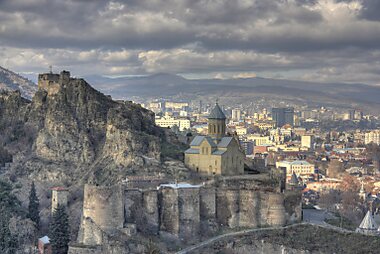
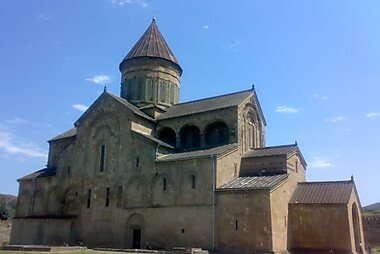
The old quarters of Tbilisi sit beneath the fortress of Narikala, while a short drive away the ancient capital Mtskheta holds two UNESCO-listed churches. Further out, in different directions, roads climb north toward the glacier-topped Mount Kazbek or west into the medieval stone towers of Svaneti. Georgia suits travelers who like to combine a walkable, food-and-wine-focused city break with serious mountain scenery and deep history, all on a modest budget.



Georgia – Planning a Trip?
Build your day-by-day itinerary in the Tripomatic app.


Money & payments
ATMs are common in cities and most towns, and cards work in restaurants, hotels, and shops in tourist areas. Carry some cash for small guesthouses, local marshrutka minibuses, market stalls, and mountain villages, where card readers are less reliable.
Featured Lists


Georgia's Castles and Forts
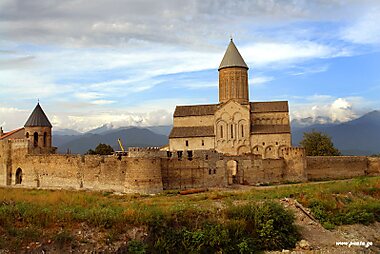
Georgia’s landscape is defined by its defensive architecture, spanning from Roman maritime outposts like Gonio to the high-altitude Khikhani Fortress in Adjara. This collection includes the 9th-century Rabati complex in Akhaltsikhe, the royal ruins of Geguti, and the iconic Narikala Fortress overlooking Tbilisi. These sites showcase diverse influences, including Byzantine, Persian, and Ottoman engineering, reflecting the country's history as a strategic crossroads between Europe and Asia.
19 places
Georgia's Natural Wonders
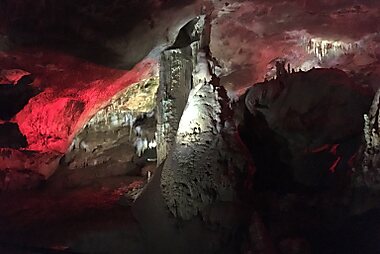
Georgia's diverse landscape features the Greater Caucasus's highest peaks, including the 5,068-meter Shkhara and the dormant stratovolcano Mount Kazbek. The region's karst topography houses the Krubera Cave, one of the world's deepest, and the illuminated chambers of Prometheus Cave. Hydrological landmarks range from the triple-tiered Kinchkha Waterfall to the sulfur-rich thermal baths of Torgvas Abano and Kyndyg. High-altitude highlights include the Gergeti Glacier and the Abano Pass, which reaches 2,826 meters, connecting the Kakheti region to the remote Tusheti mountains.
16 places
Tours & Activities
Georgia — Map

 Open the interactive map
 Tipping
Tipping is appreciated but not obligatory. In restaurants, check the bill first: some already add a service charge, in which case an extra tip is optional. Where nothing is added, 5-10% for good service is common in cities. Taxi drivers are usually tipped by rounding up the fare, and a private guide is typically tipped for a full day of touring.
5-10%
a few GEL for porters or housekeeping
round up
20-40 GEL per day
Electricity
Georgia uses Type C and F plugs at 220 V / 50 Hz, the same standard as most of continental Europe. Travelers from the UK, US, Canada, or Australia will need an adapter.
Language
Georgian is the official language, written in its own alphabet unrelated to Latin or Cyrillic. Street signs and menus in Tbilisi and the main tourist towns are usually also in Latin script, but road signs thin out in rural areas, so a translation app or offline map is useful once off the main routes. English is spoken in hotels, restaurants, and tour operations in tourist areas, less so outside them; Russian is still widely understood among older generations.
Staying connected
A prepaid SIM or eSIM from Magti, Silknet, or Cellfie (formerly Beeline) is inexpensive and quick to set up, usually needing only a passport at the point of sale. Mobile data coverage is solid across the country, including most mountain valleys, though it can drop out on high passes and in the most remote parts of Svaneti and Tusheti.
Safety & emergencies
Georgia is one of the safer countries in the region for travelers, with low rates of violent crime. The main risks are petty ones: pickpocketing in crowded tourist spots and markets, and unmetered taxis overcharging at the airport or train stations, best avoided by agreeing a fare upfront or using a ride-hailing app.
The breakaway regions of Abkhazia and South Ossetia are outside Georgian government control, and most governments advise against travel there. The rest of the country, including areas near these administrative boundary lines, is generally safe to visit.
Health
Tap water is generally safe to drink in Tbilisi and other major cities; in older buildings or more remote towns, bottled water is a reasonable precaution. Pharmacies, marked with a green or red cross, are common in urban areas and many stay open late or around the clock. No special vaccinations are required beyond those routinely recommended for travel, though checking with a doctor or travel clinic before a trip is always sensible.
Visas & entry
Georgia has one of the more open visa policies in the region. Citizens of the EU, UK, US, Canada, Australia, and many other countries can enter visa-free for stays of up to a year. Travelers from countries without visa-free access can usually apply for an e-visa online before arrival.
Visa and entry requirements change frequently. Verify current requirements with the official immigration authority or your country's embassy before travel.
Etiquette
A supra, the traditional Georgian feast, is led by a toastmaster (tamada) who calls a long series of toasts, usually with wine or chacha. Guests are expected to at least sip when a toast is raised; declining outright can seem impolite, though saying you don't drink alcohol is understood.
At monasteries and churches, dress modestly: women are often expected to cover their shoulders and sometimes their hair, with scarves usually available to borrow at the entrance, and men should avoid shorts. Photography inside churches is sometimes restricted during services; it's polite to check before taking pictures.
Holidays & opening hours
Many public holidays follow the Orthodox calendar, and the stretch from Christmas (7 January) through the New Year and Epiphany is a major family season, when some restaurants and shops close or shorten their hours. Around Easter, expect similar disruptions, especially outside big cities.
Shops generally open in the late morning and stay open into the evening, seven days a week, including Sunday, so opening hours cause less disruption to travel plans than in much of Western Europe.
Getting around
- By marshrutka: Shared minibuses are the backbone of intercity travel, connecting Tbilisi to nearly every town, including Kazbegi, Telavi, and Svaneti. They leave from central stations once full rather than on a fixed timetable, and tickets are bought on board or just before departure.
- By train: Georgian Railway runs comfortable trains between Tbilisi, Kutaisi, and the Black Sea coast. Book ahead in summer, especially for the Tbilisi-Batumi route, when tickets can sell out. Georgian Railway
- By air: Domestic flights exist but rarely save meaningful time given the country's small size; most travelers rely on road and rail instead.
Driving
- Mountain roads: Routes to Kazbegi and deep into Svaneti climb through high passes; some stretches, including the road to Ushguli, are unpaved and best driven with a 4x4, especially outside summer.
- Fuel: Stations are a mix of major chains (Wissol, Socar, Gulf) and smaller independents, offering multiple octane grades; both cash and card are generally accepted.
- Winter driving: Snow and ice are common on mountain passes from late autumn to spring; some high routes close temporarily after heavy snowfall.
- EV charging: Charging points exist in Tbilisi and along the main highways but are sparse elsewhere, so plan longer mountain detours carefully if driving electric.
Food & drink
Breakfast is often light, bread and cheese with coffee or tea, while lunch and dinner are the main events, especially when they take the form of a supra, a long shared table of small dishes rather than individual courses. Khachapuri, cheese-filled bread baked in many regional styles, and khinkali, twisted soup dumplings eaten by hand, are the two dishes found everywhere, from simple canteens to family-run cafes.
Grilled meat skewers, walnut-based sauces, and the bean stew lobio round out a typical meal, followed by churchkhela, a chewy strung-walnut candy, as a sweet snack. Wine is central to the culture and is often served young and slightly cloudy from clay qvevri vessels; chacha, a strong grape brandy, appears at toasts and celebrations. Most everyday eating happens in small family-run restaurants rather than formal dining rooms.
Where to explore
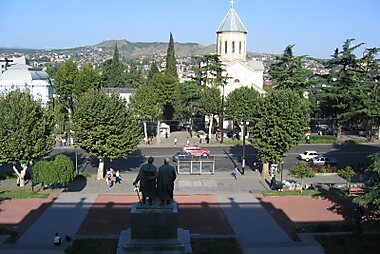
Tbilisi, the capital, mixes a walkable old town of sulfur bathhouses and balconied houses with a fast-growing modern skyline.
Mtskheta, Georgia's ancient capital just outside Tbilisi, holds two UNESCO World Heritage churches and is an easy half-day trip.
Kazbegi, in the high Caucasus near the Russian border, is the base for reaching Gergeti Trinity Church beneath Mount Kazbek.
Kakheti, Georgia's main wine region, centers on the hill town of Sighnaghi and the regional hub Telavi, both surrounded by vineyards.
Borjomi is a spa town built around a mineral-water park, with forested hiking trails just outside it.
Akhaltsikhe, in Georgia's southwest, is the gateway to the cave monastery of Vardzia and Khertvisi Fortress.
Gori is known for the rock-hewn town of Uplistsikhe and its Stalin-era history.
Svaneti, high in Upper Svaneti, is a region of medieval stone defensive towers, including the remote UNESCO village of Ushguli, one of the highest continuously inhabited settlements in Europe.
On the Black Sea coast, Kobuleti is a low-key beach town near the larger resort city of Batumi, known for its promenade and subtropical botanical garden. Zugdidi in western Georgia is the usual staging point for onward travel into Svaneti.
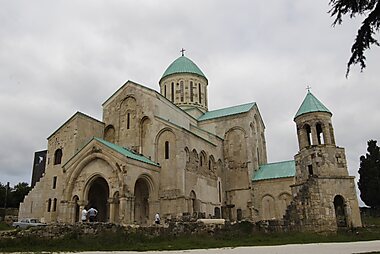
Western Georgia's Imereti region is centered on Kutaisi, the country's third city, home to Bagrati Cathedral and Gelati Monastery.
Georgia – Plan Your Trip
Pick the places you want to see and Tripomatic turns them into a day-by-day route, with smart routing, time estimates, and everything you need for a perfect trip.


Related destinations


Data: © OpenStreetMap contributors, Wikidata, Wikipedia, Tripomatic, Official websites, geoBoundaries (CC BY 4.0). Tours by GetYourGuide. We earn commission from bookings. Travel guide generated with AI.