



Vancouver
Vancouver sits between the Pacific Ocean and the Coast Mountains in British Columbia. Downtown occupies a compact peninsula, so the ocean, forested parks, and snow-capped peaks are visible from the street. It suits travelers who want an outdoor-focused city break: hiking, cycling, and beach time alongside a modern downtown, without a long drive out of town.
The city has no old town or grand historic monuments. It is a young Pacific port city shaped by its setting more than its past. Coast Salish and other Northwest Coast Indigenous cultures run through the city's art, architecture, and museums. Large Chinese and South Asian communities have shaped its food scene.

Vancouver – Planning a Trip?
Build your day-by-day itinerary in the Tripomatic app.


When to visit
Summer (June to September) is warm and mostly dry, with far less rain than the rest of the year. Spring and fall are cooler and wetter but still pleasant. Winter is mild but grey and rainy at sea level, though the North Shore mountains just outside the city get heavy snow.
The biggest annual event is the Celebration of Light, an international fireworks competition held over English Bay each summer, with several nights of choreographed shows.
Best time to visit: June, July, August, September
Pack a light rain jacket for a spring, fall, or winter visit — showers can appear with little warning.
Top sights
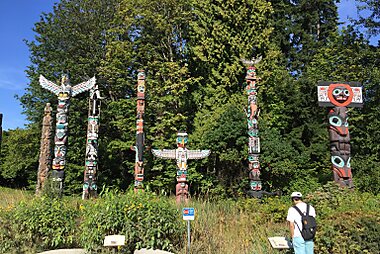

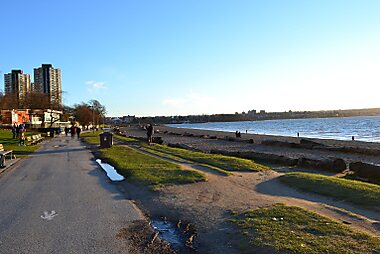
Stanley Park is a large peninsula park next to downtown, ringed by a seawall path for walking or cycling, with totem poles, old-growth trees, and beach coves.
Granville Island Public Market is a covered food market on a former industrial island under the Granville Street Bridge, packed with produce stalls, bakeries, and artisan food stands.
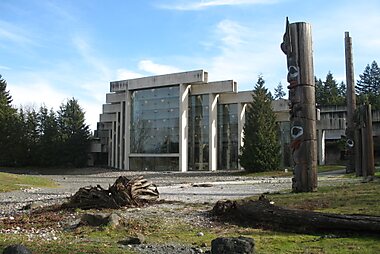
Museum of Anthropology, on the University of British Columbia campus, has a major collection of Northwest Coast Indigenous art, including totem poles and carvings by Bill Reid.
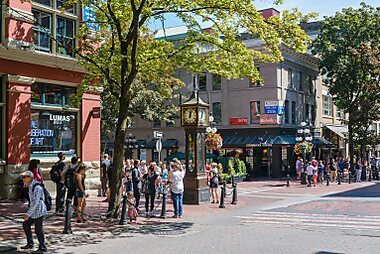
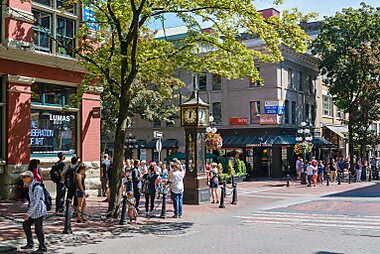
Gastown is Vancouver's oldest neighborhood, with cobblestone streets, Victorian-era buildings, and the steam-powered Gastown Steam Clock that whistles every quarter hour.
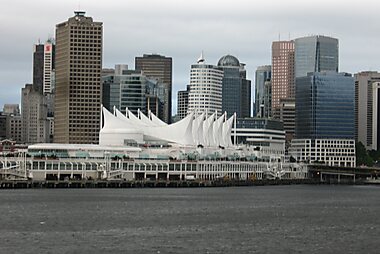
Canada Place is instantly recognizable by its sail-shaped rooftops over the cruise terminal and convention centre, with a waterfront promenade looking out to the North Shore mountains.
English Bay Beach is the city's classic sunset spot, a curving sand beach a short walk from downtown.
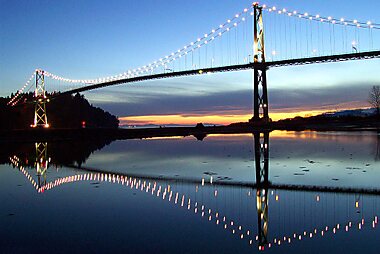
Lions Gate Bridge links downtown to the North Shore across Burrard Inlet; the pedestrian path across it gives wide views over the harbor.
Featured Lists


Vancouver Cultural Attractions
Vancouver’s cultural landscape features a mix of historic venues and modern institutions. Major hubs include the Vancouver Art Gallery, housed in a neoclassical former courthouse, and the waterfront Canada Place, which hosts immersive cinematic experiences. Vanier Park serves as a museum cluster, containing the Museum of Vancouver, the H.R. MacMillan Space Centre, and the Vancouver Maritime Museum, which displays the historic St. Roch schooner. For performing arts, the city offers heritage theaters like The Orpheum, a 1927 vaudeville house, and the Queen Elizabeth Theatre.
12 places


What to experience
Vancouver's outdoor setting shapes most of its signature experiences.
- Cycle or skate the Stanley Park seawall at sunset, when the Coast Mountains turn pink over the water.
- Paddle a canoe or stand-up paddleboard across False Creek or English Bay — several outfitters rent gear right on the water.
- Ride one of the small passenger ferries that shuttle across False Creek between Granville Island, Yaletown, and Science World — a cheap, scenic way to get around.
- Watch a dragon boat practice or race on False Creek. Vancouver has a large, active dragon boat racing community.
Tours & Activities
Vancouver — Map

 Open the interactive map
 Day trips
Vancouver's setting makes for easy day trips into mountains, forest, and along the coast.
- North Vancouver's North Shore — about 25 minutes by car, or SeaBus plus local bus — home to Capilano Suspension Bridge Park and Grouse Mountain's gondola and hiking trails.
- Whistler — about 2 hours by car or bus along the Sea-to-Sky Highway — a year-round mountain resort with hiking and biking in summer and a major ski area in winter.
- Victoria — about 3.5 hours by ferry and bus, or a 35-minute floatplane flight — British Columbia's small, walkable capital, known for its waterfront and historic buildings.
Getting there
- By air: Vancouver International Airport (YVR) is the main gateway, about 12 km south of downtown. The Canada Line SkyTrain reaches downtown in about 25 minutes; a small surcharge applies for trips starting at the airport.
- By train: VIA Rail's transcontinental Canadian arrives at Pacific Central Station, and Amtrak Cascades trains from Seattle use the same station, about 4 hours south.
- By bus: Long-distance coaches to Seattle, Whistler, and other destinations in British Columbia also depart from Pacific Central Station.
Getting around
- Public transit: TransLink runs the SkyTrain (three lines), buses, and the SeaBus passenger ferry across Burrard Inlet to North Vancouver. Tap a contactless bank card or phone at the fare gates or on board. No separate ticket or card is needed. TransLink
- Taxi / ride-hailing: Uber and Lyft both operate citywide.
- On foot / cycling: Downtown, the West End, and the seawall are flat and easy to walk or cycle; a public bike-share system covers the central areas. Reaching the North Shore or UBC on foot is impractical — use transit.
Driving
- Is a car worth it?: Not for downtown — parking is expensive and traffic backs up at bridge crossings. A car is useful mainly for reaching the North Shore mountains, the Sea-to-Sky Highway, or the Fraser Valley beyond transit's reach.
- Parking: Metered street parking and pay parkades are common downtown; expect CAD 15–25 per day. Pay by app or at the meter.
- Restrictions: none beyond normal city traffic rules — there is no congestion charge.
Food & drink
Vancouver's food scene reflects its Pacific setting and large Asian communities. Fresh seafood, sushi, and dim sum are all strong here. The city has a big Japanese-Canadian food culture, and is often credited as the birthplace of the California roll.
For a browse-and-graze meal, head to Granville Island Public Market's food stalls, or the restaurants along Denman Street and Commercial Drive, which cluster casual, affordable options from across the city's many cuisines.
Safety & health
Vancouver is generally safe for tourists; violent crime against visitors is rare. Petty theft from parked cars and unattended bikes happens, so don't leave valuables visible. The Downtown Eastside, a few blocks from Gastown, has a highly visible drug crisis and open drug use. It's fine to walk through in daylight, but best avoided alone at night.
Tap water is safe to drink everywhere in the city.
History
Vancouver's site has been home to the Musqueam, Squamish, and Tsleil-Waututh First Nations for thousands of years. The modern city grew out of a sawmill settlement nicknamed "Gastown" after saloon keeper John Deighton — the neighborhood now known as Gastown carries his nickname, "Gassy Jack." A fire destroyed the young settlement in 1886, the same year Vancouver was incorporated. It was quickly rebuilt in brick, so most of today's Gastown dates to the late 1880s and 1890s.
Expo 86, the 1986 World's Fair, transformed the old rail yards and industrial waterfront around False Creek. Those sites became the high-rise neighborhoods that define downtown Vancouver's skyline today.
Country facts
Quick practical facts for Canada at a glance:
- Currency
- Canadian Dollar CAD $ · Card payments · Widely accepted
- Emergency numbers
- 911
- Electricity
- 120 V · 60 HzType A / Type B
- Languages
- English, French
- Tap water
- Safe to drink
- Driving side
- Right
- Calling code
- +1


Vancouver – Plan Your Days
Turn the places from this guide into a real itinerary, with smart routing, time estimates, and everything you need for a perfect trip.




