


Washington, D.C.
Washington, D.C. is the political capital of the United States, purpose-built to house the federal government rather than grown up as a trading or industrial city. Its low skyline and wide avenues center on the National Mall, where free national museums and monuments sit within walking distance of each other.
Most visitors come to see American democracy up close: the Capitol, the White House, and the Supreme Court are all here, alongside the Smithsonian's museums and galleries. The city rewards a few focused days rather than one rushed loop, and its history runs from Pierre L'Enfant's original 1791 street plan to the civil rights marches that filled the Mall in the 20th century.

Washington, D.C. – Planning a Trip?
Build your day-by-day itinerary in the Tripomatic app.


When to visit
Spring and autumn are the most comfortable seasons for walking the National Mall. Summers are hot and humid, and winters are cold with occasional snow. Plan around the National Cherry Blossom Festival, held for about three weeks from late March into early April, when the trees around the Tidal Basin bloom and the city sees its biggest crowds of the year.
Best time to visit: May, September, October
October brings the sunniest, driest days for outdoor sightseeing, while high summer is the most humid stretch to plan around.
Top sights
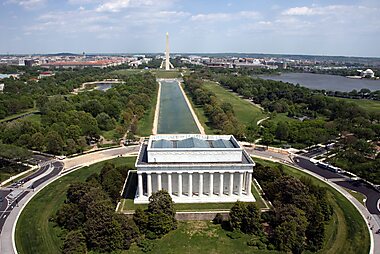
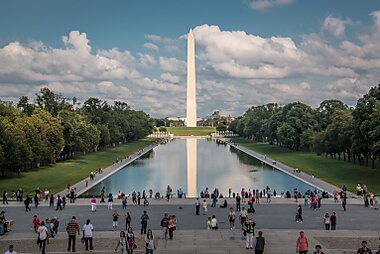
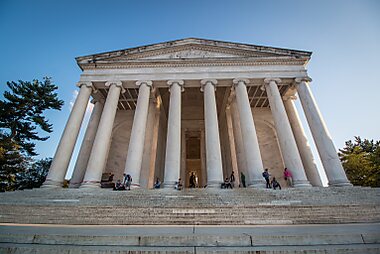
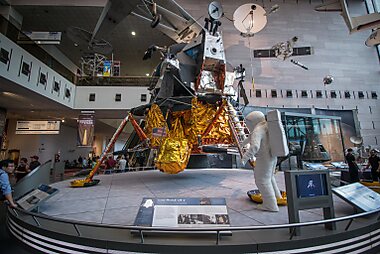
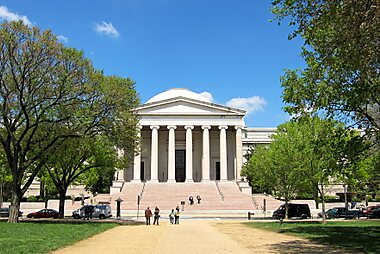
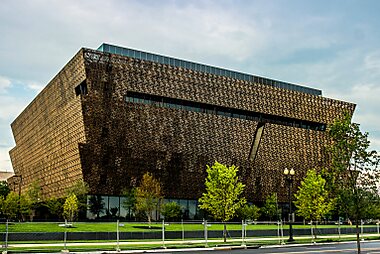
National Mall is the green spine of the capital, a lawn about three kilometers long linking the Capitol to the Lincoln Memorial and lined with free museums, including National Gallery of Art.
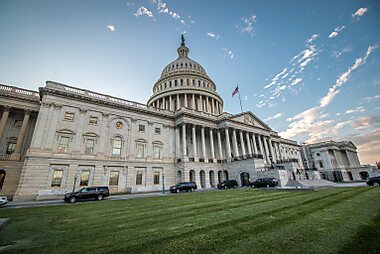
United States Capitol has housed Congress since 1800, and its dome remains one of the city's most recognizable landmarks. Free tours cover the rotunda and Statuary Hall.
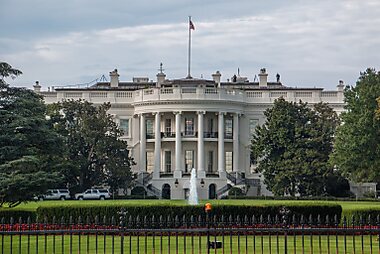
White House has been the home and office of every U.S. president since John Adams. Standard tours require advance booking through a member of Congress.
Washington Monument sits roughly at the midpoint of the Mall, between the Capitol and the Lincoln Memorial, and an elevator ride to its observation deck gives the best overview of the city's flat, low-rise skyline.
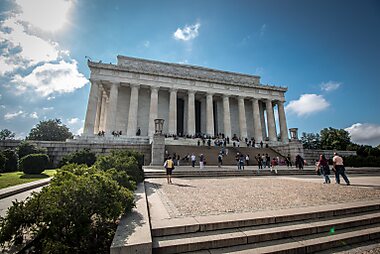
Lincoln Memorial holds a seated marble statue of the president and the steps where Martin Luther King Jr. delivered his "I Have a Dream" speech in 1963.
Jefferson Memorial sits across the Tidal Basin in a domed rotunda modeled on the Pantheon in Rome, and is most photographed when the surrounding cherry trees bloom in spring.
National Air and Space Museum covers flight and space exploration with real spacecraft, including a Wright brothers' airplane and Apollo-program artifacts. Admission is free.
National Museum of African American History and Culture traces African American history and culture across several floors, from slavery and segregation to music and sport. Free timed-entry passes are recommended.
Featured Lists


Iconic Memorials & Monuments
Washington, D.C.’s landscape is defined by its monumental architecture, centering on the National Mall and extending across the Potomac to Arlington. This collection features iconic presidential tributes like the Lincoln Memorial’s marble colonnade and the Washington Monument’s stone obelisk. It also honors military service through the reflective walls of the Vietnam Veterans Memorial and the bronze figures of the Korean War Veterans Memorial. Beyond political figures, the list includes the 9/11 Pentagon Memorial, the U.S. Holocaust Memorial Museum, and the Tomb of the Unknown Soldier, representing a comprehensive history of American sacrifice and remembrance.
20 places

Parks & Gardens
Washington, D.C.’s landscape is defined by its grand civic spaces and intimate botanical retreats. This collection spans the 1,000-acre National Mall and the historic United States Botanic Garden to specialized sites like the Hirshhorn Sculpture Garden and the riverside Georgetown Waterfront Park. Visitors can explore the multi-tiered fountains of Meridian Hill, the Victorian-style Enid A. Haupt Garden, and significant monuments including the World War II and Japanese American Memorials. From Bartholdi’s monumental fountain to the modern art installations near the National Gallery, these green spaces blend history, art, and horticulture across the capital.
12 places
Historic Cemeteries & Tombs
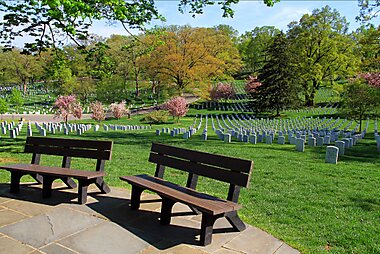
Explore the solemn landscapes and historical narratives of the Washington, D.C. area through its most significant burial grounds. This list features Arlington National Cemetery, the final resting place for thousands of service members and notable figures like President William Howard Taft and explorer Matthew Henson. It also includes specialized sites such as the 1858 German-American Prospect Hill Cemetery and the 19th-century Glenwood Cemetery, showcasing diverse commemorative styles and the region’s rich social history.
6 places
What to experience
- Catch a free performance on the Millennium Stage at John F. Kennedy Center for the Performing Arts, held most evenings year-round at no charge.
- Rent a paddle boat on Tidal Basin for a view of the surrounding memorials from the water, especially during cherry blossom season.
- Walk or bike the C&O Canal towpath through Georgetown, a flat path along a 19th-century canal.
- Watch a Washington Nationals baseball game at Nationals Park on the Anacostia riverfront.
Tours & Activities
Washington, D.C. — Map

 Open the interactive map
 Day trips
Washington's monumental core covers only a few square kilometers, so day trips reach both Virginia and Maryland easily.
- Arlington National Cemetery — about 15 minutes by Metro (Blue Line) — the nation's largest military cemetery, including the Tomb of the Unknown Soldier and more than 400,000 graves.
- Old Town Alexandria — about 25 minutes by Metro or a seasonal water taxi — cobblestone streets, 18th-century townhouses, and a working waterfront lined with restaurants.
- Mount Vernon — about 40 minutes by car, or a seasonal riverboat from the Wharf — George Washington's plantation home overlooking the Potomac River.
- Baltimore — about 45 minutes by MARC train from Union Station — a working harbor city with the National Aquarium and historic rowhouse neighborhoods.
- Shenandoah National Park — about 1.5 to 2 hours by car — Blue Ridge Mountain scenery along Skyline Drive, with hiking trails and waterfalls.
Getting there
- By air: Ronald Reagan Washington National Airport (DCA) is the closest, about 15 minutes from downtown by Metro (Blue or Yellow Line). Washington Dulles International (IAD) is the main international gateway, about 55 minutes away via the Silver Line, or by Metrobus 5A from Rosslyn. Baltimore/Washington International (BWI) also serves the region, connected by MARC train in about 45 minutes.
- By train: Washington Union Station is the hub for Amtrak's Northeast Corridor, with frequent service to New York, Philadelphia, and Boston, plus regional MARC and VRE commuter trains.
- By bus: Intercity coach services also operate from Union Station, with connections to nearby cities along the East Coast.
Getting around
- Public transit: The Metrorail subway and Metrobus network, run by WMATA, cover most of the city and close-in suburbs. Fares are paid with a SmarTrip card, sold at station machines, or by tapping a contactless bank card or phone directly at the fare gates. See WMATA for maps and fares.
- Taxi and ride-hailing: Uber and Lyft operate widely and are often more practical than a taxi for trips outside the Metro's reach.
- On foot and by bike: The monumental core is flat and walkable end to end. Capital Bikeshare docks are common citywide for short rides.
Driving
- Is a car worth it?: No. Traffic and parking make a car a liability within the city; the Metro and walking cover the monumental core easily. A car only helps for day trips like Mount Vernon or Shenandoah National Park.
- Parking: Downtown street parking is metered and limited, and many blocks near the Mall have none at all. Paid garages near the museums are the more reliable option.
- Restrictions: There is no congestion charge, but rush-hour traffic is heavy and several downtown streets reverse direction or restrict turns during peak hours.
Food & drink
Washington's defining street food is the half-smoke, a smoked, coarser cousin of the hot dog usually topped with chili and onions. The U Street Corridor, once nicknamed "Black Broadway" for its jazz clubs, is now the city's densest cluster of Ethiopian restaurants, reflecting one of the largest Ethiopian communities outside Africa.
Food halls such as Union Market bring together dozens of small vendors under one roof and are a good option for a casual, varied meal.
Safety & health
Washington is generally safe for tourists, especially in the National Mall area and other well-visited neighborhoods. Standard city caution applies after dark away from the main sights, and pickpocketing can occur on crowded Metro trains and around busy monuments.
Be wary of unofficial street vendors near the memorials offering "free" tours or souvenirs that turn out to have a hidden charge.
History
Congress chose this stretch of land along the Potomac as the nation's permanent capital in 1790, and engineer Pierre L'Enfant laid out its wide avenues and grand vistas the following year. The Capitol's cornerstone was laid in 1793, and the White House was completed in 1800. Both were burned by British troops in 1814 during the War of 1812, then rebuilt largely to their original designs.
President Abraham Lincoln was shot at Ford's Theatre in 1865, days after the Civil War's end. After emancipation, the city became a center of Black political and cultural life, and its 20th-century civil rights history culminated in the 1963 March on Washington, which filled the National Mall.
Country facts
Quick practical facts for the United States at a glance:
- Currency
- US Dollar USD $ · Card payments · Widely accepted
- Emergency numbers
- 911 Police · Ambulance · Fire brigade
- Electricity
- 120 V · 60 HzType A / Type B
- Languages
- English
- Tap water
- Safe to drink
- Driving side
- Right
- Calling code
- +1


Washington, D.C. – Plan Your Days
Turn the places from this guide into a real itinerary, with smart routing, time estimates, and everything you need for a perfect trip.