


Dresde
Dresden is the capital of Saxony. It sits on the Elbe river and is known for its Baroque old town. Much of it was destroyed in 1945 and rebuilt, so the skyline you see today is largely a careful reconstruction.
The city suits art, music and architecture fans. Museums and the opera are among the best in Germany. Green parks and river meadows run through the centre, and the New Town across the river has a lively, creative scene. Two or three days cover the highlights.

Dresde – ¿Estás planeando un viaje?
Crea tu itinerario día a día en la app de Tripomatic.
Cuándo viajar
Late spring and early autumn are the most comfortable times. Summer is warm and good for the river meadows, with some rain. Winter is cold and grey, but the Advent season is the main draw.
The biggest event is the Striezelmarkt, one of Germany's oldest Christmas markets. It is held on the Altmarkt during Advent and has been running since 1434. Book hotels early for December weekends.
Mejor época para viajar: junio, agosto, septiembre
Lugares destacados
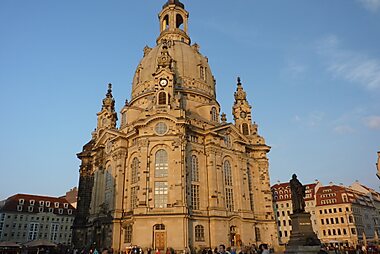

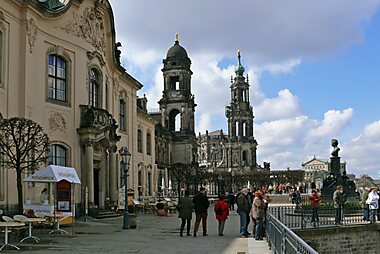

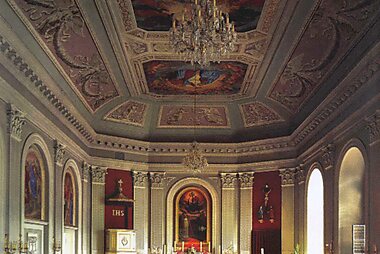
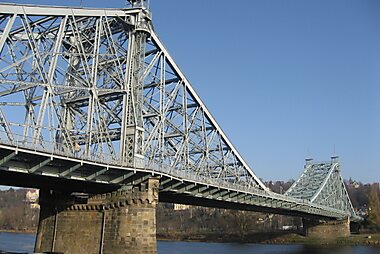
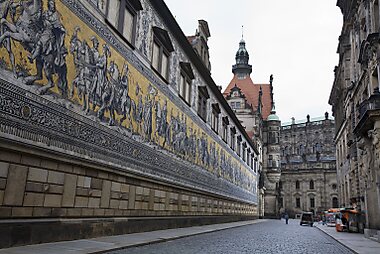
- Church of Our Lady is the symbol of the city. The Baroque church was rebuilt from its ruins and reopened in 2005. You can climb the dome for views over the old town.
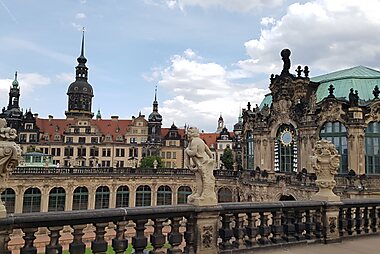
- Zwinger is a Baroque palace complex with courtyards, pavilions and gardens. It houses museums, including the Old Masters picture gallery and the porcelain collection.
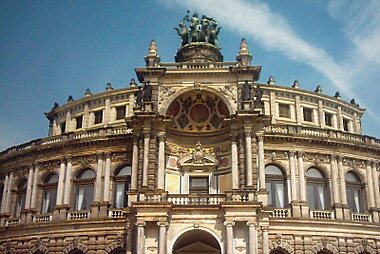
- Semperoper is the city's opera house. Go for an evening performance or take a guided tour.
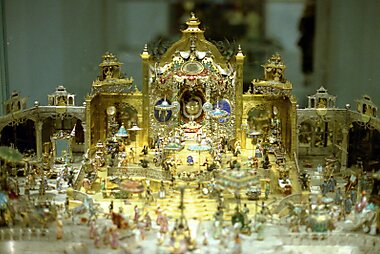
- Historisches Grünes Gewölbe holds the treasury of the Saxon rulers. It displays jewels, ivory and gold in rooms laid out as they were in the 18th century.
- Neues Grünes Gewölbe shows more royal treasures in the same palace. The two collections can be visited together.
- Procession of Princes is a long wall mural of Saxon rulers on horseback. It is made of porcelain tiles and is hard to miss.
- Brühl's Terrace is a terrace above the river. It is a popular walk with wide views of the Elbe.
- Loschwitzer Brücke is the blue steel bridge across the Elbe in the Loschwitz district. It is a good start for a walk on the quieter east side.
- Großer Garten is a large Baroque park south-east of the centre. It has a palace, gardens and a small railway.
- Schloss Pillnitz is a riverside summer palace with Asian-style roofs. You can reach it by boat from the centre.
Listas destacadas

Editor's Picks — Dresden
A compact guide to central Dresden highlighting key historic and cultural sites: the Zwinger’s Baroque courtyards and galleries, the Gemäldegalerie Alte Meister with its 15th–18th‑century paintings, and the Residenzschloss with its layered architectural styles. Also included are the 19th‑century Semperoper, the 18th‑century Katholische Hofkirche, the modern‑art collections at the Albertinum on Brühl’s Terrace, and the decorated courtyards of the Kunsthofpassage.
7 lugares
Dresden's Hidden Gems
A compact selection of lesser-known Dresden highlights featuring distinct architectural and cultural details: Pfunds Molkerei’s lavish hand-painted tile interiors and gilded counters that earned it a Guinness record; Yenidze’s early-20th-century cigarette factory façade with Moorish-style dome and minaret-like tower; the Dreikönigskirche with origins in the 15th century; the Großer Garten, a 1.8 km² rectangular Baroque city park; and the Asisi Panometer housed in a former gasometer showing large 360° panoramic paintings.
5 lugares
Must‑See Heritage & Sights
A compact selection of Dresden highlights focused on art, riverfront landmarks and local history. Features the Gemäldegalerie Alte Meister’s 15th–18th-century paintings, the suspended Schwebebahn linking Loschwitz across the Elbe, the cantilever Blue Wonder bridge, baroque Loschwitz church and riverside Elbe castles. Also included are literary and local-history museums housed in period villas and a museum tracing Prohlis’s 7,000-year settlement history.
9 lugares


Bridges of Dresden
A concise tour of Dresden’s notable Elbe and valley crossings, highlighting a mix of historic stone arches, iron truss engineering and modern motorway viaducts. The list covers the baroque Augustusbrücke, the cantilevered Loschwitz (“Blue Wonder”), the suspended Schwebebahn funicular, the controversial Waldschlößchen road bridge and key rail and autobahn spans north and south of the city.
6 lugaresAudioguías – Dresde
Explora a pie con una visita autoguiada con audio que describe cada punto conforme llegas a él.


Escucha las visitas en audio de Dresde
1 ruta a pie en Audioguías de Tripomatic


Qué experimentar
Dresden has a few activities that are specific to the city.
- Take a historic paddle steamer on the Elbe in the warm season. Boats run from the old town to Pillnitz and to Saxon Switzerland.
- Ride the Loschwitz funicular and the suspension railway for the hill views above the river.
- Watch the sunset from the Elbe meadows. Locals bring picnics in summer.
- Visit the Striezelmarkt in Advent. Try a hot drink and the local Stollen.
- Attend a performance at Semperoper. Opera, ballet and concerts run for most of the year.
- Take the small railway in Großer Garten.
Tours y actividades
Dresde — Mapa

 Abrir el mapa interactivo
Excursiones de un día
These places are close and easy to reach. Most can be done by train, tram or boat.
- Radebeul is about 20 min by tram or S-Bahn. It is a wine town with vineyards and a Karl May museum.
- Meissen is about 40 min by S-Bahn. It is the home of Meissen porcelain and has a hilltop castle and cathedral.
- Moritzburg is about 30 min by bus. It is a Baroque hunting palace on a lake.
- Pirna and Saxon Switzerland are about 30 to 60 min by S-Bahn. This national park has rock towers, the Bastei bridge and the Königstein fortress. It is the best choice for hiking.
- Bautzen is about 1 hour by train. It has a hilltop old town and is the centre of Sorbian culture.
- Görlitz is about 1.5 to 2 hours by train. It has a well-kept old town on the Polish border.
- Leipzig is about 1 hour by train. It is a large city with a strong music and history scene.
Qué explorar
Cómo llegar
- By air: Dresden Airport (DRS) has a limited choice of flights. It is about 9 km from the centre. The S-Bahn line S2 reaches the main station in about 20 minutes. Many visitors also fly to Berlin or Prague.
- By train: Dresden Hauptbahnhof is the main station. Direct trains run to Berlin (about 2 hours), Leipzig (about 1 hour), Prague (about 2.5 hours) and Frankfurt. Book on Deutsche Bahn.
- By bus: Long-distance coaches stop near the main station. They connect Dresden with Berlin, Prague and other cities.
Cómo desplazarse
- Public transit: Trams and buses cover the city. The operator also runs river ferries, a funicular and a suspension railway. Buy tickets at machines or in the DVB app. See DVB for fares and maps.
- On foot and by bike: The old town is compact and flat. A cycle path runs along both banks of the Elbe.
Conducción
- Is a car worth it?: No, not for the city. Trams, trains and boats cover most trips. A car helps only for remote spots in the Ore Mountains.
- Parking: Underground car parks near the old town charge by the hour. Park-and-ride lots at the edge of town are cheaper.
- Restrictions: The area around the Frauenkirche is mostly for pedestrians.
Gastronomía
Saxon food is hearty. Try Sauerbraten with dumplings, Quarkkeulchen (fried quark pancakes) and Eierschecke, a custard cake. Dresdner Stollen is the famous Christmas bread and is sold in bakeries in winter.
Good places to eat are clustered in a few areas. The Neustadt, around Alaunstraße and Louisenstraße, has many small restaurants, cafes and bars. The streets around Neumarkt and the Frauenkirche have restaurants with outdoor tables. For a special stop, visit Pfunds Molkerei, a famous dairy shop with painted tiles.
Seguridad y salud
Dresden is safe for visitors. Violent crime against tourists is rare.
- Pickpockets work in crowds, such as the Christmas market and busy trams.
- Watch for bicycles on shared paths and trams on the streets.
- Tap water is safe to drink.
Historia
Dresden became a royal city under the Saxon rulers. Augustus the Strong built much of the Baroque city in the early 1700s. Zwinger was built between 1710 and 1728, and Dresden Castle was the seat of the Saxon rulers.
On 13 to 15 February 1945, bombing destroyed most of the old town. The dome of Church of Our Lady collapsed on 15 February. Reconstruction of the church began in 1994 and it was reconsecrated in 2005. You can still see dark original stones in the new walls.
During the East German period, the city rebuilt in a socialist style. Many old buildings returned only after 1990. The rebuilt Neumarkt shows this recent work.
Datos del país
Quick practical facts for Germany at a glance:
- Moneda
- euro EUR € · Pago con tarjeta · Habitualmente aceptado
- Teléfonos de emergencia
- 112 Ambulancia · Bomberos
- Electricidad
- 230 V · 50 HzTipo C / Tipo F
- Idiomas
- alemán
- Agua del grifo
- Potable
- Sentido de la circulación
- Derecha
- Prefijo telefónico
- +49


Dresde – Planifica tus días
Convierte los lugares de esta guía en un itinerario real, con rutas inteligentes, estimaciones de tiempo y todo lo que necesitas para un viaje perfecto.


Destinos relacionados


Data: © OpenStreetMap contributors, Wikidata, Wikipedia, Tripomatic, Official websites, geoBoundaries (CC BY 4.0). Tours by GetYourGuide. We earn commission from bookings. Travel guide generated with AI.
Planifica tu viaje con Tripomatic
- Planificación con IAConsigue un día listo con un solo toque, deja que la IA distribuya tu lista de deseos a lo largo de tu viaje o planifícalo todo chateando.
- Alertas de viajeAvisos oficiales, alertas meteorológicas, huelgas y desastres naturales para los lugares de cada día de tu viaje.
- Festivos y eventosConsulta festivos, festivales y cierres durante los días de tu viaje, y qué implican para tus planes.
- Estimación de costesDesgloses de costes de viaje con IA para saber qué presupuesto necesitas antes de salir.
- Tours y entradasReserva tours, entradas sin colas y actividades directamente desde tu plan.