


Ferrara
Ferrara is a calm, flat city on the plain of the River Po, between Bologna and Venice. For three centuries it was the seat of the Este family, one of the great courts of the Italian Renaissance. Its centre is a UNESCO World Heritage site. Medieval lanes in the south meet wide, straight Renaissance streets in the north, an early example of modern town planning. An almost complete ring of brick walls still surrounds the whole old town.
Ferrara is a city of bicycles, and locals ride everywhere. It suits travelers who like art, history and a slower pace, with fewer crowds than its famous neighbours. Two or three days are enough to see the main sights. The poet Ludovico Ariosto wrote Orlando Furioso here, and the city is the setting of Giorgio Bassani's novels about its Jewish community.

Ferrara – ¿Estás planeando un viaje?
Crea tu itinerario día a día en la app de Tripomatic.


Cuándo viajar
Late spring and early autumn are the best times, with mild weather for cycling and walking. July and August are hot and humid. Winter is cold, grey and often foggy, but the museums are quiet.
The biggest event of the year is the Palio di Ferrara, with roots in the 13th century. In May the city's historic districts hold parades in Renaissance costume and flag-throwing contests. On the last weekend of May they race on horseback, on foot and on donkeys in Piazza Ariostea. In late August the Ferrara Buskers Festival fills the streets with street musicians from many countries.
Mejor época para viajar: mayo, septiembre, octubre
Lugares destacados

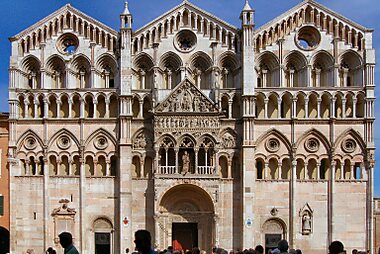
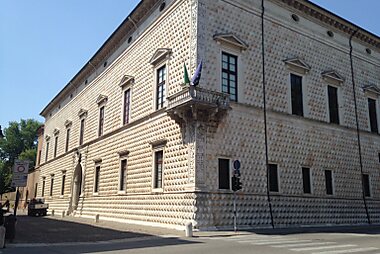
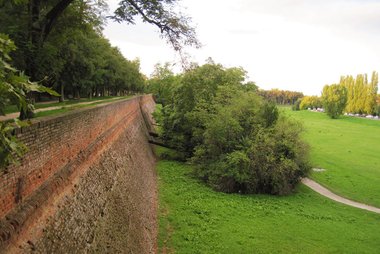
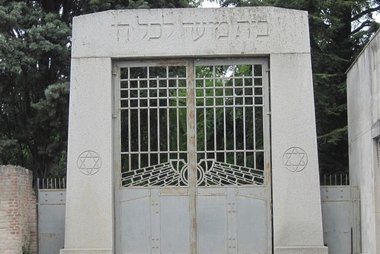
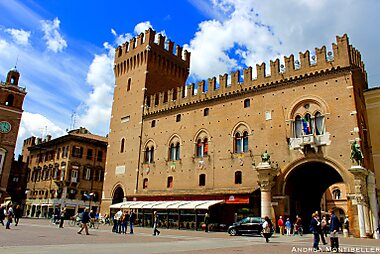
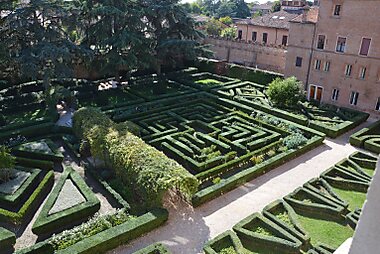
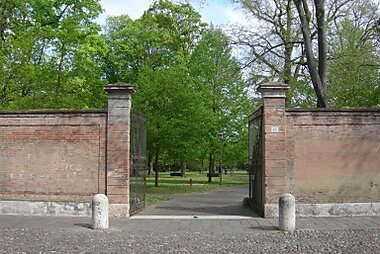
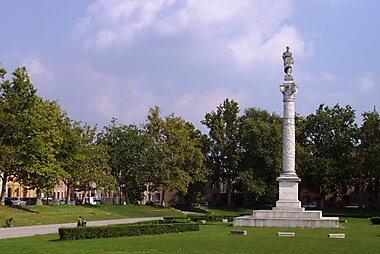
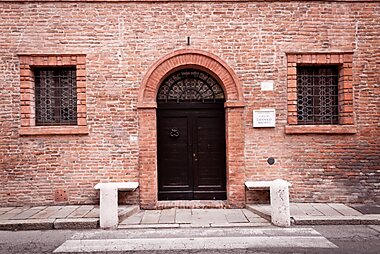
The main sights are close together in a flat centre that is easy to explore on foot or by bike.
- Este Castle is a moated brick fortress from 1385 in the very centre, with the ducal apartments inside. Restoration works began in 2026 and will run until 2030. The castle stays open during the works, but some rooms may be closed, so check before you go.
- Cattedrale di San Giorgio Martire was consecrated in 1135. Its carved façade mixes Romanesque and Gothic styles, and a row of small shops still lines its south side.
- Palazzo Municipale was the first home of the Este family. It faces the cathedral, and its inner courtyard has a grand staircase.
- Palazzo dei Diamanti is famous for its façade of about 8,500 marble blocks cut like diamonds. It holds the city's picture gallery and large art exhibitions.
- Palazzo Schifanoia was a pleasure palace of the Este. Its Hall of the Months is covered in 15th-century frescoes of court life, the zodiac and the seasons.
- Mura di Ferrara run for about 9 km around the old town. Today they form a green belt with bastions, trees and a path on top.
- National Museum of Italian Judaism and the Shoah tells the story of more than two thousand years of Jewish life in Italy. It is housed in the city's former prison.
- Museo di Casa Romei is a 15th-century merchant's house with painted rooms, wooden ceilings and a quiet courtyard.
Listas destacadas
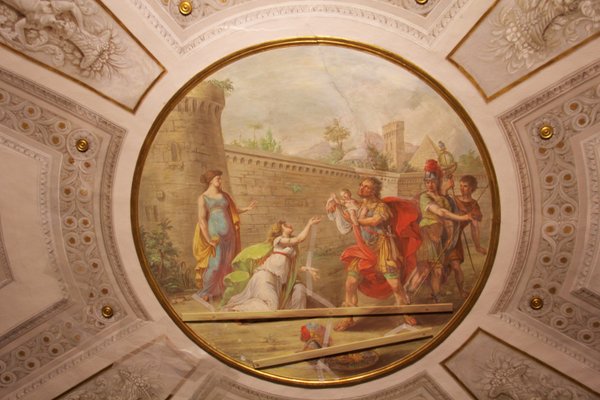


Qué experimentar
These activities are typical of Ferrara and part of local life.
- Ride a bike around the walls: the path on top of Mura di Ferrara makes a 9 km loop under the trees. Locals walk, run and cycle here, especially at sunset.
- Follow the places of Bassani's novels: walk from the old ghetto streets around Via Mazzini to the Cimitero Ebraico, where the writer is buried. These are the settings of The Garden of the Finzi-Continis.
- Watch street performers in August: during the Ferrara Buskers Festival, musicians and acrobats play on squares and corners all over the centre for several evenings.
- See an opera or concert: the Teatro Comunale di Ferrara, opened at the end of the 18th century, has a full season of opera, concerts and theatre.
Tours y actividades
Ferrara — Mapa

 Abrir el mapa interactivo
Excursiones de un día
Ferrara sits between the big art cities of the north and the wetlands of the Po Delta. These trips are easy in a day, listed from closest to farthest.
- Bologna (≈30–50 min by train): the regional capital, known for its arcades, medieval towers and food.
- Comacchio (≈40 min by car): a small lagoon town with canals and bridges. It is the gateway to the Po Delta Park, good for boat trips and birdwatching.
- Pomposa Abbey (≈45 min by car): a Benedictine abbey with a tall Romanesque bell tower and medieval frescoes, alone in the flat countryside near the coast.
- Padua (≈30–60 min by train): a university city with Giotto's frescoes in the Scrovegni Chapel and the large Basilica of Saint Anthony.
- Venice (≈1–1.5 hours on fast trains): the city of canals, reachable for a long day out.
- Ravenna (≈1 hour 15 min by train): famous for its early Christian and Byzantine mosaics.
- Mantua (≈1 hour 20 min by car): another Renaissance court city, set between three lakes, with the vast Ducal Palace.
Qué explorar
Ferrara is one of several historic cities in Emilia-Romagna linked by regional trains.
Cómo llegar
- By air: the nearest airport is Bologna Guglielmo Marconi, about 50 km away. A private airport bus to Ferrara takes about 1 hour; check its times in advance. Otherwise, take the Marconi Express monorail to Bologna Centrale station, then a train to Ferrara.
- By train: Ferrara station is on the main line between Bologna and Venice, a 15-minute walk west of the castle. Regional trains reach Bologna in 30–50 minutes and Padua in 30–60 minutes. Some high-speed trains between Venice and Rome also stop here. Check times on Trenitalia.
- By car: the A13 motorway between Bologna and Padua passes just outside the city.
Cómo desplazarse
- By bike: this is the local way to get around. The centre is flat, many streets have little traffic, and bikes can be rented near the station and in the centre.
- On foot: all the main sights are within a 20-minute walk of the castle.
- By bus: city buses are run by TPER. You can pay on board by tapping a contactless bank card on the green validator, with no extra charge. Tickets from the machine on board cost more. Buses are most useful from the station to the centre. See TPER.
- Tourist information: the official tourist office has maps and cycling routes. See Ferrara tourist information.
Conducción
- Is a car worth it?: not for the city, which is best on foot or by bike. A car helps for the Po Delta and the countryside.
- Restrictions: much of the historic centre is a limited traffic zone (ZTL) with cameras. Do not drive in without a permit, or you will receive a fine by post.
- Parking: use the paid car parks just outside or along the walls and walk or cycle in.
- Fog: in winter, thick fog is common on the roads of the Po plain. Drive slowly.
Gastronomía
Ferrara has its own cooking, different from Bologna's. Try cappellacci di zucca, pasta stuffed with pumpkin and served with butter and sage or meat sauce. Salama da sugo is a spiced pork sausage, slowly boiled and served with mashed potatoes. The local bread, the coppia ferrarese, is twisted into four crunchy arms. For dessert, look for pampepato, a spiced chocolate cake, and tenerina, a soft chocolate cake. Eel from the Comacchio lagoons appears on many menus.
Good places to eat cluster in the medieval lanes south of the cathedral, around Via Mazzini, Via Saraceno and Via delle Volte. The squares around the cathedral and the castle are busy with cafés and wine bars at aperitivo time.
Seguridad y salud
Ferrara is a very safe city, and violent crime against visitors is rare. Bike theft is the most common problem, so always lock your bike to something fixed, even for a short stop. In summer, mosquitoes are common in the evening, especially near the walls and parks, so bring repellent. Tap water is safe to drink.
Historia
The Este family took power in Ferrara in the 13th century and ruled for more than three hundred years. After a revolt in 1385, Niccolò II d'Este built Este Castle to protect his family. The 15th century was the golden age of the court, when artists painted the frescoes of Palazzo Schifanoia. In 1492 Duke Ercole I doubled the size of the city. His architect Biagio Rossetti planned the straight streets of the new northern quarter, with Palazzo dei Diamanti at its main crossroads. The poets Ariosto and Tasso worked at the court, and Lucrezia Borgia, duchess of Ferrara, is buried in Monastero del Corpus Domini.
In 1598 the Este line ended and the city passed to the Pope. Ferrara became a quiet provincial town, which is why so much of its old fabric survives. Its large Jewish community lived in a ghetto from the 17th century until Italian unification, a story told in the National Museum of Italian Judaism and the Shoah. In 1995 the Renaissance city became a UNESCO World Heritage site, later extended to the Po Delta.
Datos del país
Quick practical facts for Italy at a glance:
- Moneda
- euro EUR € · Pago con tarjeta · Ampliamente aceptado
- Teléfonos de emergencia
- 112
- Electricidad
- 230 V · 50 HzTipo C / Tipo F / Tipo L
- Idiomas
- italiano
- Agua del grifo
- Potable
- Sentido de la circulación
- Derecha
- Prefijo telefónico
- +39


Ferrara – Planifica tus días
Convierte los lugares de esta guía en un itinerario real, con rutas inteligentes, estimaciones de tiempo y todo lo que necesitas para un viaje perfecto.


Destinos relacionados




Data: © OpenStreetMap contributors, Wikidata, Wikipedia, Tripomatic, Official websites, geoBoundaries (CC BY 4.0). Tours by GetYourGuide. We earn commission from bookings. Travel guide generated with AI.
Planifica tu viaje con Tripomatic
- Planificación con IAConsigue un día listo con un solo toque, deja que la IA distribuya tu lista de deseos a lo largo de tu viaje o planifícalo todo chateando.
- Alertas de viajeAvisos oficiales, alertas meteorológicas, huelgas y desastres naturales para los lugares de cada día de tu viaje.
- Festivos y eventosConsulta festivos, festivales y cierres durante los días de tu viaje, y qué implican para tus planes.
- Estimación de costesDesgloses de costes de viaje con IA para saber qué presupuesto necesitas antes de salir.
- Tours y entradasReserva tours, entradas sin colas y actividades directamente desde tu plan.