


Kranjska Gora
Kranjska Gora is a small Alpine resort in the far north-west of Slovenia, close to the borders with Austria and Italy. It sits in the upper Sava valley, with the steep peaks of the Julian Alps rising directly south of the village and Triglav National Park starting at its edge.
In winter it is one of Slovenia's main ski resorts, and the nearby Planica valley is famous for ski jumping. In summer it becomes a base for hiking, cycling and driving the Vršič mountain road. The village itself is quiet and compact, with a few old farmhouses among hotels and apartments. It suits active travellers more than sightseers, and three or four nights give time for the main walks and a drive over the pass.

Kranjska Gora – Reis plannen?
Stel je dagelijkse reisroute samen in de Tripomatic-app.


Beste reistijd
There are two seasons. Winter, from about December to March, is for skiing and usually brings reliable snow. Summer, from June to September, is best for hiking, cycling and the Vršič road, which is closed by snow for much of the winter. July and August are warm but often bring afternoon thunderstorms. Spring and late autumn are quiet, and some huts and lifts close.
The biggest annual event is the ski jumping World Cup final in Planica, held in late March. It draws large crowds of fans to the foot of the giant hills, so book accommodation early if you plan to go.
Topbezienswaardigheden
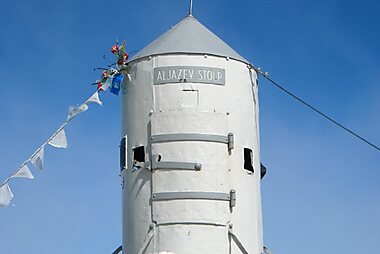
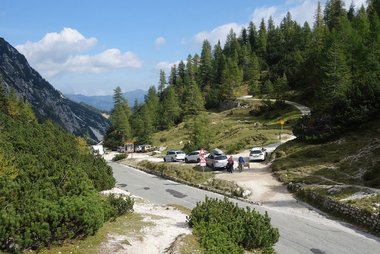
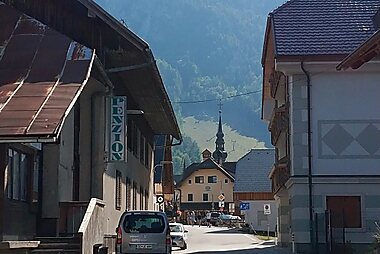
Vršič Pass is the highest road pass in Slovenia, at 1,611 m. The road climbs from Kranjska Gora in a series of numbered hairpin bends, with 50 in total on both sides, and continues down into the Trenta valley. At the top there are mountain huts and wide views of the peaks.
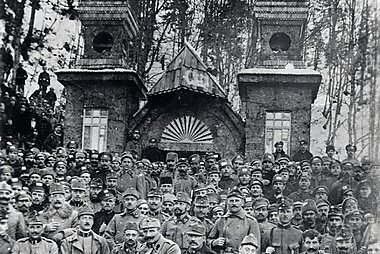
Russian Chapel is a small wooden Orthodox chapel on the way up to the pass. Russian prisoners of war built it during the First World War, and it is now a memorial to the men who died building the road.
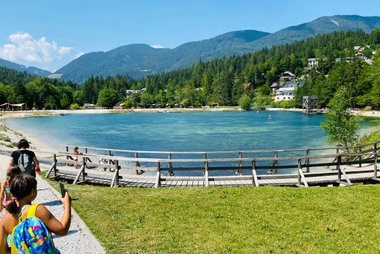
Lake Jasna lies at the southern edge of the village, where the Vršič road begins. A short path circles the two green lakes, and a bronze statue of an ibex stands on a rock by the shore.
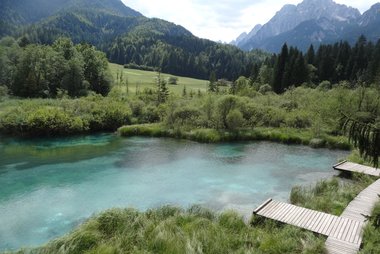
Nature Reserve Zelenci is a protected wetland west of the village, between Podkoren and Rateče. A short, flat boardwalk leads to a small, deep green spring lake that is the source of the Sava Dolinka river, and to a wooden observation tower.
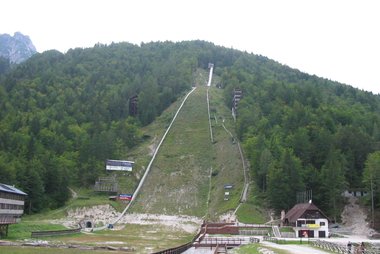
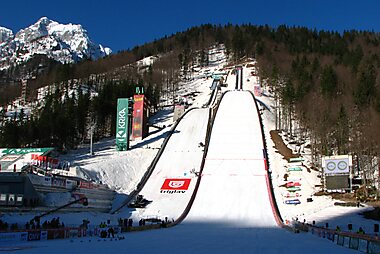
Planica Nordic Centre lies in the Planica valley near Rateče, below the steep walls of the Ponce mountains. Its giant ski-flying hill is one of the largest in the world. Outside competition days you can visit the centre, see the hills up close and, in season, ride the steep zip line beside them.
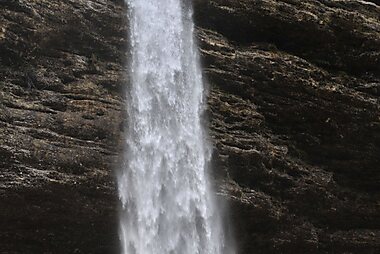
Peričnik is a two-step waterfall in the Vrata valley above Mojstrana. The lower fall drops about 50 m, and a path leads behind the curtain of water. The rocks there are wet and slippery.
Liznjek House is an 18th-century farmhouse in the centre of the village, now a small museum. Its rooms, cellar and barn show how a wealthy farming family lived in the 19th century.
In Gozd Martuljek, a marked trail leads up a narrow gorge to the Martuljek waterfalls, below the jagged peaks of Martuljške gore. The lower fall is an easy walk; the upper one needs a longer, steeper hike.
Aanbevolen lijsten

Kranjska Gora's Alpine Essentials
Located in the Julian Alps near the borders of Austria and Italy, Kranjska Gora features the Vršič Pass, Slovenia's highest mountain road with 50 hairpin turns. The area is home to the Planica Nordic Centre, a premier site for ski jumping and flying world records. Natural highlights include the emerald waters of Lake Jasna, the Peričnik Falls in Triglav National Park, and the Zelenci Nature Reserve, the source of the Sava Dolinka River. Cultural sites like the Russian Chapel commemorate the region's history during World War I.
10 plaatsen


Religious Sites of Interest
This collection features historically significant religious architecture across the Kranjska Gora region, ranging from the 16th-century Gothic Church of the Assumption to the Russian Chapel on the Vršič Pass, built by prisoners of war during World War I. The list includes remote mountain sites like the Aljaž Chapel in the Vrata Valley and the high-altitude chapel at Kredarica, showcasing a mix of Roman Catholic and Orthodox traditions set against the backdrop of the Julian Alps.
13 plaatsen
Ski Resorts and Lifts
This collection highlights the winter sports infrastructure of Kranjska Gora, Slovenia's oldest ski resort, established in 1948. It features the Planica Nordic Centre, home to the Letalnica bratov Gorišek ski flying hill and the historic Bloudkova velikanka. The network includes chair lifts, poma lifts, and T-bars serving the diverse terrain between Podkoren and the Vitranc slopes. These facilities support international competitions like the Vitranc Cup and provide access to slopes ranging from beginner practice areas to FIS-standard racing runs.
47 plaatsen
Wat te beleven
Most experiences here are outdoors and depend on the season.
- Watch the ski flyers in Planica: In late March, crowds gather below the giant hill to watch jumpers fly well over 200 m. The atmosphere is like a large outdoor festival.
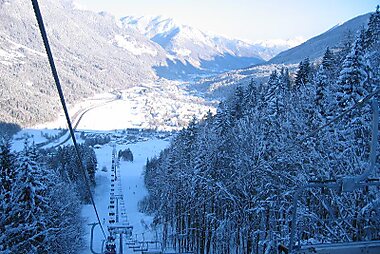
- Ski the World Cup slopes: Kranjska Gora Ski Resort spreads above the village and Podkoren and hosts alpine World Cup races. Many of its runs are of medium difficulty, and there are gentle slopes for beginners.
- Drive or ride over Vršič at dawn: Start early to avoid the traffic, count the numbered hairpin bends and stop at the Russian Chapel on the way up.
- Cycle across the border: Follow the D-2 cycle path west to Rateče and on into Italy for coffee in Tarvisio or a walk around the Fusine Lakes.
- Hike up to a mountain hut: Walk up the Tamar valley or to a hut near Vršič for a simple lunch with a view of the north faces of the Julian Alps.
Tours en activiteiten
Kranjska Gora — Kaart

Dagtochten
Kranjska Gora sits where three countries meet, so lakes, mountain roads and towns in Slovenia, Italy and Austria are all close by.
- Fusine Lakes (Italy): about 20 minutes by car, or an easy bike ride. Two calm mountain lakes below the Mangart peak, with easy paths around both.
- Tarvisio (Italy): about 20 minutes by car. A small border town with shops and cafés, and an easy ride along the cycle path from Rateče.
- Bled: about 45 minutes by car. The famous lake with its island church and castle on a cliff.
- Villach (Austria): about 40 minutes by car. A historic Carinthian town on the Drava river, reached through the Karawanks tunnel or over the steep Wurzen Pass.
- Bovec: about 1.5 hours over the Vršič Pass in summer. The road drops into the Soča valley, known for its turquoise river, rafting and First World War history.
Plaatsen om te ontdekken
Kranjska Gora is part of Upper Carniola, the Alpine north-west of Slovenia.
- Mountains and national park: Triglav National Park covers the peaks south of the village, and Martuljške gore is the jagged range above Gozd Martuljek.
- Lakes: Bled and Bohinj are the region's two famous lakes, both easy to reach by car.
- Historic towns: Radovljica and Kranj have compact old centres further down the valley.
Bereikbaarheid
- By air: Ljubljana Jože Pučnik Airport is about 66 km away, roughly 45 minutes by car. Klagenfurt Airport in Austria is about 40 minutes away, and Trieste Airport in Italy about an hour. Shared shuttle services run from the airports.
- By train: There is no railway in the valley. The nearest station is Jesenice, on the line from Ljubljana to Austria. From there, Arriva buses reach Kranjska Gora in about 30 minutes. Slovenian Railways
- By bus: Direct buses run from Ljubljana bus station via Kranj and Jesenice. Arriva Slovenia
- By car: The village is a short drive from motorways in all three countries: the Karawanks tunnel to Austria, Tarvisio in Italy, and the Slovenian motorway at Jesenice.
Vervoer ter plaatse
- On foot: The village centre is small and flat, and Lake Jasna is about a 20-minute walk away. Other sights are spread along the valley, several kilometres apart.
- Buses: Regional buses run along the valley between Mojstrana, Gozd Martuljek, Kranjska Gora, Podkoren and Rateče. At stops without a ticket office, pay the driver on board in cash. Arriva Slovenia
- Vršič bus: In summer, a free bus crosses the Vršič Pass between Kranjska Gora and Bovec. Visitors are asked to leave cars in the valley and use it.
- Cycling: The paved D-2 cycle path follows a former railway line along the whole valley, from Jesenice to the Rateče border crossing, and continues into Italy. Bike and e-bike rental is easy to find in the village.
- Tourist information: Kranjska Gora tourist board
Autorijden
- Is a car worth it?: Useful but not essential. Buses and the cycle path cover the valley, and a free summer bus crosses Vršič. A car helps for early starts, trailheads and trips across the borders.
- Parking: There are paid car parks around the village and at the main sights. Pay by text message, app or meter; the meters take cards only. Kranjska Gora parking
- Vršič road: The road is narrow, with tight cobbled hairpins on the northern side, and is closed by snow for much of the winter. A barrier at the foot of the pass controls traffic in summer, and parking near the top is limited.
- Wurzen Pass: The road over the Wurzen Pass (Korensko sedlo) to Austria has gradients of up to 18%. With a caravan or trailer, the Karawanks tunnel is the easier route.
Eten en drinken
Food in Kranjska Gora is hearty mountain cooking. Look for Carniolan sausage, štruklji (rolled dumplings with cottage cheese), buckwheat dishes, mushroom soups and fresh trout. Thick stews such as jota (beans and sauerkraut) are typical on cold days and at mountain huts.
Most restaurants and traditional inns (gostilna) are along the main street and around the old farmhouses in the village centre. Some of the most memorable meals are at the mountain huts on the Vršič road and in the Tamar valley, where simple dishes come with a view of the peaks.
Veiligheid en gezondheid
Kranjska Gora is very safe, and crime against visitors is rare. Do not leave valuables visible in cars at trailheads and busy car parks.
The real risks are in the mountains. Weather changes quickly, and summer afternoons often bring storms, so start hikes early. Many trails above the valley are steep and rocky, and higher routes need proper boots and experience. Snow can stay on high paths into early summer. In winter, ski only on marked runs, and check the avalanche warning before going off-piste. Tap water is safe to drink.
Geschiedenis
For centuries the upper Sava valley was a farming area on the route between Carniola and Carinthia. Liznjek House still shows how a wealthy farming family lived here.
In the 19th century, climbers began to explore the peaks. Jakob Aljaž, the parish priest of nearby Dovje, built the Aljaž Tower on the summit of Triglav in 1895. He also built the first path to Peričnik in the same year. Today Jakob Aljaž Monument in Dovje honours him.
During the First World War, the Austro-Hungarian army built a road over the Vršič Pass to supply the front on the Soča river. Thousands of Russian prisoners of war were forced to build it. In March 1916 an avalanche buried their camp and killed many of them. The prisoners also built the Russian Chapel, now a memorial to the dead, and the route is still called the Russian Road.
Winter sport arrived in the 1930s. The large ski jump in Planica opened in 1934, and in 1936 Sepp Bradl became the first person to jump over 100 m there. In 1948 the first ski lift in Slovenia opened in Kranjska Gora, and alpine World Cup races have been held here since 1968.
Feiten over het land
Quick practical facts for Slovenia at a glance:
- Valuta
- Euro EUR · Betalen met kaart · Algemeen geaccepteerd
- Noodnummers
- 112
- Elektriciteit
- 230 V · 50 HzType C / Type F
- Talen
- Sloveens
- Kraanwater
- Veilig om te drinken
- Rijrichting
- Rechts
- Landnummer
- +386


Kranjska Gora – Plan je dagen
Zet de plaatsen uit deze gids om in een echte reisroute, met slimme routes, tijdsinschattingen en alles wat je nodig hebt voor een perfecte reis.


Gerelateerde bestemmingen



Data: © OpenStreetMap contributors, Wikidata, Wikipedia, Tripomatic, Official websites, geoBoundaries (CC BY 4.0). Tours by GetYourGuide. We earn commission from bookings. Travel guide generated with AI.
Plan je reis met Tripomatic
- Plannen met AIKrijg met één tik een kant-en-klare dag, laat AI je verlanglijst over je reis verdelen of plan alles via de chat.
- ReiswaarschuwingenOfficiële reisadviezen, noodweer, stakingen en natuurrampen voor de plaatsen op elke dag van je reis.
- Feestdagen en evenementenBekijk feestdagen, festivals en sluitingen op de dagen van je reis en wat ze betekenen voor je plannen.
- KostenramingDoor AI berekende reiskostenoverzichten, zodat je vooraf weet welk budget je nodig hebt.
- Tours en ticketsBoek tours, skip-the-line tickets en activiteiten direct in je reisplan.