


Montalcino
Montalcino is a small walled hill town in southern Tuscany, high above the Val d'Orcia and the Ombrone valley. A fortress crowns the top of the hill, and steep lanes lead down past stone houses and churches. From the walls, you look over vineyards, olive groves and woods in every direction.
The town is the home of Brunello di Montalcino, one of Italy's most famous red wines, and wine shops and tasting rooms line its streets. A visit suits travellers who enjoy wine, quiet villages and country drives. Montalcino is also a good base for the Val d'Orcia, a UNESCO World Heritage landscape, and for the Romanesque abbey of Sant'Antimo in the valley below.

Montalcino – Planlegger du en reise?
Bygg reiseplanen din dag for dag i Tripomatic-appen.


Beste reisetidspunkt
Late spring and early autumn are the best times, with warm days and green or harvest-coloured hills. In July and August, afternoons are hot, but the town's height brings cooler evenings. Winter is cold for Tuscany at this height, with frosty nights and occasional snow, and some shops and restaurants close or keep shorter hours.
The biggest annual event is the Sagra del Tordo, held on the last weekend of October. The four town quarters compete in an archery contest near the fortress, and a parade in medieval costume fills the streets. The festival falls just after the grape harvest, so food and wine stalls add to the atmosphere.
Beste tid å besøke: mai, juni, juli, september, oktober
Hovedseverdigheter


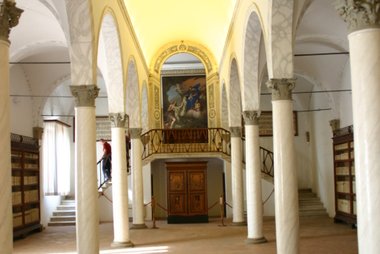
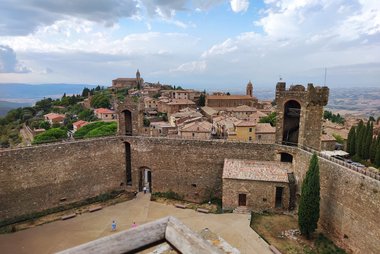
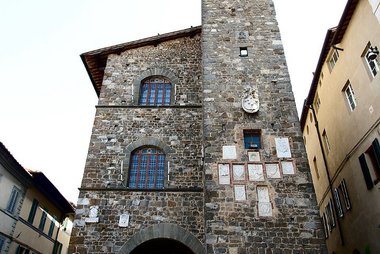

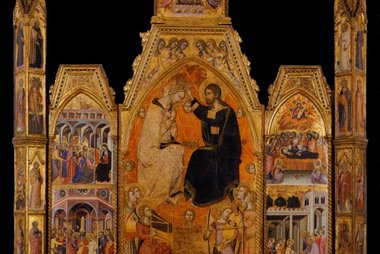

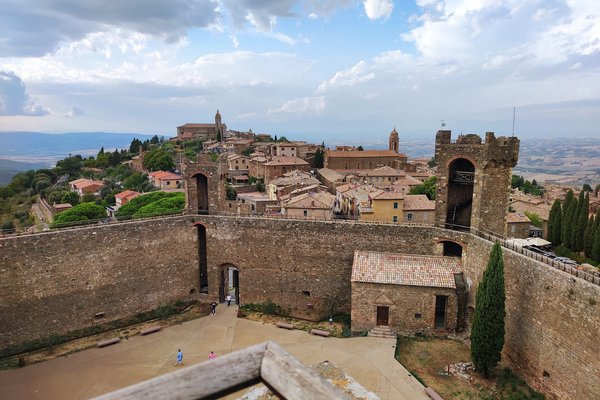
Fortezza di Montalcino stands at the top of town. The Sienese built this five-sided fortress in the 14th century, and a walkway runs along its walls with wide views over the countryside.
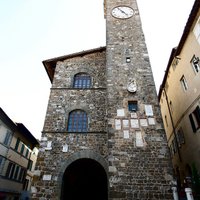
Palazzo dei Priori is the medieval former town hall on Piazza del Popolo, the small main square. Its very tall, slender tower rises above an open loggia, and the facade carries the coats of arms of old governors.
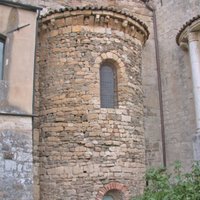
Abbey of Sant'Antimo lies about 10 km south of town, in a quiet valley of olive groves. This former Benedictine abbey church, built in pale stone in the 12th century, is a famous example of Tuscan Romanesque architecture. It is still home to a small community of monks.
Museo Civico e Diocesano d'Arte Sacra e Raccolta Archeologica fills part of the former convent of Sant'Agostino. It holds Sienese paintings and wooden sculptures, including works by Simone Martini and Ambrogio Lorenzetti, plus local archaeological finds. The same ticket covers the Tempio del Brunello, a multimedia exhibition about the town's wine.
Chiesa di Sant'Agostino, next to the museum, is a simple Gothic church with a rose window. Inside, its walls are covered with frescoes by Sienese painters of the 14th and 15th centuries.
Cattedrale di San Salvatore is the town's cathedral. It was rebuilt in Neoclassical style in the 19th century, with a tall porch of six columns, and it holds paintings by Francesco Vanni.
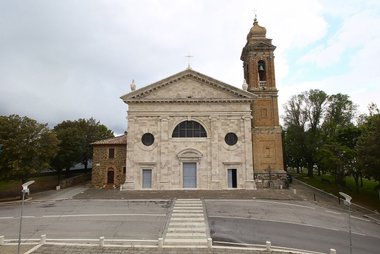
Chiesa della Madonna del Soccorso is the sanctuary of the town's patron, at the northern edge of the old town. The church has a Baroque interior and a Neoclassical facade.
Utvalgte lister
Opplevelser verdt å få med seg
The best moments here come from the town's festivals, its countryside and its wine estates.
- Join the Sagra del Tordo: on the last weekend of October, watch the archers of the four quarters compete and the costume parade wind through the streets.
- Walk the fortress ramparts: climb onto the walls of Fortezza di Montalcino in the late afternoon, when the low light shows the hills and vineyards at their best.
- Tour a wine estate: many Brunello producers around town offer cellar visits and tastings by reservation. Book a few days ahead, especially at weekends.
- Walk from Montalcino to Sant'Antimo: a footpath of about 8.4 km leads mostly downhill to Abbey of Sant'Antimo, and takes about 2 hours one way. The climb back is hard, so arrange a taxi for the return.
- Watch the harvest: in September and October, you can see grapes being picked by hand on the hills around town.
Turer og aktiviteter
Montalcino – Kart

Dagsturer
Montalcino is surrounded by famous Tuscan countryside. A car is almost essential, because buses between the villages are rare.
- Sant'Angelo in Colle — ≈15 min by car. A tiny medieval village south of Montalcino, surrounded by vineyards, with wide views towards Monte Amiata.
- San Quirico d'Orcia — ≈20 min by car. A quiet town on the old Via Francigena pilgrim route, with Renaissance gardens and a Romanesque church. The famous circle of cypress trees stands beside the road on the way.
- Bagno Vignoni — ≈20 min by car. A small spa village whose main square is a large pool of steaming thermal water.
- Abbey of Monte Oliveto Maggiore — ≈35–40 min by car. A large brick monastery in the clay hills, known for its cloister frescoed with the life of Saint Benedict.
- Pienza — ≈25 min by car. A small Renaissance town planned by Pope Pius II, famous for its views and its pecorino cheese.
- Montepulciano — ≈40 min by car. A hill town of Renaissance palaces and old wine cellars, home of Vino Nobile red wine.
- Siena — ≈45 min by car. The bus takes longer, so check the timetable. The great Gothic city of the Campo square and the Duomo.
Steder å utforske
Montalcino pairs well with other classic stops in southern Tuscany.
- Nearby hill towns: Pienza and Montepulciano, and further east Cortona.
- Further afield: San Gimignano, Volterra and the Chianti town of Greve in Chianti.
- Cities: Siena and Florence.
Reise dit
Montalcino stands on a hilltop with no railway. Most visitors arrive by car, and a car also makes it easy to explore the area.
- By air: Florence Airport (FLR) is the most convenient, about 1 hour 40 minutes by car. Pisa Airport (PSA) is about 2 hours away, and Rome Fiumicino (FCO) about 2.5 hours.
- By train: there is no station in town. The nearest useful station is Buonconvento, about 15 minutes away by car, on the regional line from Siena towards Grosseto. From the station, continue the last 14 km to town by Autolinee Toscane bus (line 114, check the timetable) or by taxi. Book trains on Trenitalia. Trenitalia
- By bus: Autolinee Toscane buses run from Siena to Montalcino, via Buonconvento, in roughly 1.5 hours. Check the timetable and the last bus back, as services are thinner on Sundays and holidays. Autolinee Toscane
- By car: from Siena, take the SR2 Via Cassia south and turn off at Buonconvento or Torrenieri. The drive takes about 45 minutes.
Komme seg rundt
- On foot: the old town is small, and you can cross it in about 15 minutes. The lanes are steep and paved with stone, with many steps.
- Buses: Autolinee Toscane buses link Montalcino with Buonconvento, Torrenieri and Siena, but services to the villages and wine estates are infrequent. You can pay on board by tapping a contactless bank card or phone; on these regional buses, tap when you get on and again when you get off. Tickets are also available in the at bus app. Autolinee Toscane
- Taxi and transfers: there are only a few local taxis, so book ahead, especially if you plan to visit wineries and drink.
- Cycling: the town is too steep for casual cycling. The hilly country roads suit fit road cyclists and e-bike tours.
Kjøring
- Is a car worth it? Yes. A car is the easiest way to reach Montalcino and to explore the Val d'Orcia and its wineries. You will not need it inside the walls.
- Restrictions: the historic centre is a limited traffic zone (ZTL). Only authorised vehicles may enter, and camera fines are sent automatically. If your hotel is inside the walls, ask it to register your plate.
- Parking: use the paid car parks just outside the walls, for example below the fortress or near the Madonna del Soccorso church. Pay at the machines. They fill quickly on summer weekends and during festivals.
Mat og drikke
Montalcino is above all a wine town. Brunello di Montalcino is a red wine made only from Sangiovese grapes, and it must age for at least five years, two of them in wood, before it goes on sale. In 1980, it was one of the first Italian wines to receive DOCG status. The younger Rosso di Montalcino is cheaper and ready to drink sooner. Local menus feature thick hand-rolled pici pasta, wild boar, pecorino cheese and, in autumn, mushrooms and truffles from the woods.
For a tasting in town, the many enoteche on the streets near Piazza del Popolo pour Brunello by the glass. For the history of the wine, visit Biondi Santi, the estate where Brunello was first made in the 19th century, or Castello Banfi, a large estate around a medieval castle. Estate visits usually need a booking. For a long lunch, the farm restaurants in the countryside and the village of Sant'Angelo in Colle are good choices.
Sikkerhet og helse
Montalcino is very safe, and crime against visitors is rare. The main nuisances are summer crowds and the occasional pickpocket in busy spots, so keep an eye on bags and phones.
The streets are steep and paved with stone, so wear good shoes and carry water on hot days. If you plan to taste wine, do not drive afterwards. Italian drink-driving limits are strict, so book a driver or a tour instead.
Historie
Montalcino grew up in the Middle Ages on a hill above the old road to Rome. For centuries it was disputed between Siena and Florence, and from the 13th century it came firmly under Siena. In the 14th century, the Sienese built Fortezza di Montalcino at the top of the hill.
The town's most famous moment came in the 16th century. After Siena fell to Florence and Spain in 1555, Sienese exiles moved to Montalcino and kept the Republic of Siena alive here for four more years. It finally surrendered in 1559, and the town passed to the Medici rulers of Florence. A statue of Cosimo I de' Medici in the loggia of Palazzo dei Priori still marks the change.
For a long time, Montalcino was a poor farming town. That changed with wine. In the 19th century, the Santi family selected a local Sangiovese grape and made the first Brunello at their estate, Biondi Santi. After the Second World War, more producers began to make Brunello, and the wine brought wealth and fame to the town.
Fakta om landet
Quick practical facts for Italy at a glance:
- Valuta
- euro EUR € · Kortbetaling · Allment akseptert
- Nødnumre
- 112
- Elektrisitet
- 230 V · 50 HzType C / Type F / Type L
- Språk
- italiensk
- Kranvann
- Trygt å drikke
- Kjøreside
- Høyre
- Retningsnummer
- +39
Montalcino – Planlegg dagene dine
Gjør stedene fra denne guiden om til en ordentlig reiseplan, med smart ruteberegning, tidsestimater og alt du trenger for en perfekt reise.


Lignende destinasjoner



Data: © OpenStreetMap contributors, Wikidata, Wikipedia, Tripomatic, Official websites, geoBoundaries (CC BY 4.0). Tours by GetYourGuide. We earn commission from bookings. Travel guide generated with AI.
Planlegg reisen din med Tripomatic
- AI-drevet planleggingLa AI bygge reiseplanen din, svare på reisespørsmål og legge inn bestillingsdokumentene dine i reisen.
- ReisevarslerOffisielle reiseråd, ekstremvær, streiker og naturfarer for stedene på hver dag av reisen din.
- Helligdager og arrangementerSe høytidsdager, festivaler og stengte dager under reisen din, og hva de betyr for planene dine.
- KostnadsberegningAI-drevne kostnadsoverslag for reisen, slik at du har oversikt over budsjettet før du drar.
- Turer og billetterBestill turer, forbi-køen-billetter og aktiviteter direkte i reiseplanen din.