


Polignano a Mare
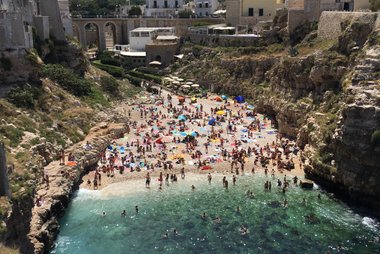
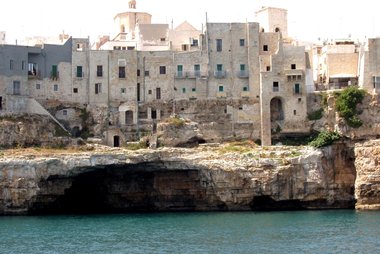
Polignano a Mare is a small town on the Adriatic coast of Apulia, about 35 km south-east of Bari. Its whitewashed old town sits on top of limestone cliffs, and the sea has cut deep caves into the rock below. The tiny pebble cove between two cliffs, seen from the bridge above, is the town's famous postcard view.
The town suits a short, relaxed stay: one or two nights for the cliffs, the terraces and the seafood, with easy trips to the trulli, the caves of Castellana and the white towns of the Itria Valley. It is also the hometown of the singer Domenico Modugno, famous for the song "Volare". Expect big crowds on summer weekends and a much quieter town from November to March.

Polignano a Mare – Planlegger du en reise?
Bygg reiseplanen din dag for dag i Tripomatic-appen.


Beste reisetidspunkt
May, June, September and early October are the best months: warm, sunny and good for swimming, with fewer crowds than in high summer. July and August are hot and very busy, especially at weekends, when the old town and the cove fill up. Winter is mild but often wet and windy, and some restaurants and boat trips close.
The biggest local event is the Feast of San Vito, the patron saint, in mid-June. The saint's relics arrive by sea on a decorated raft from the abbey of San Vito, followed by fishing boats, and land at Cala Paura. A procession through town and fireworks over the seafront follow.
Beste tid å besøke: mai, juni, juli, september, oktober
Hovedseverdigheter
Most sights are on the edge of the old town, within a few minutes' walk of each other.
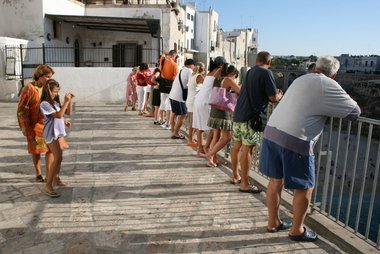
Lama Monachile is the small pebble cove at the end of a narrow inlet between high cliffs. Look down on it from the road bridge above, or walk down the steps for a swim. It has no facilities and gets very crowded on summer afternoons.
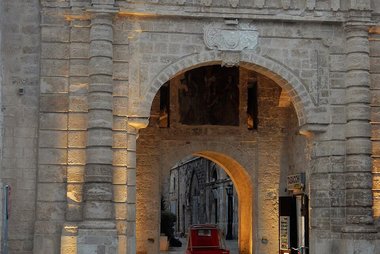
Porta Vecchia is the old arched gate from Piazza Garibaldi into the historic centre. Behind it, white lanes lead to small terraces built right on the cliff edge, with views over the sea and the caves.
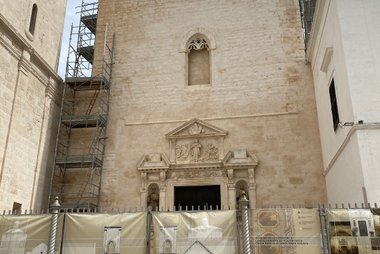
Chiesa Matrice Santa Maria Assunta stands on the main square of the old town. The church dates from the 13th century and was the town's cathedral until the 19th century.
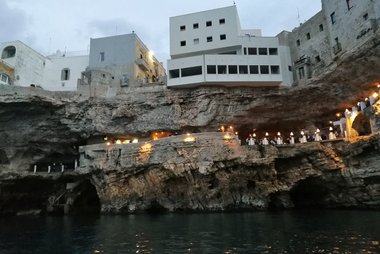
Grotta Palazzese is a large sea cave under the cliffs. In summer it holds a restaurant inside the cave, open only to guests with a booking. You can also see it from the sea on a boat trip.
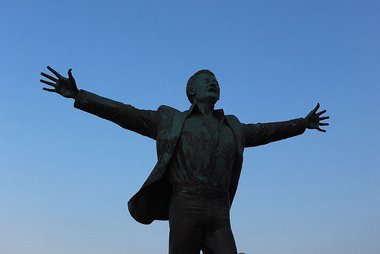
Monumento a Domenico Modugno stands on the seafront promenade north of the old town. The bronze statue shows the singer with his arms open towards the sea.
Museo Pino Pascali (Ex Macello) shows contemporary art in a former slaughterhouse on the seafront. The museum honours Pino Pascali, an important Italian sculptor of the 1960s who grew up in Polignano.
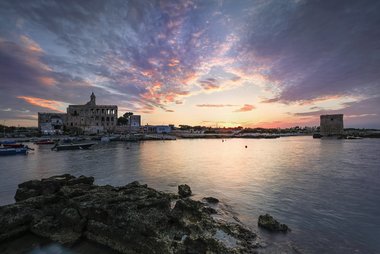
Complesso monastico Abbazia di San Vito is a quiet abbey complex beside a tiny fishing harbour, about 3 km north-west of the centre. It is a popular spot at sunset.
Utvalgte lister

Polignano a Mare: Absolute Must-Sees
Polignano a Mare is defined by its limestone cliffs and the deep inlet of Lama Monachile. This selection covers the cove and the bridge above it, the cliff-top terraces of the old town, the famous Grotta Palazzese sea cave, the Chiesa Matrice and the statue of singer Domenico Modugno, plus the seaside Abbey of San Vito and the Pino Pascali contemporary art museum.
12 steder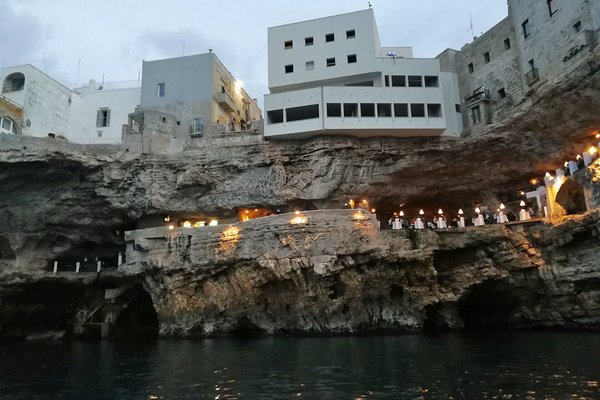

Coastal Viewpoints and Caves
Polignano a Mare is built upon 20-meter-high limestone cliffs, carved by the Adriatic Sea into a complex network of over 70 sea caves and natural arches. This selection features the town’s iconic 'balconate' (balconies), including the famous vantage points overlooking the Roman-era bridge at Lama Monachile and the expansive Piazza Ardito. These locations highlight the karst geology of the Apulian coast and provide direct views of the white-washed historic center perched over the water.
12 stederOpplevelser verdt å få med seg
Life in Polignano is centred on the sea and the cliffs.
- See the sea caves by boat: a boat trip along the cliffs is the best way to understand the town. Boats go into or past several caves, including the one under the old town, and many trips stop for a swim.
- Watch cliff diving: Polignano regularly hosts a stop of the Red Bull Cliff Diving World Series, with athletes diving into the cove from a high platform. Local young people also jump from the rocks on summer days. Do not jump yourself unless you know the depth and currents.
- Swim from the rocks: away from the crowded cove, locals swim from the flat rocks along the coast north of the old town, near Cala Paura.
- Sunset at San Vito: drive or cycle to Complesso monastico Abbazia di San Vito at sunset, when the small harbour is at its quietest.
- The evening passeggiata: on summer evenings the whole town walks along the cliff-top terraces and the seafront promenade after dinner.
Turer og aktiviteter
Polignano a Mare – Kart

Dagsturer
Polignano sits between the coast and the hills of central Apulia, so many good day trips are less than an hour away. A car makes most of them easier.
- Monopoli: about 5 to 10 minutes by train. A larger old town with an old harbour full of blue fishing boats, and good small beaches south of town.
- Conversano: about 20 minutes by car. A quiet hill town with a castle and a Romanesque cathedral.
- Castellana Caves: about 20 minutes by car. A large show cave with stalactites, visited on guided tours.
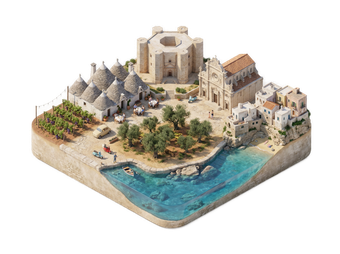
- Alberobello: about 30 minutes by car. The UNESCO town of trulli, the white houses with cone-shaped stone roofs.
- Bari: 25 to 45 minutes by train. The regional capital, with the Basilica of San Nicola and a lively old town.
- Ostuni: about 40 minutes by car. The "white town" on a hill above olive groves. Locorotondo and Cisternino in the Itria Valley make good stops on an inland route.
- Matera: about 1 hour 10 minutes by car. Famous for the Sassi, old cave houses carved into a ravine.
Steder å utforske
Polignano a Mare is on the Adriatic coast of Apulia, south of Bari.
- Nearby towns: Alberobello and its trulli are inland, and Ostuni is further down the coast. Matera lies just across the border in Basilicata.
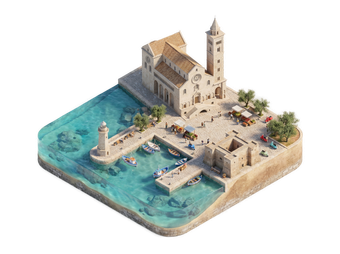
- Cities: Bari is the regional capital and main gateway. Trani has a cathedral right by the sea. To the south are Brindisi, the Province of Taranto and Lecce Province, home to Baroque Lecce.
- The Gargano in the north: the seaside towns of Vieste, Peschici and Vico del Gargano, and the Isole Tremiti offshore.
Reise dit
- By air: Bari Karol Wojtyła Airport is the closest, about 50 km away. Take the airport train (Ferrotramviaria, separate ticket) to Bari Centrale station (about 20 minutes), then a regional train to Polignano. By car or taxi it takes about 35 minutes. Brindisi Airport is about 80 km away, roughly 50 minutes by car.
- By train: Polignano a Mare is on the Adriatic railway between Bari and Lecce. Regional trains from Bari Centrale run often and take 25 to 45 minutes. The station is about 10 minutes' walk from the old town. Trenitalia
- By car: the coastal SS16 dual carriageway passes the town, with exits for Polignano. Bari is about 40 minutes away.
Komme seg rundt
- On foot: the old town, the cove and the seafront are close together and best explored on foot. The old town has some steps and uneven stone lanes.
- Public transport: you will not need buses within town. Use the train for Monopoli, Bari and other towns along the coast. Buy tickets in the Trenitalia app or at the station machines before you board, and validate paper tickets on the platform. Trenitalia
- Boat trips: in the warm months, small boats take visitors along the cliffs to see the sea caves from the water.
- Cycling: the coast road is fairly flat, and bikes and e-bikes can be rented locally, but summer traffic is heavy.
Kjøring
- Do you need a car? Not for Polignano itself, which is walkable and well served by trains to Bari and Monopoli. A car is very useful for the Itria Valley, Alberobello and the caves.
- Parking: use the paid car parks and blue-line street parking around the edge of the centre. Pay at the machines or the attendant. Yellow lines are for residents only. Spaces are hard to find on summer weekends, so arrive early.
- Restrictions: the old town behind the Arco Marchesale is a limited traffic zone (ZTL) with camera enforcement. Do not drive in unless your hotel has arranged a permit.
Mat og drikke
Seafood is the focus here. Look for crudo di mare (raw local fish and shellfish), octopus, and orecchiette pasta with turnip tops or fish sauces. Apulian street food is also easy to find: panzerotti (fried pastries filled with tomato and mozzarella), focaccia barese and taralli.
Polignano has its own coffee drink, the caffè speciale: espresso with lemon zest, sugar, cream and a dash of amaretto. It was created at the bar of the Campanella family, Il Super Mago del Gelo, near Piazza Garibaldi, which also sells gelato. Pescaria, a seafood sandwich shop that started here and is now known across Italy, has long queues in summer. For a sit-down dinner, the restaurants in the old town lanes and along the cliff terraces have the best views. Book ahead on summer weekends.
Sikkerhet og helse
Polignano is a safe town. The main risks are crowds and the sea, not crime.
- Crowds: on summer weekends the old town and the cove get very busy. Keep an eye on bags and phones in crowded spots.
- Sea and cliffs: do not jump or dive from the cliffs unless you know the depth and the currents. The water near the cliffs gets deep quickly, and the sea can be rough when the wind blows from the north. Stay away from the foot of the cliffs, where rocks sometimes fall.
- Sun: there is little shade on the rocks and the pebble beach. Bring water, a hat and sun cream, and water shoes for the rocks.
Historie
The old town grew on a limestone spur above the sea, protected by cliffs on three sides. The main route into it on land was through Porta Vecchia, which still leads into the maze of lanes today. The ancient Roman road Via Traiana, which connected Rome to Brindisi, crossed the inlet at Lama Monachile.
In the Middle Ages Polignano was a bishop's seat, and Chiesa Matrice Santa Maria Assunta served as its cathedral. Tradition says that the relics of Saint Vitus came here by sea, and the Benedictine monks of Complesso monastico Abbazia di San Vito kept them on the coast north of town. Coastal towers such as Torre Incina were built later to watch for pirate raids.
In the 20th century the town gave Italy two famous names: the singer Domenico Modugno, born here in 1928, and the artist Pino Pascali, who grew up here. Their memory lives on in the statue on the seafront and in Museo Pino Pascali (Ex Macello).
Fakta om landet
Quick practical facts for Italy at a glance:
- Valuta
- euro EUR € · Kortbetaling · Allment akseptert
- Nødnumre
- 112
- Elektrisitet
- 230 V · 50 HzType C / Type F / Type L
- Språk
- italiensk
- Kranvann
- Trygt å drikke
- Kjøreside
- Høyre
- Retningsnummer
- +39


Polignano a Mare – Planlegg dagene dine
Gjør stedene fra denne guiden om til en ordentlig reiseplan, med smart ruteberegning, tidsestimater og alt du trenger for en perfekt reise.


Lignende destinasjoner

Data: © OpenStreetMap contributors, Wikidata, Wikipedia, Tripomatic, Official websites, geoBoundaries (CC BY 4.0). Tours by GetYourGuide. We earn commission from bookings. Travel guide generated with AI.
Planlegg reisen din med Tripomatic
- AI-drevet planleggingLa AI bygge reiseplanen din, svare på reisespørsmål og legge inn bestillingsdokumentene dine i reisen.
- ReisevarslerOffisielle reiseråd, ekstremvær, streiker og naturfarer for stedene på hver dag av reisen din.
- Helligdager og arrangementerSe høytidsdager, festivaler og stengte dager under reisen din, og hva de betyr for planene dine.
- KostnadsberegningAI-drevne kostnadsoverslag for reisen, slik at du har oversikt over budsjettet før du drar.
- Turer og billetterBestill turer, forbi-køen-billetter og aktiviteter direkte i reiseplanen din.