


České Budějovice
České Budějovice is the largest city in South Bohemia and the region's main hub. King Přemysl Otakar II founded it in 1265 as a royal town, and its street grid still centers on a huge arcaded square. The city is best known worldwide as the home of Budweiser Budvar beer.
For visitors it works well as a calm, low-key base. The old town is small, flat, and easy to walk. From here you can reach a famous château, a UNESCO village, and the town of Český Krumlov on easy day trips.

České Budějovice – A planear uma viagem?
Cria o teu itinerário dia a dia na app Tripomatic.
Quando visitar
The best window is late spring to early autumn, roughly May through September. Summer days are warm but rarely uncomfortable, and evenings on the square are pleasant. Winter is cold with frequent frost, though the Advent market on the main square brings it to life.
The city's biggest annual event is Země živitelka, a large agricultural fair held at the exhibition grounds in late August. For a quieter trip, come in June or September.
Melhor altura para visitar: agosto, setembro
Principais atrações
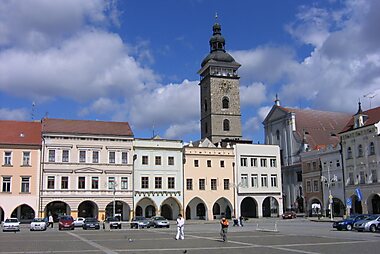
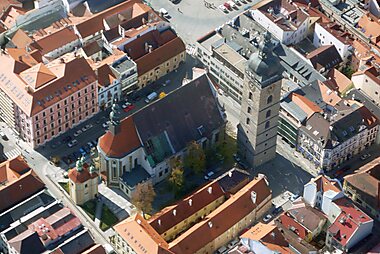



Náměstí Přemysla Otakara II is the heart of the city and one of the largest squares in Central Europe, ringed by arcaded townhouses and a Baroque town hall.
At its center stands Samsonova kašna, a large Baroque fountain from the 1720s that once supplied the city's water.
Černá věž is the tall Renaissance bell tower beside the square; climb its steps for a wide view over the old town.
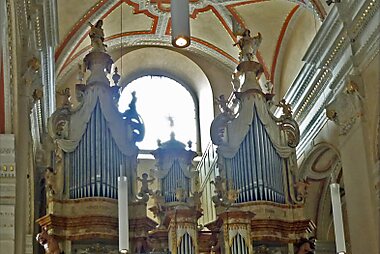
Next to it, Katedrála svatého Mikuláše is the city's Baroque cathedral, paired with that free-standing tower.
Obětování Panny Marie stands on Piarist Square and belongs to the former Dominican monastery, the oldest building complex in the city.
Železná panna is a stout tower left from the medieval walls that later served as a prison.
Rabenštejnská věž is another surviving fortification tower, tucked into the streets on the northern edge of the old town.
Listas em destaque


Guias áudio – České Budějovice
Explora a pé com um passeio áudio autoguiado que narra cada paragem à medida que chegas.


Ouve os passeios áudio de České Budějovice
1 passeio na aplicação Guias de Áudio Tripomatic


O que experienciar
České Budějovice rewards slow, local moments. A few to try:
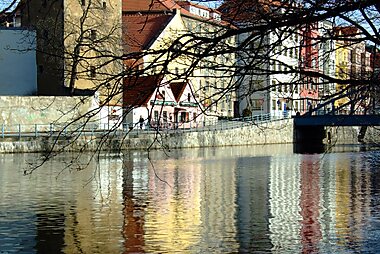
- Take a paddleboat or small boat onto the Vltava and Malše rivers in summer, right beside the old town.
- Find the bludný kámen, a marked stone set into the main square. Local legend says anyone who steps on it after 10 p.m. will wander the streets lost until dawn.
- Browse the Advent market stalls on the main square through December.
- Walk or cycle the riverside greenery of Stromovka and follow the Vltava path out of town.
Excursões e atividades
České Budějovice — Mapa

 Abrir o mapa interativo
 Passeios de um dia
Most of the region's sights are close, so day trips are easy. A few worth the ride:
- Hluboká nad Vltavou — about 10 km north, 15–20 min by train or bus. A white neo-Gothic château modeled on England's Windsor Castle, with gardens and a gallery.
- Holašovice — about 15 km west, roughly 25 min by car. A UNESCO-listed village of preserved rural Baroque farmhouses set around a pond.
- Český Krumlov — about 25 km south, 45 min by bus. A UNESCO old town wrapped in a river bend below a large castle.
- Třeboň — about 25 km east, roughly 30 min by bus. A Renaissance spa town among historic fishponds, good for walking and cycling.
Como chegar
- By air: There is no airport with scheduled service in the city. Most visitors fly into Prague (airport code PRG, about 150 km away) and continue by train or bus in roughly 2 to 2.5 hours. Vienna and Linz airports are alternatives from the south.
- By train: Direct trains run from Prague in about 2 to 2.5 hours. The city also sits on the line to Linz in Austria, with links to Plzeň. Trains are run by Czech Railways.
- By bus: Frequent coaches serve Prague (about 2.5 hours) and there is a quick, popular link to Český Krumlov (about 45 min).
Como se deslocar
- Public transit: City buses and trolleybuses are run by DPMČB. Buy single tickets from the driver, from ticket machines, or through the transit app. For most visitors the center is small enough that you will rarely need them. Official info: DPMČB. National trains: Czech Railways.
- On foot: The historic core is compact and flat, so almost everything is a short walk.
- Cycling: Flat ground and riverside paths make cycling easy, including the route north toward Hluboká.
Conduzir
- Is a car worth it? Not for the city itself, which is easily walkable. A car mainly helps for reaching Holašovice and smaller villages; Hluboká, Český Krumlov, and Třeboň are all simple by bus or train.
- Parking: Central streets are paid, zoned, and often full. It is easier to use a car park or park-and-ride at the edge of the center and walk in.
- Restrictions: The historic core has restricted and partly pedestrian access, so do not plan to drive up to the square.
Comida e bebida
South Bohemia is fish country, so look for carp and other freshwater fish, especially around Christmas. But the city's real specialty is beer. Budvar návštěvnické centrum is the home of Budweiser Budvar, and České Budějovice is the original "Budweiser" — the source of a long trademark dispute with the American brand. An older brewery, Budweiser Bürgerbräu, also brewed here.
Most of the good eating and drinking clusters in the arcades around the main square and the streets just off it. The historic Masné krámy, a former medieval meat market turned beer hall, is a local institution for hearty Czech food and Budvar on tap.
Segurança e saúde
České Budějovice is a calm, safe city, and crime affecting visitors is rare. Normal care with your belongings in crowds and around the train station is enough. Tap water is safe to drink, and there are no particular tourist scams to watch for.
História
The city was founded in 1265 by King Přemysl Otakar II as a royal town to anchor his power in the south. Its regular grid and the vast central Náměstí Přemysla Otakara II still follow that medieval plan.
Wealth came from the salt trade, silver, and later brewing. Černá věž and surviving gate towers like Železná panna recall the fortified town of that era.
In 1832 the region completed one of continental Europe's first horse-drawn railways, running from here toward Linz. Large-scale brewing followed, and Budweiser Budvar was founded in 1895.
Factos sobre o país
Quick practical facts for the Czech Republic at a glance:
- Moeda
- Coroa tcheca CZK Kč · Pagamentos com cartão · Geralmente aceite
- Números de emergência
- 112
- Eletricidade
- 230 V · 50 HzTipo C / Tipo E
- Idiomas
- tcheco
- Água da torneira
- Própria para beber
- Sentido de condução
- Direita
- Indicativo telefónico
- +420


České Budějovice – Planeia os teus dias
Transforma os lugares deste guia num verdadeiro itinerário, com rotas inteligentes, estimativas de tempo e tudo o que precisas para uma viagem perfeita.




