



Hungria
Hungary is a landlocked Central European country with a language unlike any of its neighbours, a thermal bath culture unique in Europe, and a capital — Budapest — that consistently ranks among the continent's most rewarding city breaks. Beyond the capital, the country offers UNESCO World Heritage sites, medieval castle towns, a vast grassy plain (puszta), and the wine-growing hills of Tokaj and Eger.
Most first-time visitors base themselves in Budapest and make day trips to nearby destinations. Those with more time discover real variety: the spa towns and summer beaches around Lake Balaton, the baroque streets of Sopron and Győr, and the layered Roman, Ottoman, and baroque history of Pécs in the south.



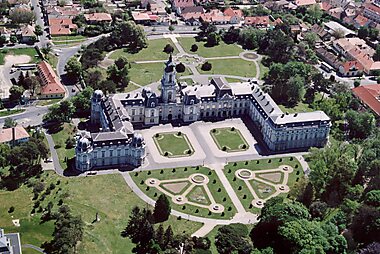
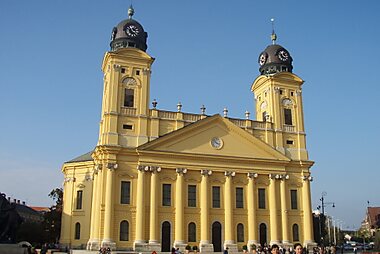
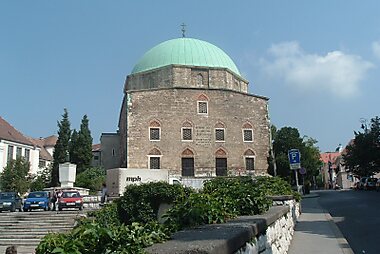
Hungria – A planear uma viagem?
Cria o teu itinerário dia a dia na app Tripomatic.


Dinheiro e pagamentos
Hungary uses the Hungarian Forint (HUF). Although Hungary is an EU member, it has not adopted the euro. Euros are occasionally accepted at tourist-facing businesses, but exchange rates are poor. ATMs (bankautomata) in cities give competitive rates; avoid exchange booths at Budapest airport and near major sights, which charge heavy margins.
Cash is still widely needed. Market stalls, some public transport, village shops, and smaller restaurants outside the capital often do not accept cards. Keep a float of forints on hand throughout your trip.
Listas em destaque


Thermal Baths & Water Parks
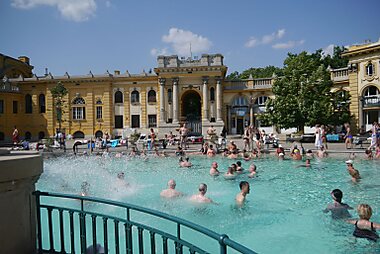
Hungary’s aquatic landscape ranges from historic thermal complexes in Budapest to modern adventure parks. This collection features the neo-baroque Széchenyi and Art Nouveau Gellért baths, alongside the natural cave pools of Miskolctapolca. Adventure seekers can explore Hajdúszoboszló’s extensive slide park or the Zemplén Kalandpark, home to the country’s longest chairlift. Notable features include the organic architecture of the Hagymatikum and traditional Turkish-style baths in Eger.
11 lugares

Excursões e atividades
Hungria — Mapa

 Abrir o mapa interativo
 Gorjetas
Tipping is expected in restaurants and cafés. The standard amount is around 10%. The local practice is to tell the server the total you wish to pay when settling the bill — not to leave coins on the table, which can be read as not wanting change back. Rounding up taxi fares is common. Tipping is not expected in fast food outlets or supermarkets.
10%
arredondar para cima
arredondar para cima
500–1000 HUF/dia
10–15%
Eletricidade
Hungary uses Type C and F (Schuko) plugs at 230 V / 50 Hz — standard European sockets. Most modern chargers and travel adapters work without modification.
Idioma
Hungarian (Magyar) is the sole official language. It belongs to the Finno-Ugric family and is unrelated to the languages of all its neighbours. Even a few basic words are genuinely appreciated by locals. English is widely spoken in Budapest, at tourist attractions, and in hotels throughout the country. German is common in western Hungary near the Austrian border. Outside cities and tourist areas, English coverage becomes patchy.
Segurança e emergências
Hungary is a safe destination for tourists. Pickpocketing is the main concern in Budapest, particularly on trams 4 and 6, around the central tourist zone, and at major sights. Keep bags close in crowds and on public transport. Scams targeting tourists — typically an invitation to a bar or club followed by an inflated bill — are reported in the Váci Street and ruin bar area; decline unsolicited invitations from strangers. Outside the capital, Hungary is low-risk.
Saúde
Tap water is safe to drink throughout Hungary, including in Budapest. Pharmacies (gyógyszertár) are plentiful and well stocked; staff often speak German or basic English. Standard hours are 08:00–18:00 on weekdays; each district has at least one 24-hour duty pharmacy (ügyelet). No vaccinations are specifically required for Hungary; routine immunisations should be up to date.
Vistos e entrada
Hungary is a member of the Schengen Area. Citizens of the EU, EEA, Switzerland, the United States, Canada, Australia, New Zealand, the United Kingdom, Japan, South Korea, and many other countries may enter without a visa for up to 90 days in any 180-day period.
Travellers from countries that require a Schengen visa must apply at the Hungarian embassy or consulate in their country of residence before travel.
Visa and entry requirements change frequently. Verify current requirements with the official immigration authority or your country's embassy before travel.
Etiqueta
Shake hands on first meeting; Hungarians tend to be formal in introductions. In traditional sit-down restaurants, wait to be seated rather than choosing a table yourself. When visiting churches or religious sites, dress modestly. Photography is acceptable in public spaces; ask permission inside museums or at private events. When paying a restaurant bill, state the total you want to pay to the server rather than leaving cash on the table — the latter can imply you do not want your change.
Feriados e horários de funcionamento
Public holidays bring closures to banks, government offices, and many smaller shops; large supermarkets and shopping centres typically stay open. 20 August (State Foundation Day) is a major national holiday with fireworks and extended closures. Easter weekend also sees widespread closures. Standard shop hours are 09:00–18:00 on weekdays and 09:00–14:00 on Saturdays; Sunday trading is restricted for large-format retailers, though shopping malls and supermarkets usually open.
Como se deslocar
- By train: MÁV (Magyar Államvasutak) is the national rail operator and Budapest is the central hub. Direct intercity services run to Debrecen, Pécs, Győr, Eger, and Miskolc. Seat reservations are compulsory on intercity (IC) trains. Book tickets and check timetables at MÁV — Hungarian State Railways.
- By bus: Volánbusz covers intercity and regional routes, useful for destinations with limited rail service and for the southern shore of Lake Balaton. FlixBus also serves several international and domestic routes via Budapest.
- By car: Hungary's motorway network is compact and efficient; a vignette is required (see driving). Renting a car is the practical choice for the Balaton shoreline, Tokaj wine region, and smaller castle towns.
- Within Budapest: Budapest's metro, trams, and buses are cheap and cover all tourist areas. Contactless bank card payment works on trams and buses; buy metro tickets at machines before boarding.
Conduzir
- Speed limits: 50 km/h in built-up areas, 90 km/h on rural roads, 110 km/h on dual carriageways, 130 km/h on motorways.
- Alcohol: Hungary enforces a zero-tolerance alcohol limit (0.00‰). Do not drive after consuming any alcohol.
- Motorway vignette: Motorways and expressways require an electronic vignette (e-matrica). Purchase online before travel at ematrica.nemzetiutdij.hu or at any petrol station on arrival. A 10-day vignette for a passenger car costs approximately 11,000–12,000 HUF (~€26–28); weekly and monthly options are also available. Driving without a valid vignette results in an on-the-spot fine.
- Required equipment: A warning triangle, reflective vest, and first aid kit must be carried in the vehicle.
- Winter tyres: Not legally required but strongly recommended from November to March.
- Parking: Paid blue-zone (kék zóna) street parking operates in city centres; pay at meters or via the ParkL app. Multi-storey car parks are available near major sights.
- Fuel: Stations are self-service; card payment at the pump is standard. Petrol is labelled 95-ös benzin (regular) or 98-as benzin (premium); diesel is gázolaj.
- EVs: The MOL Plugee network is the main charging provider. Coverage is reasonable in Budapest and along motorways; rural coverage is patchy. Some chargers accept contactless payment; others require the MOL Plugee app.
Comida e bebida
Hungarian cooking is hearty and built around pork, beef, paprika, onion, and sour cream. The main meal of the day is ebéd (lunch), traditionally a hot two-course affair; restaurants serve weekday napi menü (set lunch menus) at low prices that are popular with locals. Dinner (vacsora) tends to be lighter.
The essential dishes: gulyás is a paprika-spiced beef soup served with bread — quite different from the thick stew that goes by the name abroad. Pörkölt is the richer stew version, made with pork, beef, or chicken. Halászlé (fisherman's soup) is a deep-red, fiery broth of freshwater fish, especially associated with the Tisza and Danube regions. Lángos — deep-fried dough topped with sour cream and grated cheese — is the definitive street food, sold at markets and by Lake Balaton. Rétes (strudel) comes filled with sour cherry, poppy seed, or apple. The wines of Tokaj — above all the amber, sweet Tokaji Aszú — have been famous across Europe for centuries. Eger's Egri Bikavér (Bull's Blood) is the country's best-known red wine. Pálinka, an unaged fruit brandy distilled from plums, apricots, or pears, is the national spirit.
Onde explorar
Hungary's destinations fall naturally into four zones: the capital, the lake and spa country of western Hungary, the historic towns of the northwest and north, and the Great Plain (Alföld) in the east.
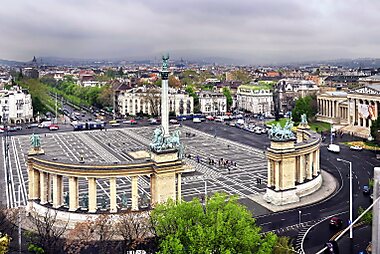
Budapest is the dominant draw for most visitors. Its thermal baths, grand 19th-century boulevards, hilltop castle quarter, Great Synagogue, and ruin-bar nightlife make it one of Central Europe's most rewarding city destinations.
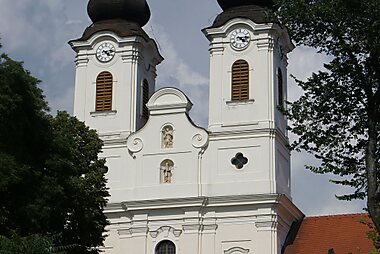
Lake Balaton is Hungary's inland sea and the country's main domestic holiday destination. The southern shore is busy and resort-oriented in summer; the northern shore is quieter, with volcanic hills, the Tihany Peninsula and its Benedictine abbey, and the thermal lake at Hévíz nearby.
Pécs in southern Hungary blends Roman, Ottoman, and baroque layers; its early Christian necropolis is a UNESCO World Heritage Site. Eger in the north is famous for its medieval castle made famous by the 1552 Ottoman siege, baroque old town, and the red wines of the surrounding hills.
Sopron, near the Austrian border, is one of Hungary's best-preserved medieval towns and easy to combine with a visit from Vienna. Győr is an underrated baroque city at the junction of the Danube tributaries. In the east, Debrecen is Hungary's second-largest city, a historic Calvinist centre and the gateway for exploring Hortobágy National Park and the surrounding puszta.
Hungria – Planeia a tua viagem
Escolhe os lugares que queres ver e o Tripomatic transforma-os numa rota dia a dia, com rotas inteligentes, estimativas de tempo e tudo o que precisas para uma viagem perfeita.




