


Malorka
Mallorca is the largest of Spain's Balearic Islands, in the western Mediterranean. It pairs a busy capital, Palma, with a mountainous coast, quiet inland villages, and many well-known beaches. City, mountains, and sea sit within an hour's drive of each other. That mix is what sets it apart from a typical single-beach island break.
The north-west coast is backed by the Serra de Tramuntana mountains and draws hikers and cyclists. The south and east coasts are where most travelers head for calm coves instead. Families, couples, and active travelers all find a fit here, and the island works equally well as a week-long base or a few days tacked onto a Spain trip. The composer Frédéric Chopin and writer George Sand famously spent a difficult winter here in 1838–39, an episode that still shapes how the village of Valldemossa presents itself to visitors today.

Malorka – Plánuješ výlet?
Zostav si itinerár deň po dni v aplikácii Tripomatic.


Kedy navštíviť
Spring and autumn are mild and pleasant with fewer crowds, summer is hot and dry with the sea at its warmest, and winter is quiet and cool, mostly rain-free.
Time a visit around Sant Joan on the night of 23–24 June, when bonfires and beach parties light up the coast across the island to mark the summer solstice — a genuinely island-wide tradition, not a single-town event. July and August are the busiest and most expensive weeks, so late spring or September gets similar weather with smaller crowds.
Najlepší čas na návštevu: máj, jún, júl, august, september, október
Hlavné pamiatky




Palma Cathedral rises straight out of the sea wall in Palma, its Gothic interior lit by a huge rose window and a canopy designed by Antoni Gaudí. Right next door, Almudaina Palace was originally a Moorish citadel. It later became a royal residence and is still used by the Spanish royal family for official visits.
On a wooded hilltop above the city, Bellver Castle is Europe's rare circular castle, built for a 14th-century king, and its terraces give sweeping views over Palma Bay.
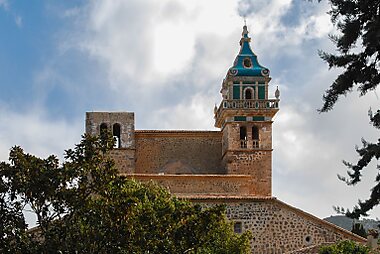
Serra de Tramuntana runs the length of the north-west coast. This UNESCO-listed range of terraced hills, cliffside villages, and hairpin roads is why many people bring a car to Mallorca instead of only lying on a beach. Tucked into it, Cartoixa de Valldemossa is a former monastery in the village of Valldemossa where Frédéric Chopin and George Sand spent the winter of 1838–39.
Further north, Mirador d'es Colomer is the classic photo stop on the road to Cap de Formentor, looking straight down onto jagged cliffs and the open sea.
Inland toward the east coast, Drach (Dragon's) Cave is a vast underground cave system with an underground lake, where visitors take a boat ride during a live classical-music performance.
On the north coast, the walled old town of Las Murallas de Alcúdia still has intact medieval ramparts you can walk along, giving a rare look at how Mallorca's coastal towns once defended against pirate raids.
Odporúčané zoznamy

Majorca Essentials
Majorca’s landscape is defined by the UNESCO-listed Serra de Tramuntana mountain range and the iconic Gothic architecture of Palma. This selection features the 14th-century circular Bellver Castle, the subterranean Drach Caves, and the restored medieval walls of Alcúdia. Coastal highlights include the dramatic Cap de Formentor cliffs, the secluded Calo des Moro, and the white sands of Es Trenc. Cultural landmarks like the Valldemossa Charterhouse and the Lluc Sanctuary offer insight into the island's royal and religious history, while Palma Cathedral showcases modern interventions by Antoni Gaudí.
15 miest
Best Beaches in Mallorca
Mallorca's coastline offers diverse landscapes, from the wild, cliff-lined coves of the north like Sa Calobra and Formentor to the extensive, shallow-water bays of Alcúdia and Muro in the northeast. The southern coast features the protected dunes of Es Trenc and the twin beaches of Mondragó Natural Park: s'Amarador and sa Font de n’Alís. For those seeking secluded spots, the island provides pebble-strewn shores like Coll Baix, accessible primarily by boat or hike, alongside well-serviced resort beaches such as Magaluf and Cala Gran.
15 miest


Authentic Mallorcan Flavors
This collection highlights Mallorca's culinary landscape, centered around the historic Mercat de l’Olivar in Palma, one of Europe's largest covered markets. The selection features cliffside seafood establishments like Sa Foradada and Ca's Patró March, known for their Mediterranean views and wood-fired cooking. It includes regional restaurants in the Tramuntana mountains, such as Mirador de ses Barques, and coastal spots in Port de Pollença and Ses Salines, offering traditional Spanish dishes, fresh fish, and local tapas across the island's diverse coastline.
10 miest

Top Sports & Outdoor
This list highlights Mallorca’s premier outdoor sports and leisure spots, including historic golf courses such as Golf Poniente established in 1978, and unique courses like Golf Santa Ponsa II with its island-shaped 18th hole. It also features sandy beaches ideal for swimming and water sports, alongside notable climbing zones offering varied routes and challenges.
10 miestČo zažiť
Mallorca's signature experiences are outdoor and seasonal rather than indoor sightseeing — the island rewards getting on the water, into the hills, or out at sunset.
- Ride the century-old wooden Sóller train from Palma up through the mountains, then continue down to the coast on the vintage tram into Port de Sóller.
- Swim in a hidden cove reachable only on foot or by boat along the Tramuntana coast, such as the walk down to Caló des Moro.
- Cycle the flat lanes of the island's interior around the almond and citrus groves — a favorite spring training route for European road cyclists.
- Watch the sunset from one of the clifftop watchtowers along the Banyalbufar coast road, one of the best-known stretches of the island for it.
- Join the bonfires and beach parties on Nit de Sant Joan (23–24 June), when the whole island stays up to welcome midsummer.
Prehliadky a aktivity
Malorka — Mapa

 Otvoriť interaktívnu mapu
Jednodňové výlety
Mallorca is an island, so a "day trip" usually means a boat rather than a bus — either out to a protected archipelago or across to one of its sister islands.
- Cabrera National Park — half-day and full-day boat tours leave from Colònia de Sant Jordi. An uninhabited archipelago of clear coves and a 14th-century castle, protected as a national park; landing numbers are limited, so book ahead.
- Ciutadella, Menorca — ≈1 hour by fast ferry from Port d'Alcúdia. A quieter island with a handsome old town, a working fishing harbor, and coves with less crowding than Mallorca's.
- Ibiza, Ibiza — ≈2–2.5 hours by ferry from Palma. Its walled Dalt Vila old town is a UNESCO World Heritage Site, and the island offers a livelier nightlife scene than Mallorca if that's what you're after.
Kam sa vybrať
Beyond the capital, a few towns are worth building a base or a stop around.
In the north, l'Alcúdia keeps its walled old town and sits beside a long sandy bay. Pollença is a stone-built market town below the Tramuntana mountains, close to the drive out to Cap de Formentor.
On the south-east coast, Cala d'Or is a resort village built around a string of small coves, a good base for calmer swimming away from the bigger northern beach towns.
Ako sa tam dostať
- By air: Palma de Mallorca Airport (PMI) is the main gateway, with year-round connections across Europe and a big seasonal summer schedule. It sits about 8 km east of Palma; the airport bus (line A1) takes roughly 20–25 minutes into the centre, and a taxi takes 15–20 minutes and costs roughly €25–35.
- By ferry: overnight and day ferries run to Palma from Barcelona (≈7–8 hours) and Valencia (≈7–8 hours), and from Dénia; car ferries also connect Port d'Alcúdia and Palma with Menorca and Ibiza. Useful if you're bringing a car or continuing on to another Balearic island.
- By train: there is no rail link to the mainland — the island's only railway is the historic line between Palma and Sóller, run as a heritage service rather than intercity transport.
Doprava na mieste
- Public transit: TIB (Transports de les Illes Balears) runs island-wide buses linking Palma to every major town, and Palma itself has its own city bus network (EMT). Buy single tickets from the driver with cash or card, or load a rechargeable travel card or the TIB app for regular use. TIB journey planner
- Taxi / ride-hailing: taxis are metered and easy to find in Palma and at the airport; ride-hailing apps have limited coverage outside the capital, so ask your hotel for a local taxi number in smaller towns.
- On foot / cycling: Palma's old town is compact and best explored on foot. Outside the capital, a car is far more practical than public transport for reaching beaches and mountain villages, though the flatter east coast is popular with cyclists.
Šoférovanie
- Is a car worth it?: yes, unless you're staying entirely in Palma — the Tramuntana villages, northern beaches, and inland towns are far easier to reach with your own car than by bus.
- Parking: Palma's old town has paid on-street zones (blue/green lines, pay by app or meter) and several underground car parks near the centre; many coastal resort towns fill their free street parking by mid-morning in summer.
- Restrictions: Palma's historic centre has a low-emission zone (ZBE) with restricted access for the most polluting vehicles — check your rental car's label before driving in.
Jedlo a pitie
Mallorcan food is simpler and more rustic than mainland Spanish cuisine, built around bread, pork, and whatever vegetables are in season. Look for pa amb oli (bread rubbed with tomato and olive oil, topped with cheese or ham), tumbet (a layered vegetable and potato bake), and ensaïmada, the island's spiral pastry eaten for breakfast.
For lunch or dinner, head to Palma's old town streets around Plaza Mayor, where small bars serve tapas and local wine side by side. Outside the capital, the fish restaurants clustered around fishing harbors like Port de Sóller are a reliable bet for fresh seafood.
Bezpečnosť a zdravie
Mallorca is a safe destination for tourists — violent crime is rare. The main risks are petty: pickpocketing on crowded beaches, at busy markets, and around nightlife areas in Palma and the party resorts of the south, so keep valuables out of sight and be extra alert late at night.
Summer heat is the more practical hazard: temperatures regularly climb into the low 30s °C in July and August, so carry water, use sun protection, and avoid strenuous hikes in the Tramuntana mountains during the hottest midday hours.
História
Mallorca changed hands many times before settling into Spain. Romans, Vandals, and Byzantines all held the island before Moorish rule took root in the 10th century, leaving behind the layout of Palma's old town and the bathhouse now known as Banys Àrabs.
In 1229, King James I of Aragon landed on the island and took Palma after a bitter siege, ending Moorish rule; a statue of him, James I of Aragon, still stands in the city he conquered. His successors converted the old Moorish citadel into Almudaina Palace and began building Palma Cathedral on the site of the city's main mosque — a project that took centuries to complete. His son, King James II, ruled an independent Kingdom of Mallorca and built Bellver Castle as his residence, its unusual circular plan setting it apart from every other castle on the island.
Fakty o krajine
Quick practical facts for Spain at a glance:
- Mena
- euro EUR € · Platby kartou · Široko akceptované
- Tiesňové čísla
- 112
- Elektrina
- 230 V · 50 HzTyp C / Typ F
- Jazyky
- španielčina
- Voda z vodovodu
- Pitná
- Jazdná strana
- Vpravo
- Predvoľba
- +34
Malorka – Naplánuj si výlet
Vyber si miesta, ktoré chceš vidieť, a Tripomatic ich premení na trasu deň po dni – s inteligentným plánovaním trás, časovými odhadmi a všetkým potrebným pre dokonalý výlet.




