


Pompei
Pompeii is the Roman town that Mount Vesuvius buried in AD 79. Its streets, houses, temples, baths and shops survive under the volcano, and walking through them is the closest you can get to daily life in the Roman world. It is one of the most visited sites in Italy and a UNESCO World Heritage Site.
Most people come on a day trip from Naples or Sorrento, but the modern town of Pompei is a practical base too. It grew up around a large pilgrimage church, and it has hotels, restaurants and direct trains. Plan at least half a day for the ruins; a full day lets you see the famous houses without rushing. The site is huge and has little shade, so it suits travellers who are happy to walk for hours.

Pompei – Planst du eine Reise?
Erstelle deine Reiseroute Tag für Tag in der Tripomatic-App.


Beste Reisezeit
April, May and October are the best months: warm, mostly dry and comfortable for long walks in the ruins. July and August are very hot, with almost no shade on the site, so arrive at opening time. Winter is mild and quiet, but the site closes earlier and some days are rainy.
The biggest local events are the two days of the Supplica, a mass prayer at the town's sanctuary on 8 May and on the first Sunday of October, when thousands of pilgrims fill the town. In summer, the Roman theatre inside the ruins hosts evening performances of ancient drama and concerts. The first Sunday of every month is free at the archaeological site, which makes it very crowded.
Beste Reisezeit: April, Mai, Oktober
Top-Sehenswürdigkeiten
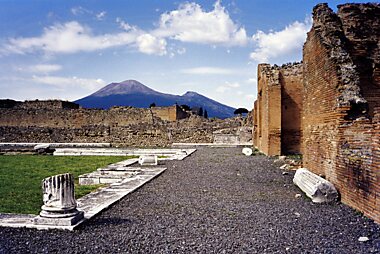


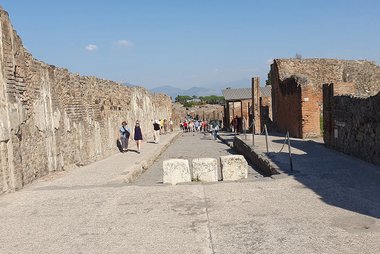


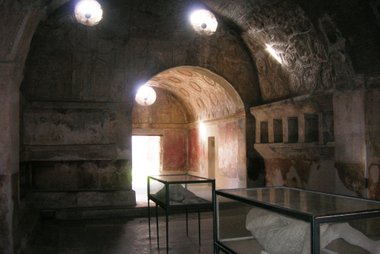
Pompeii Archaeological Site covers the whole excavated Roman town, about two-thirds of which has been uncovered. Tickets are personal and entry is limited per day, with time slots in the busy season, so book ahead and check current rules on the official site. Pompeii Archaeological Park
Forum of Pompeii was the centre of public life, with temples, the law court and markets around a long open square. On a clear day, Vesuvius rises directly behind it.
Via dell'Abbondanza is the main street of the ancient town, lined with shops, bars and houses. The deep ruts left by cart wheels and the raised stepping stones are still there.
Amphitheatre of Pompeii is one of the oldest surviving Roman amphitheatres, built of stone around 70 BC. It held up to 20,000 people for gladiator fights.
House of the Vettii belonged to two rich freedmen, probably brothers, and has some of the finest wall paintings in Pompeii.
House of the Faun is one of the largest houses in the town. A copy of the small bronze dancing faun stands in its atrium, and a copy of the famous Alexander mosaic lies on the floor further inside.
Villa of the Mysteries lies just outside the town walls. Its large painted frieze of a mysterious ritual is one of the best-preserved works of ancient painting. It is on the suburban villas route, which not every ticket includes, so check before you buy.
Teatro Grande is a large open-air theatre cut into the hillside, next to the smaller covered theatre and Temple of Isis.
Also worth finding:
- Antiquarium is the site's museum, with body casts, frescoes and objects from daily life. It is a good first stop.
- Stabian Baths are the oldest public baths in the town, with changing rooms, pools and heated floors.
- Lupanar (brothel) has small stone beds and explicit wall paintings. Expect a queue.
- Thermopolium of Vetutius Placidus is a Roman street-food counter with clay jars set into the bar.
- Garden of the Fugitives shows the plaster casts of 13 people who died here while trying to escape.
- In the modern town, Santuario della Beata Vergine del Santo Rosario is a large pilgrimage church and the heart of Pompei today.
Empfohlene Listen


Erlebnisse & Aktivitäten
A few things to do here beyond walking the ruins by day:
- Summer concerts in the Amphitheatre: in early summer, evening concerts are held at Amphitheatre of Pompeii, with music under the stars in the arena where Romans once watched gladiators.
- Watch ancient drama in a Roman theatre: on summer evenings, Greek and Roman plays are staged in Teatro Grande, where Pompeii's citizens watched theatre 2,000 years ago.
- See the ruins at night: in late summer and early autumn, parts of the site open on some Friday and Saturday evenings for lit night walks. Places are limited, so book ahead on the official site.
- Join the Supplica: on 8 May or the first Sunday of October, the square in front of Santuario della Beata Vergine del Santo Rosario fills with pilgrims for a mass prayer. It is a strong picture of religious life in southern Italy.
Touren & Aktivitäten
Pompei — Karte

Tagesausflüge
Pompeii sits on the Circumvesuviana railway, so most day trips are easy without a car.
- Oplontis Ruins — about 10 minutes by train to Torre Annunziata, or the park's free shuttle bus. A grand Roman villa with excellent wall paintings and very few visitors.
- Ercolano — about 20 minutes on the same Circumvesuviana line towards Naples (get off at Ercolano Scavi). The ruins of Herculaneum are smaller than Pompeii but better preserved, with wooden beams and upper floors still in place.
- Mount Vesuvius — a direct EAV bus runs from Pompei to the car park near the top, then it is about 30 minutes on foot up a gravel path to the crater rim. Tickets are sold online only, for a fixed time, and the path closes in bad weather.
- Naples — about 35 minutes by train. The National Archaeological Museum holds the best mosaics, frescoes and statues taken from Pompeii.
- Sorrento — about 40 minutes by train. A cliff-top town above the sea and the gateway to the Amalfi Coast and Capri.
- Positano and Amalfi — about 1.5 hours to Positano and 2.5 hours to Amalfi, by train to Sorrento and then bus or ferry. Colourful villages on the Amalfi Coast; long but popular.
- Capri — about 1.5 hours by train to Sorrento, then ferry. An island of cliffs, boat trips and the Blue Grotto.
Orte zum Entdecken
Pompeii sits in Campania, between Naples and the Sorrento peninsula.
- The city: Naples is the region's capital and main transport hub.
- Along the coast: Sorrento, Positano, Amalfi and Ravello make a good base for a few nights by the sea.
- Islands in the Bay of Naples: Capri, Ischia and Procida.
- Other Roman sites: Ercolano for Herculaneum, and Pozzuoli for its Roman amphitheatre and volcanic landscape.
Anreise
- By air: Naples International Airport (Capodichino, NAP) is the nearest airport, about 30 km away. Take the Alibus shuttle to Napoli Centrale/Garibaldi station, then the Circumvesuviana train to Pompei Scavi. A taxi takes about 40 minutes without traffic.
- By Circumvesuviana train: the Naples–Sorrento line stops at Pompei Scavi–Villa dei Misteri, right next to the Porta Marina and Piazza Esedra entrances. It takes about 35 minutes from Napoli Garibaldi and about 40 minutes from Sorrento. In the warm season, the Campania Express runs on the same line with reserved seats for a supplement. EAV (Circumvesuviana)
- By Trenitalia: regional trains on the Naples–Salerno line stop at Pompei station in the modern town, about 35–40 minutes from Napoli Centrale. From there it is about 15–20 minutes on foot to the Piazza Anfiteatro entrance. High-speed trains from Rome, Florence and Milan arrive at Napoli Centrale. Trenitalia
- By bus: Busitalia Campania buses connect Pompei with Salerno.
Unterwegs vor Ort
- Entrances: the ruins have three entrances — Porta Marina and Piazza Esedra on the west side, near Pompei Scavi station, and Piazza Anfiteatro on the east side, near the modern town and the sanctuary. You can enter at one and leave at another.
- Inside the site: everything is on foot. Distances are long and the old streets have large, uneven stones, so wear good shoes. Only small bags are allowed (30 × 30 × 15 cm at most). Free shuttle buses link the main site with the other sites of the park, such as Oplontis; check the official site for routes.
- Trains: buy Circumvesuviana tickets at the station ticket office or machine, or in the official GoEav app. Validate paper tickets on the platform before boarding.
- Modern town: the centre around the sanctuary is small and easy to walk. Taxis wait near the stations and the sanctuary.
Autofahren
- Is a car worth it?: not for Pompeii alone. Trains from Naples and Sorrento stop next to the entrances. A car only helps if you also want to explore Vesuvius and the inland towns on your own; avoid driving in Naples and on the Amalfi Coast in summer.
- Getting there: take the A3 Naples–Salerno motorway (a toll road) and leave at the Pompei Ovest exit for the ruins.
- Parking: there are paid car parks near the Porta Marina and Piazza Anfiteatro entrances. Ignore people who wave you into private car parks along the road and agree the price before you leave the car.
Essen & Trinken
Pompei follows Neapolitan food traditions. Look for Neapolitan pizza, pasta with clams or with tomatoes from the Vesuvius slopes, and the local Lacryma Christi del Vesuvio wine, red or white, made from vines grown on the volcano. Sfogliatella, a crisp shell-shaped pastry filled with ricotta, is the classic breakfast.
The best area to eat is the modern town centre around the sanctuary square and Via Roma, about 10 minutes on foot from the Piazza Anfiteatro entrance. Restaurants right outside Porta Marina are aimed at tour groups. Inside the ruins, food is limited to a cafeteria near the Forum, so bring water and a snack. For a special meal, Ristorante President in the town centre holds a Michelin star.
Sicherheit & Gesundheit
Pompei is generally safe for visitors. The main risks are the sun and the ground, not crime.
- Heat: there is little shade in the ruins. In summer, carry plenty of water, wear a hat and sunscreen, and plan your walk around the hottest hours. There are drinking-water fountains inside the site.
- Uneven ground: the Roman paving stones are large, slippery and uneven. Wear sturdy shoes with good grip.
- Touts: at the entrances and car parks, people offer unofficial guided tours or "skip-the-line" tickets. Buy tickets only from the official site or ticket offices, and use licensed guides.
- Pickpockets: they work on the crowded Circumvesuviana trains between Naples and Sorrento. Keep bags closed and in front of you.
Geschichte
Pompeii was founded by the Oscans, a local Italic people, and later came under Samnite control. After the Roman general Sulla besieged the town in 89 BC, it became a Roman colony. By the first century AD it was a busy trading town of about 10,000–20,000 people, close to the sea and the mouth of the Sarno river. You can still see its daily life in the shops and bars along Via dell'Abbondanza.
A strong earthquake damaged the town in AD 62, and repairs were still unfinished when Vesuvius erupted in AD 79. Ash and pumice buried Pompeii under several metres of debris. Pliny the Younger watched the eruption from across the bay and described it in two letters; his uncle, Pliny the Elder, died trying to rescue people. The traditional date is 24 August, but recent finds point to October.
Excavation began in the 18th century, and the town was identified by an inscription in 1763. In 1863, Giuseppe Fiorelli began pouring plaster into the hollows left by bodies in the ash. These casts, shown at Garden of the Fugitives and in the site museum, Antiquarium, are the most moving sight in Pompeii. Pompeii became a UNESCO World Heritage Site in 1997, together with Herculaneum and Oplontis.
The modern town grew up later, around Santuario della Beata Vergine del Santo Rosario. The lawyer Bartolo Longo began building it in 1876, and it became one of Italy's major pilgrimage sites. He was declared a saint in 2025.
Länderfakten
Quick practical facts for Italy at a glance:
- Währung
- Euro EUR € · Kartenzahlung · Weitgehend akzeptiert
- Notrufnummern
- 112
- Stromnetz
- 230 V · 50 HzSteckertyp C / Steckertyp F / Steckertyp L
- Sprachen
- Italienisch
- Leitungswasser
- Trinkbar
- Fahrseite
- Rechtsverkehr
- Telefonvorwahl
- +39


Pompei – Plane deine Tage
Verwandle die Orte aus diesem Reiseführer in eine echte Reiseroute mit intelligenter Routenführung, Zeitschätzungen und allem für eine perfekte Reise.


Ähnliche Reiseziele




Data: © OpenStreetMap contributors, Wikidata, Wikipedia, Tripomatic, Official websites, geoBoundaries (CC BY 4.0). Tours by GetYourGuide. We earn commission from bookings. Travel guide generated with AI.