


Sorrent
Sorrento sits on top of a cliff above the Gulf of Naples, with a direct view across the water to Vesuvius. The old town is small and easy to walk, with narrow lanes, churches, lemon groves and shops selling limoncello and inlaid woodwork.
Its main strength is location. Sorrento is the end of the train line from Naples and the start of the road to the Amalfi Coast, and boats leave its harbour for Capri several times a day in season. Many travellers stay here for a week and visit Pompeii, Capri and Positano on day trips. The town is also a calmer, cheaper base than the Amalfi Coast villages.

Sorrent – Planst du eine Reise?
Erstelle deine Reiseroute Tag für Tag in der Tripomatic-App.


Beste Reisezeit
May, June, September and early October are the best months: warm, mostly dry and good for swimming, with fewer crowds than in high summer. July and August are hot, humid and very busy. From November to March many hotels close, ferries run less often and rain is frequent, especially in November, but prices are low.
The biggest local event is Holy Week, in March or April. On Good Friday, hooded members of local brotherhoods walk through the town in two processions: a white one early in the morning and a black one in the evening, with torches and slow band music. Book rooms early for Easter.
Beste Reisezeit: Mai, Juni, Juli, August, September, Oktober
Top-Sehenswürdigkeiten
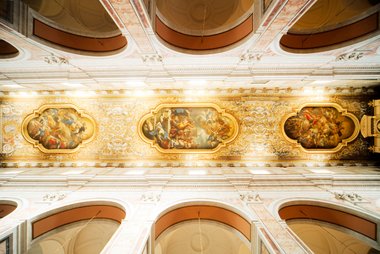
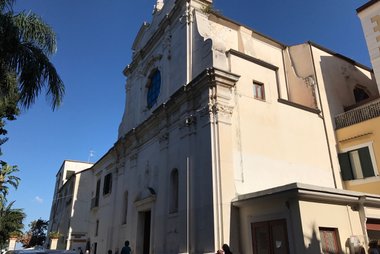
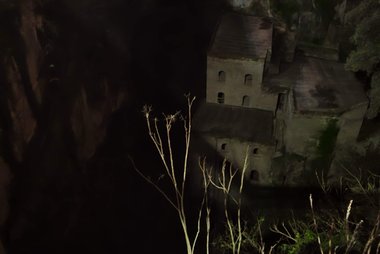
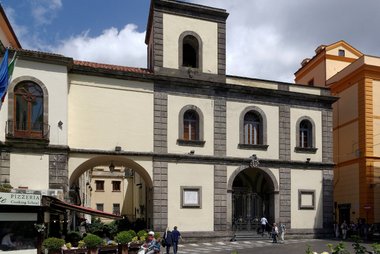

Sorrento's sights are close together. You can see most of them in a day on foot, with time left for the sea.
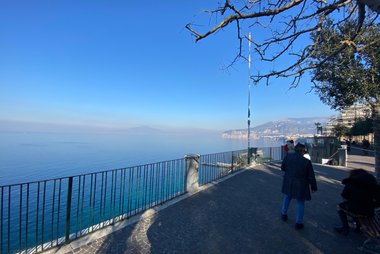
- Villa Comunale Viewpoint is a clifftop terrace in a small park with the town's classic view across the Gulf of Naples to Vesuvius. It is free to visit.
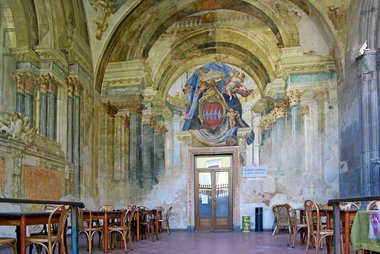
- Chiesa di San Francesco d'Assisi stands next to the park. Its 14th-century cloister, with Gothic arches around a quiet courtyard, hosts concerts and exhibitions in summer.
- Vallone dei Mulini is a deep green gorge right behind Piazza Tasso. You look down from the street onto the ruins of an old flour mill, covered in ferns.
- Basilica of Sant'Antonino is built over the tomb of the town's patron saint. Visit the crypt with its ex-votos, and look for the whale bones in the porch.
- Sorrento Cathedral has doors and choir stalls decorated with local inlaid wood. Torquato Tasso was baptised here.
- Sedil Dominova is a 14th-century open loggia with a tiled dome and frescoed walls, once a meeting place for local nobles. It is in the middle of the old town.
- Museo Correale di Terranova is the town's main museum, in a family villa. It has Neapolitan paintings, porcelain and inlaid wood, and a garden that ends at a terrace over the sea.
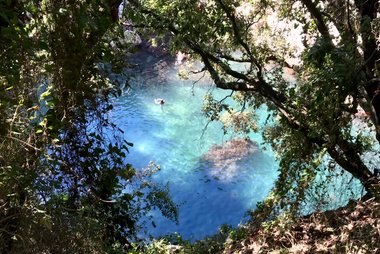
- Bagni della Regina Giovanna are the ruins of a Roman villa on the Capo di Sorrento headland, about 30 minutes on foot from the centre.
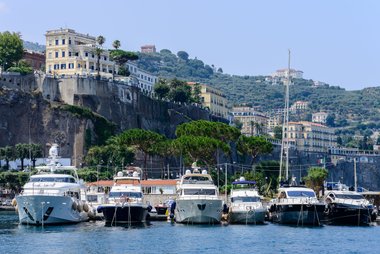
Below the old town, the fishing quarter of Marina Grande has small boats, colourful houses and seafood restaurants on the water.
Empfohlene Listen


Sorrento's Historical Treasures
Sorrento's historical landscape spans from Roman maritime architecture to 16th-century defensive fortifications. This collection highlights the archaeological remains of the Villa Pollio Felice at Capo di Sorrento and the preserved Bastione di Parsano, part of the city's Spanish-era defensive walls. Cultural heritage is further explored through the Museobottega della Tarsialignea, which preserves the local tradition of inlaid wood, and monuments dedicated to the poet Torquato Tasso and the city's patron saint, Antonino Abate.
6 Orte
Sorrento's Sacred Sites
Sorrento’s religious architecture spans centuries, from the 11th-century Sorrento Cathedral with its 15th-century facade to the 14th-century Franciscan monastery. This collection includes urban churches featuring Baroque and Romanesque elements, as well as hilltop monastic sites like San Paolo al Deserto in Sant'Agata sui Due Golfi, which offers panoramic views of the Gulfs of Naples and Salerno. These sites house significant artworks, including intricate marble marquetry and historic cloisters.
7 Orte
Erlebnisse & Aktivitäten
A few things that make a stay in Sorrento special:
- Watch the sunset over the Gulf: go to Villa Comunale Viewpoint in the early evening, when the light softens over Vesuvius and the lights come on around the bay.
- Swim in the natural pool: walk out along the headland to Bagni della Regina Giovanna and swim in the rock pool beside the Roman ruins. Go early or late in the day in summer.
- Take a boat along the coast: in summer, small boats leave Sorrento Marina Piccola for trips around the tip of the peninsula and Capri, with stops to swim.
- Browse the inlaid-wood workshops: Sorrento is known for tarsia, pictures made from small pieces of coloured wood. Old-town workshops sell boxes, trays and music boxes made this way.
- Join the feast of the patron saint: on 14 February, Sorrento celebrates Sant'Antonino with a procession of his silver statue, street lights and fireworks.
Touren & Aktivitäten
Sorrent — Karte

Tagesausflüge
Sorrento is one of the best bases in the region. Most trips need no car. They are listed from closest to farthest.
- Capri is 20–30 minutes by fast ferry from Marina Piccola. Take a bus or taxi up to Anacapri for quieter streets and the chairlift to Monte Solaro.
- Pompeii is about 30 minutes by Circumvesuviana train. The Pompei Scavi station is next to the main entrance to the ruins.
- Massa Lubrense and the bay of Nerano, at the tip of the peninsula, have quiet coves and footpaths. They are about 30–40 minutes by local bus or car.
- Positano is about 40 minutes by SITA bus along the coast road. In summer there are also ferries.
- Ercolano has the ruins of Herculaneum, smaller and better preserved than Pompeii. The Circumvesuviana takes about 50 minutes.
- Naples is about 1 hour 10 minutes by train, or 35–45 minutes by hydrofoil, with fewer sailings in winter.
- Amalfi is about 1.5 hours by bus, and in summer also by ferry. From there, a bus climbs to Ravello and its villa gardens.
Orte zum Entdecken
Sorrento is in Campania, and many of the region's best-known places are within easy reach.
- The islands: Capri and Anacapri are a short boat ride away. Ischia and Procida are larger and quieter, with thermal spas and fishing villages.
- The Amalfi Coast: Positano, Amalfi and Ravello line the coast road east of the peninsula.
- Around Vesuvius: Naples, Pompeii and Ercolano are all on the Circumvesuviana line.
Anreise
Most visitors fly into Naples and continue by bus, train or boat.
- By air: Naples International Airport is the nearest airport. The Curreri bus runs direct from the airport to Sorrento station several times a day and takes about 75–90 minutes. Buy tickets at the airport desk, online, or from the driver when the desk is closed.
- By train: high-speed trains reach Naples Centrale from Rome, Florence and Milan. Trenitalia From the underground Napoli Garibaldi station below Naples Centrale, the Circumvesuviana line runs to Sorrento in about 1 hour 10 minutes, with stops at Herculaneum and Pompeii. Buy tickets at the station, in the EAV app, or tap a contactless bank card at the gates where this is offered. EAV Circumvesuviana
- By boat: hydrofoils link the Molo Beverello port in Naples with Sorrento's Marina Piccola in 35–45 minutes all year, with fewer sailings in winter. Boats also run to Capri all year, and from spring to autumn to Positano, Amalfi and Ischia.
- By bus: SITA buses link Sorrento with Positano and Amalfi along the coast road. The stop is next to the train station.
Unterwegs vor Ort
The centre is compact, and most visitors walk everywhere.
- On foot: the old town, Piazza Tasso and the Villa Comunale are all within a few minutes of each other. Marina Piccola and Marina Grande are at sea level, down steep lanes and steps.
- Lift: a small lift runs from the Villa Comunale park down to the seafront near Marina Piccola.
- Local buses: EAV buses and small minibuses from Piazza Tasso link the centre with Marina Piccola, Marina Grande and the Capo di Sorrento area. Minibus tickets to the harbours can usually be bought on board; for EAV buses, buy tickets at tobacconists, newsstands or in the EAV app.
- SITA buses: for Positano and Amalfi. Tickets are not sold on board; buy them at the ticket office in Sorrento station or at tobacconists, and validate them when you get on.
- Taxis: taxis wait at Piazza Tasso and at the station. They are expensive, so agree the fare first for longer trips.
Autofahren
- Is a car worth it?: no, for a stay in Sorrento itself. Trains, buses and boats reach the main day trips, and parking is hard and expensive. A car helps only for exploring the quiet villages at the tip of the peninsula.
- Restricted zone: the historic centre is a ZTL (limited traffic zone) checked by cameras. Driving in without a permit brings a fine by post. If your hotel is inside the zone, ask it to register your plate before you arrive.
- Parking: use one of the paid garages near the centre. On the street, blue lines are paid at the meter, white lines are free but rarely available, and yellow lines are reserved for residents or disabled drivers.
- Coast road: the road to Positano and Amalfi is narrow and very busy in summer. On busy days from spring to autumn, traffic east of Positano is often limited by number plate, so check the current rules before you drive.
Essen & Trinken
Sorrento is known for its lemons, which grow in terraced groves all around the town. They go into limoncello, a sweet lemon liqueur served cold after dinner, and into delizia al limone, a small sponge cake filled with lemon cream. Local dishes to try include gnocchi alla sorrentina, baked with tomato and mozzarella, fresh fish, and cheeses from the hills such as fior di latte and provolone.
For eating out, the lanes of the old town around Piazza Tasso and Corso Italia have many trattorias and pizzerias. For seafood with a sea view, walk down to Marina Grande, where restaurants sit on the old fishing quay. The hill village of Sant'Agata sui Due Golfi, above the town, is home to Don Alfonso 1890, one of the most famous fine-dining restaurants in southern Italy.
Sicherheit & Gesundheit
Sorrento is a safe town with little crime. The main risks are small ones:
- Pickpockets: take care on the crowded Circumvesuviana trains and at busy bus stops, especially in summer.
- Traffic: many streets outside the centre are narrow and have no pavement. Walk carefully, especially on the roads to the beaches and to Capo di Sorrento.
- Steep steps: the walk down to the harbours is steep and slippery when wet. Wear good shoes.
- Sun and heat: in July and August, avoid long walks in the middle of the day and carry water.
Geschichte
Sorrento began as a Greek and then a Roman town called Surrentum. Rich Romans built villas on the cliffs, and the ruins at Bagni della Regina Giovanna belonged to one of them. Local legend says that Queen Giovanna II of Naples later swam in the natural pool there, which gave the site its name.
The town's patron saint, the abbot Antoninus, died here in the 7th century. His tomb is in the crypt of Basilica of Sant'Antonino. In the Middle Ages the town was protected by deep gorges on two sides, like the one at Vallone dei Mulini, and by walls on the land side. In 1558 an Ottoman fleet attacked Sorrento and took many people as slaves, and new walls were built afterwards.
The poet Torquato Tasso was born here in 1544. From the 18th century, Sorrento became a stop on the Grand Tour, and writers such as Goethe, Byron, Dickens and Ibsen stayed here. The famous Neapolitan song Torna a Surriento, from the early 20th century, made the town's name known around the world.
Länderfakten
Quick practical facts for Italy at a glance:
- Währung
- Euro EUR € · Kartenzahlung · Weitgehend akzeptiert
- Notrufnummern
- 112
- Stromnetz
- 230 V · 50 HzSteckertyp C / Steckertyp F / Steckertyp L
- Sprachen
- Italienisch
- Leitungswasser
- Trinkbar
- Fahrseite
- Rechtsverkehr
- Telefonvorwahl
- +39


Sorrent – Plane deine Tage
Verwandle die Orte aus diesem Reiseführer in eine echte Reiseroute mit intelligenter Routenführung, Zeitschätzungen und allem für eine perfekte Reise.


Ähnliche Reiseziele




Data: © OpenStreetMap contributors, Wikidata, Wikipedia, Tripomatic, Official websites, geoBoundaries (CC BY 4.0). Tours by GetYourGuide. We earn commission from bookings. Travel guide generated with AI.