



Siena
Siena is a hilltop city in southern Tuscany. Its medieval centre is one of the best preserved in Italy and is a UNESCO World Heritage Site. Brick palaces, steep lanes and Gothic churches spread over three ridges, and most streets are closed to traffic. The heart of the city is a shell-shaped square, where locals meet, eat and, twice a year, watch the Palio horse race.
The city was once a strong republic and a rival of Florence. That past still shapes daily life: Siena is divided into 17 neighbourhoods called contrade, each with its own flag, church and fountain. Two or three nights are enough to see the main sights at a slow pace and use Siena as a base for the Chianti hills and the Val d'Orcia. Saint Catherine of Siena, one of Italy's patron saints, was born here.

Siena – Planst du eine Reise?
Erstelle deine Reiseroute Tag für Tag in der Tripomatic-App.


Beste Reisezeit
Spring (April–June) and autumn (September–October) are the best times: mild days, green or golden hills and fewer crowds. July and August are hot and busy. Winter is cool and quiet, with short opening hours at some sights.
The biggest event is the Palio, the horse race around the main square on 2 July and 16 August. The city fills up for several days before each race with trial runs, dinners and parades. Book a room early if you want to be there, or avoid these dates if you prefer a quiet visit.
Beste Reisezeit: Mai, Juni, September, Oktober
Top-Sehenswürdigkeiten
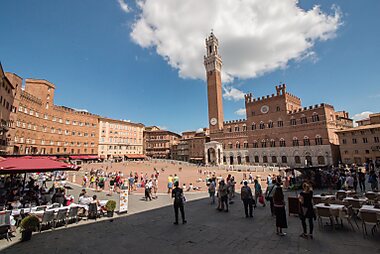
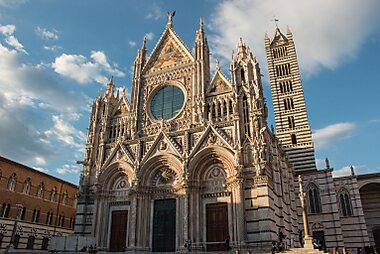
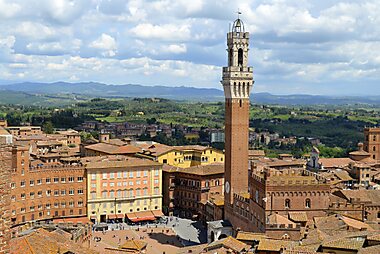
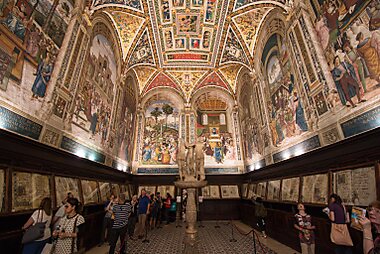
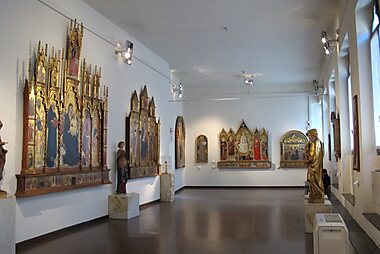
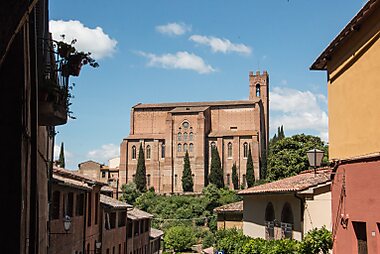
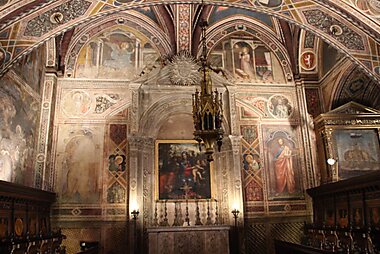
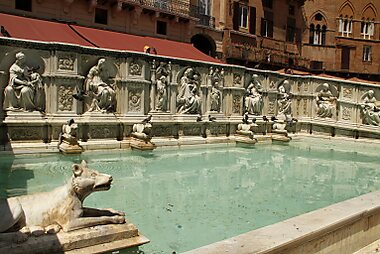
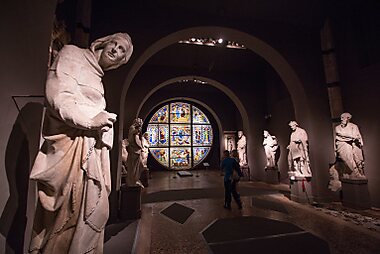

Most sights sit within a 10-minute walk of each other. The cathedral area has a combined pass that covers several of its sites.
- Piazza del Campo is the sloping, shell-shaped main square. Its brick paving is split into nine sections, a reminder of the Council of Nine that ruled the city. Sit on the paving and watch the light change on the palaces.
- On the square stands the Civic Museum and Public Palace, Siena's Gothic town hall. Its rooms hold Ambrogio Lorenzetti's frescoes of Good and Bad Government and Simone Martini's Maestà.
- Torre del Mangia rises 102 m from the town hall. Climb about 400 steps for a view over the square, the rooftops and the hills. Tickets are sold at the town hall for timed slots and often sell out, so go early in the day.
- Cathedral of Santa Maria Assunta has a striped black-and-white marble interior, a carved pulpit by Nicola Pisano and an inlaid marble floor. Most of the floor is covered for protection and shown only for a few weeks a year, usually including late summer and autumn. Inside, the Piccolomini Library has bright frescoes by Pinturicchio from the early 1500s.
- Opera del Duomo Museum displays Duccio's great Maestà altarpiece. From the museum you can climb the Facciatone, the unfinished wall of a planned larger cathedral, for one of the best views in town.
- Santa Maria della Scala, opposite the cathedral, was one of Europe's oldest hospitals and cared for the sick and pilgrims for many centuries. Today it is a large museum with frescoed wards and an archaeological collection.
- National Picture Gallery of Siena has one of the best collections of Sienese painting, from gold-ground altarpieces to the Renaissance.
- Basilica of San Domenico is a large brick church on a ridge. It holds relics of Saint Catherine, and its terrace has a classic view of the cathedral.
Empfohlene Listen


Parks, Squares & Fountains
Explore Siena's unique urban landscape through its historic squares and green spaces. This collection highlights the city's essential water heritage, from the hidden 14th-century Fonte del Casato to the ceremonial baptismal fountains belonging to various Contrade (districts). Key sites include the 18th-century gardens of La Lizza near the Medicean Fortress and Piazza San Domenico, which offers panoramic views of the Duomo. These locations provide insight into Siena's medieval infrastructure and local neighborhood traditions.
22 OrteErlebnisse & Aktivitäten
These local traditions and moments are what make a visit to Siena different.
- The Palio (2 July and 16 August): ten of the 17 contrade race bareback horses three times around Piazza del Campo. The race lasts about 90 seconds. The days before are full of trial runs and contrada street dinners, and a long historical parade enters the square before the race. Standing in the centre of the square is free; arrive early and expect big crowds and heat.
- Contrada life: walk through the neighbourhoods and look for each contrada's flags, street lamps and small fountain. Some contrade open their museums on request or around the Palio.
- Sunset on the square: in the evening, people sit directly on the sloping brick paving of the square to chat, eat a gelato or watch the tower catch the last light.
- The cathedral floor uncovering: for a few weeks each year, usually including late summer and autumn, the inlaid marble floor of the cathedral is on show. It is worth timing your trip for it. The Porta del Cielo (Gate of Heaven) visit also takes you above the vaults and onto the roofs, with views inside and outside the cathedral.
Touren & Aktivitäten
Siena — Karte

 Interaktive Karte öffnen
Tagesausflüge
Siena is a good base for the hill towns and wine country of southern Tuscany. A car gives the most freedom, but buses reach the main towns from Piazza Gramsci.
Close by
- Monteriggioni (about 20 minutes by car, 15 km): a small village inside a complete ring of medieval walls with 14 towers. The open stretch of the wall walk on the south side needs a ticket and gives views over the countryside.
- Chianti (about 30–60 minutes by car): rolling hills, vineyards and stone villages such as Castellina in Chianti and Greve in Chianti. It is best explored by car, with a stop for a wine tasting.
Further afield
- San Gimignano (about 1 hour 15 minutes by bus, often with a change in Poggibonsi): a hilltop town famous for its medieval stone towers.
- Montalcino (about 1 hour by car): a fortified hill town, home of Brunello wine.
- Pienza and Montepulciano (about 1–1.5 hours by car): two Renaissance hill towns. Pienza overlooks the Val d'Orcia, a UNESCO-listed landscape of cypress-lined roads and farms. Montepulciano is known for its Vino Nobile wine. They are easy to combine in one day by car.
- Florence (about 1 hour 15 minutes by rapid bus, about 1.5 hours by train): the Renaissance capital of Tuscany, if you have not seen it yet.
Orte zum Entdecken
Siena sits in the heart of Tuscany, and many of the region's best-known towns are within reach.
- Art cities: Florence is the region's capital and its biggest art city.
- Hill towns to the north and west: San Gimignano with its tower houses, and Volterra, an Etruscan and medieval town on a high ridge.
- Wine country: Greve in Chianti in the Chianti hills, and Montalcino and Montepulciano to the south.
- Val d'Orcia and beyond: Pienza in the Val d'Orcia, and Cortona, a hill town further east near the border with Umbria.
Anreise
- By air: the nearest airports are Florence Airport (about 70 km) and Pisa Airport (about 150 km). From Florence Airport, take the tram into Florence and continue by bus or train. From Pisa Airport, the People Mover shuttle runs to Pisa Centrale station, with trains to Siena in about 2 hours. Rome Fiumicino has a few direct buses a day.
- By train: regional trains link Florence and Siena in about 1.5 hours, some with a change in Empoli. From Rome, change in Florence or Chiusi. Siena station sits below the old town; take the escalators from the shopping centre opposite up to Porta Camollia, or a city bus. Trenitalia
- By bus: the fast bus from Florence takes about 1 hour 15 minutes and stops at Piazza Gramsci, right at the edge of the historic centre. This is often more convenient than the train. Long-distance coaches also link Siena with Rome.
Unterwegs vor Ort
- On foot: the historic centre is compact but hilly, with steep lanes and steps. Walking is the only practical way to see it. Wear comfortable shoes.
- Escalators: escalators link the car parks and the station area to the old town, including from the Santa Caterina and San Francesco car parks and from the station to Porta Camollia.
- Buses: Autolinee Toscane runs the city and regional buses. On most buses you can tap a contactless bank card or phone on the reader when you board. You can also buy tickets at tobacconists, newsstands, the ticket office under Piazza Gramsci or in the operator's app. Autolinee Toscane
- Taxi: there is a rank at the station, and Piazza Indipendenza near the main square is a common pick-up point. You can also call the radio taxi. Ride-hailing apps are of little use here.
- Cycling: the steep hills and narrow lanes make cycling impractical in the centre.
Autofahren
- Is a car worth it?: not for the city itself, which is best on foot. A car is the best way to explore Chianti and the Val d'Orcia.
- Restrictions: the historic centre is a ZTL (limited traffic zone) with camera enforcement. Do not drive in without a permit; fines arrive by post months later. Ask your hotel before you arrive if it offers access.
- Parking: use the large car parks at the edge of the centre, such as Il Campo, Santa Caterina, San Francesco and Fortezza-Stadio. Expect about €2 per hour. Several have escalators up into town. Street parking outside the walls uses meters.
Essen & Trinken
Sienese cooking is simple and hearty. Look for pici (thick hand-rolled pasta), often with garlic and tomato sauce or ragù, and ribollita (bread and vegetable soup) in the cooler months. Local cured meats come from the Cinta Senese pig. Siena is also famous for its sweets: panforte, a dense cake of nuts, honey and spices, and ricciarelli, soft almond biscuits.
The lanes just off the main square have many restaurants, but those with a view of the square charge more for the setting. For better value, walk a few minutes into the side streets, for example down towards Fontebranda or into the lanes east of the square. Wine bars across town pour Chianti Classico and Brunello di Montalcino by the glass.
Sicherheit & Gesundheit
Siena is a safe city for visitors. Normal care with bags and phones is enough, especially in crowds on the main square and during the Palio.
- Palio crowds: the square fills hours before the race and gates close. There is little shade, no easy exit and few toilets. Bring water and a hat, and do not bring small children into the centre of the square.
- Steep streets: the stone paving is slippery when wet. Take care on the steeper lanes.
- Restaurant bills: a cover charge (coperto) per person is normal and should be listed on the menu.
Geschichte
Siena grew rich in the Middle Ages from trade and banking on the Via Francigena, the pilgrim road to Rome. As an independent republic, it fought Florence for control of Tuscany. In 1260 Siena won a famous victory over Florence at the Battle of Montaperti.
The city's golden age came under the Council of Nine, a government of merchants that ruled from the late 1200s to the mid-1300s. They built the Palazzo Pubblico, the Gothic town hall, and finished paving Piazza del Campo. Artists such as Duccio, Simone Martini and the Lorenzetti brothers created a distinct Sienese style of painting. The Black Death of 1348 killed a large share of the population. It also stopped work on a giant new cathedral. Its unfinished wall, the Facciatone, still stands next to the cathedral.
Siena surrendered to Spanish and Florentine forces in 1555 after a long siege, and soon became part of the Medici state. Its decline in the following centuries is one reason why so much of the medieval city survives today. The bank Monte dei Paschi di Siena, founded in 1472, is often called the oldest bank in the world still operating.
Länderfakten
Quick practical facts for Italy at a glance:
- Währung
- Euro EUR € · Kartenzahlung · Weitgehend akzeptiert
- Notrufnummern
- 112
- Stromnetz
- 230 V · 50 HzSteckertyp C / Steckertyp F / Steckertyp L
- Sprachen
- Italienisch
- Leitungswasser
- Trinkbar
- Fahrseite
- Rechtsverkehr
- Telefonvorwahl
- +39


Siena – Plane deine Tage
Verwandle die Orte aus diesem Reiseführer in eine echte Reiseroute mit intelligenter Routenführung, Zeitschätzungen und allem für eine perfekte Reise.


Ähnliche Reiseziele



Data: © OpenStreetMap contributors, Wikidata, Wikipedia, Tripomatic, Official websites, geoBoundaries (CC BY 4.0). Tours by GetYourGuide. We earn commission from bookings. Travel guide generated with AI.