


Volterra
Volterra sits on a high ridge between the Era and Cecina valleys, about 30 km by road southwest of San Gimignano. It was one of the great Etruscan cities, and you can still walk in through an Etruscan gate. Most of the town you see today is medieval: grey stone palaces, narrow lanes and long views over bare clay hills.
Volterra is quieter than its famous neighbour and works well for one or two nights. It suits travelers who like ancient history, small museums and slow walks. The town is also known for alabaster, which local workshops still carve by hand. Readers of the Twilight novels may know it as the home of the vampire Volturi.

Volterra – Planst du eine Reise?
Erstelle deine Reiseroute Tag für Tag in der Tripomatic-App.


Beste Reisezeit
May, June and September are the best months, with warm days and cool evenings. July and August are hot at midday, but the hilltop often catches a breeze. Winter is cold, damp and windy, with occasional snow, and museums keep shorter hours.
The biggest annual event is Volterra A.D. 1398, held on two Sundays in mid-August. The centre and the archaeological park go back to the late Middle Ages, with nobles, merchants, monks, musicians and jugglers in costume, plus food stalls, dances and games.
Beste Reisezeit: Mai, Juni, Juli, August, September
Top-Sehenswürdigkeiten
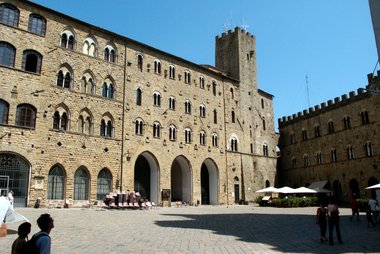

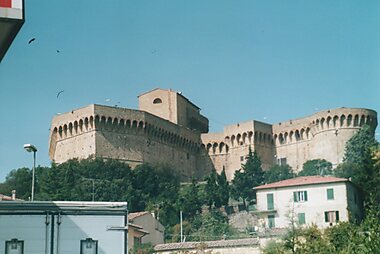
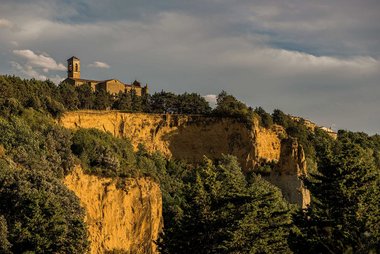
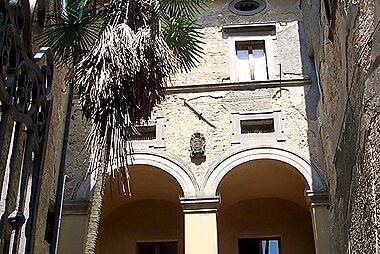
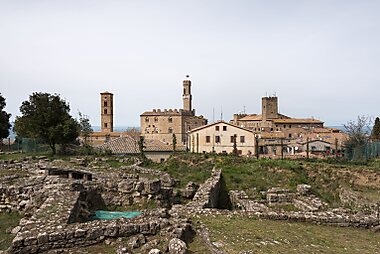
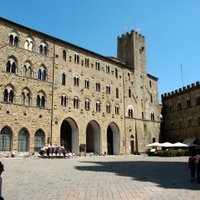
Piazza dei Priori is the medieval main square, closed in by stone palaces. It is the natural place to start a walk.
On the square, Palazzo dei Priori was begun in 1208 and is the oldest town hall in Tuscany. Inside you can visit the historic council rooms.
Just behind the square, Basilica Cattedrale di Santa Maria Assunta has a gilded coffered ceiling and a rare 13th-century wooden sculpture of the Deposition. The octagonal Battistero stands opposite its main door.
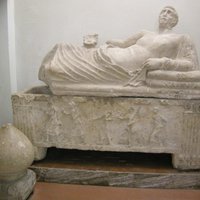
Museo etrusco Guarnacci holds hundreds of Etruscan funerary urns carved in alabaster and local stone. Its best-known pieces are the thin bronze figure called the Ombra della Sera and the terracotta Urn of the Spouses.
Pinacoteca e Museo Civico is the town's art gallery. Its highlight is the dramatic Deposition painted by Rosso Fiorentino in 1521.
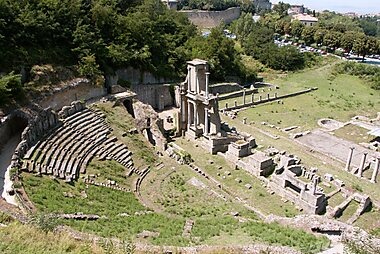
Teatro Romano dates from the 1st century BC and was uncovered in the 1950s. You can see it for free from the road along the walls above, or buy a ticket to walk among the ruins.
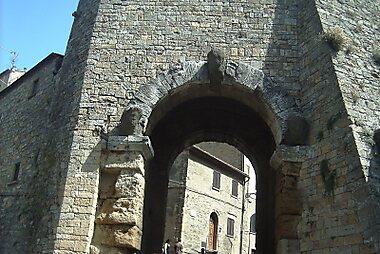
Porta all'Arco is an Etruscan city gate from the 4th to 3rd century BC. Three worn stone heads still look out from the arch.
In the hilltop park, Acropoli etrusca shows the foundations of two Etruscan temples and a large Roman cistern.
On the western edge of town, Le Balze are steep, eroding clay cliffs. Over the centuries they have swallowed churches and Etruscan tombs.
A combined 72-hour Volterra Card covers the main museums and archaeological sites. Musei di Volterra
Empfohlene Listen

Erlebnisse & Aktivitäten
Some of the best moments in Volterra are tied to its crafts and its views.
- Watch alabaster carvers at work: several workshops along Via Porta all'Arco and nearby streets still shape the stone by hand. Ecomuseo dell'alabastro explains how the stone travels from quarry to finished piece.
- Walk the walls at sunset: follow the road along the northern walls, above the Roman theatre, as the light falls on the Cecina valley.
- Learn about the prison theatre: Fortezza Medicea is still a working prison and is closed to visitors. Its inmate theatre company, the Compagnia della Fortezza, was founded in 1988 and has toured major Italian theatres.
Touren & Aktivitäten
Volterra — Karte

Tagesausflüge
Volterra sits in quiet country, so most day trips are easiest by car.
- Colle di Val d'Elsa — ≈30 min by car. A hill town with a long upper street of old palaces and a tradition of crystal glassmaking.
- Larderello — ≈40 min by car to the south. A geothermal area with steam rising from the hills, power-plant cooling towers and a museum about geothermal energy.
- San Gimignano — ≈40 min by car, or a direct bus in summer. The medieval town of stone towers and Vernaccia white wine.
- Siena — ≈1 hour by car, or by bus with a change in Colle di Val d'Elsa. The Gothic city of the Campo square and the striped cathedral.
- Pisa — ≈1 hour by car, or by bus and train via Pontedera. The Leaning Tower and the Field of Miracles.
- Florence — ≈1 h 20 min by car, or by bus via Colle di Val d'Elsa. Long for a day, but possible.
Orte zum Entdecken
Volterra fits easily into a tour of Tuscan towns and cities.
- Hill towns: San Gimignano, Montepulciano, Pienza and Montalcino.
- Cities: Siena, Pisa, Florence and Lucca.
- The coast: Cecina is the nearest beach town, west down the Cecina valley.
Anreise
- By air: Pisa airport is the closest, about 65 km away (≈1 hour by car). Florence airport is ≈1 h 20 min by car. Without a car, travel from Pisa to Pontedera by train, then take the bus.
- By train: there is no station on the hill. The usual rail gateway is Pontedera, on the Pisa–Florence line, with regular buses up to Volterra. Trenitalia
- By bus: Autolinee Toscane runs the regional buses. The main routes come from Pontedera and from Colle di Val d'Elsa, where you change for Florence and Siena. In summer a direct bus also runs from San Gimignano. Buses arrive at the edge of the old town. Autolinee Toscane
- By car: regional road SR68 links Volterra with the coast near Cecina and with Colle di Val d'Elsa. Road SR439 comes up from Pontedera.
Unterwegs vor Ort
- On foot: the walled centre is compact and best seen on foot. Expect some steep lanes and cobbles, especially near the walls and the park.
- Buses: you only need buses to leave town. Buy tickets in the Autolinee Toscane app or at a ticket office, or tap a contactless bank card when you board and again when you get off.
- Cycling: the centre is too steep and paved for easy riding. The quiet roads in the surrounding hills suit fit road cyclists and e-bikes.
Autofahren
- Is a car worth it? You do not need one in town. A car is the easiest way to see the countryside, since bus links are slow and infrequent.
- Restrictions: the historic centre is a limited traffic zone (ZTL) watched by cameras. Do not drive through the gates unless your hotel has registered your plate.
- Parking: use the paid car parks around the walls, such as Porta Fiorentina, Viale dei Filosofi, Stazione and Gioconovo. Rates are about 2 € per hour or 10–12 € per day, charged from 8:00 to 20:00. Enter your plate at the meter, and use the EasyPark or MyCicero app to extend your time.
Essen & Trinken
Volterra cooks hearty inland Tuscan food. Look for pappardelle with wild boar sauce, thick vegetable soups and grilled meat. The local sheep's cheese, Pecorino delle Balze Volterrane, has protected status. In autumn, truffles from the nearby woods appear on many menus.
Most restaurants and wine bars cluster along Via Matteotti, Via Guarnacci and the lanes around Piazza dei Priori. Volterragusto, an autumn food festival, fills the centre with local produce.
Sicherheit & Gesundheit
Volterra is a very safe town, and crime against visitors is rare. The main risks are physical: steep, worn stone streets become slippery in rain, and winter winds on the ridge can be strong.
At Le Balze the cliff edges are unstable, so stay behind fences and on marked paths. In summer, carry water and a hat, as there is little shade on the walls.
Geschichte
Volterra began as Velathri, one of the strongest cities of the Etruscans. Its huge stone walls enclosed far more ground than the later medieval town, and the city controlled the farmland, salt and minerals of the valleys below. Porta all'Arco and the temple foundations of Acropoli etrusca come from this time, while the urns in Museo etrusco Guarnacci show how its people honoured their dead.
Under Rome the town became Volaterrae and gained Teatro Romano. In the Middle Ages it was a free commune, and Palazzo dei Priori was built as the seat of its government. Rivalry with Florence ended in 1472, when Florentine troops sacked the town in a dispute over alum mines. The Medici then built Fortezza Medicea to control it.
Alabaster carving grew into a major trade in the 18th and 19th centuries, with Volterra pieces sold across Europe and beyond. In 1944, local people filled Porta all'Arco with paving stones to stop retreating German troops from blowing it up.
Länderfakten
Quick practical facts for Italy at a glance:
- Währung
- Euro EUR € · Kartenzahlung · Weitgehend akzeptiert
- Notrufnummern
- 112
- Stromnetz
- 230 V · 50 HzSteckertyp C / Steckertyp F / Steckertyp L
- Sprachen
- Italienisch
- Leitungswasser
- Trinkbar
- Fahrseite
- Rechtsverkehr
- Telefonvorwahl
- +39
Volterra – Plane deine Tage
Verwandle die Orte aus diesem Reiseführer in eine echte Reiseroute mit intelligenter Routenführung, Zeitschätzungen und allem für eine perfekte Reise.


Ähnliche Reiseziele



Data: © OpenStreetMap contributors, Wikidata, Wikipedia, Tripomatic, Official websites, geoBoundaries (CC BY 4.0). Tours by GetYourGuide. We earn commission from bookings. Travel guide generated with AI.
Plane deine Reise mit Tripomatic
- KI-gestützte PlanungErhalte mit einem Fingertipp einen fertigen Tag, lass die KI deine Merkliste über deine Reise verteilen oder plane alles im Chat.
- ReisewarnungenOffizielle Hinweise, Unwetter, Streiks und Naturgefahren für die Orte an jedem Tag deiner Reise.
- Feiertage & EventsSieh Feiertage, Festivals und Schließungen an den Tagen deiner Reise und erfahre, was sie für deine Pläne bedeuten.
- KostenschätzungKI-gestützte Reisekostenübersichten, damit du dein Budget schon vor der Abreise genau kennst.
- Touren & TicketsBuche geführte Touren, Tickets ohne Anstehen und Aktivitäten direkt in deinem Reiseplan.