Tripomatic

Berlin

City ·🇩🇪 Germany

Berlin is a city defined by reinvention. Divided by a wall for nearly three decades and rebuilt from ruins twice in the 20th century, it wears its history openly — sometimes as a solemn memorial, sometimes as a canvas for street art. Wide boulevards, Prussian palaces, and Cold War remnants sit side by side with a famously experimental cultural scene.

Germany's capital is also one of Europe's most creative cities, shaped for decades by cheap rent and open space into a hub for art, techno, and food culture drawn from all over the world. It rewards visitors who wander beyond the postcard sights into its distinct, individually flavored neighborhoods.

Berlin

Planning a Trip to Berlin?

Build your day-by-day itinerary in the Tripomatic app.

When to visit

Berlin has a temperate climate with warm summers and cold winters. Late spring through early autumn (May–September) brings the mildest, sunniest weather, ideal for exploring parks, open-air markets, and the city's famous Biergarten culture. Winters are cold and grey but atmospheric, especially around the Christmas markets that fill the city in December.

Best time to visit Berlin: May, June, July, August, September

Select a month

Typical weather in January

Poor
  • 3° (feels like -2°) · extremes -13°–9°
  • -2° at night
  • 13 rainy days
  • 3 sunny days
  • Dry air
  • Light breeze

Typical weather in February

Poor
  • 4° (feels like -1°) · extremes -12°–11°
  • -2° at night
  • 10 rainy days
  • 4 sunny days
  • Dry air
  • Light breeze

Typical weather in March

Poor
  • 9° (feels like 5°) · extremes -6°–16°
  • 1° at night
  • 12 rainy days
  • 4 sunny days
  • Dry air
  • Light breeze

Typical weather in April

Fair
  • 14° (feels like 11°) · extremes -1°–21°
  • 5° at night
  • 12 rainy days
  • 5 sunny days
  • Dry air
  • Light breeze

Typical weather in May

Great
  • 18° (feels like 17°) · extremes 3°–25°
  • 9° at night
  • 12 rainy days
  • 8 sunny days
  • Dry air
  • Calm winds

Typical weather in June

Great
  • 22° (feels like 21°) · extremes 8°–28°
  • 13° at night
  • 11 rainy days
  • 8 sunny days
  • Dry air
  • Calm winds

Typical weather in July

Great
  • 23° · extremes 11°–30°
  • 15° at night
  • 11 rainy days
  • 7 sunny days
  • Dry air
  • Calm winds

Typical weather in August

Great
  • 23° (feels like 24°) · extremes 11°–30°
  • 15° at night
  • 9 rainy days
  • 8 sunny days
  • Dry air
  • Calm winds

Typical weather in September

Great
  • 20° (feels like 19°) · extremes 7°–28°
  • 12° at night
  • 8 rainy days
  • 8 sunny days
  • Dry air
  • Calm winds

Typical weather in October

Good
  • 14° (feels like 12°) · extremes 1°–22°
  • 8° at night
  • 9 rainy days
  • 7 sunny days
  • Dry air
  • Light breeze

Typical weather in November

Poor
  • 7° (feels like 3°) · extremes -4°–13°
  • 2° at night
  • 11 rainy days
  • 4 sunny days
  • Dry air
  • Light breeze

Typical weather in December

Poor
  • 3° (feels like -1°) · extremes -13°–10°
  • -1° at night
  • 12 rainy days
  • 3 sunny days
  • Dry air
  • Light breeze

Climate data: Open-Meteo Climate API (EC_Earth3P_HR) · 1991–2020

Top sights

Berlin's landmarks span from Prussian grandeur to Cold War history. Here are the essentials for a first visit:

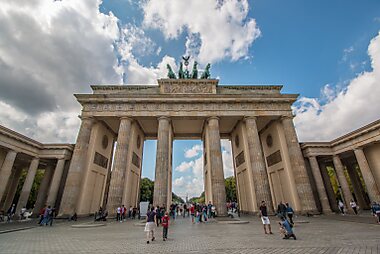
Brandenburg Gate is the city's defining symbol, a neoclassical monument that stood at the edge of the Berlin Wall's death strip and now marks the boundary between former East and West. Brandenburg Gate

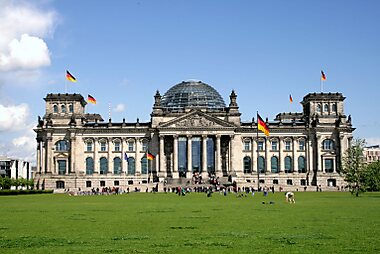
The Reichstag Building houses Germany's parliament beneath a striking glass dome by Norman Foster, open to visitors with advance registration and offering panoramic views over the city. Reichstag Building

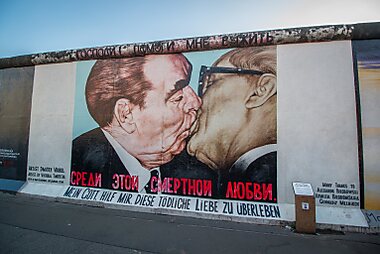
The East Side Gallery is the longest surviving stretch of the Berlin Wall, covered in over a hundred murals painted by artists after 1989. Berlin Wall

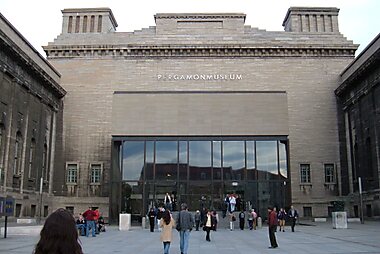
The Pergamon Museum on Museum Island holds monumental reconstructed antiquities, including the Ishtar Gate of Babylon, though parts of the museum periodically close for renovation. Pergamon Museum

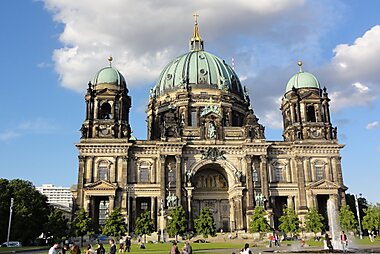
The Berlin Cathedral is a grand neo-Renaissance church on the Spree, with a dome that can be climbed for sweeping views of Museum Island. Berlin Cathedral

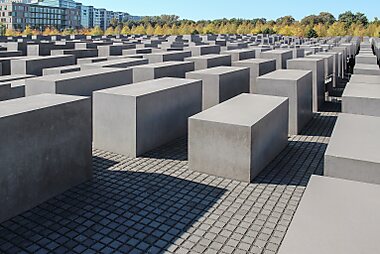
The Memorial to the Murdered Jews of Europe is a field of over 2,700 concrete slabs near Brandenburg Gate, a stark and widely visited Holocaust memorial. Memorial to the Murdered Jews of Europe

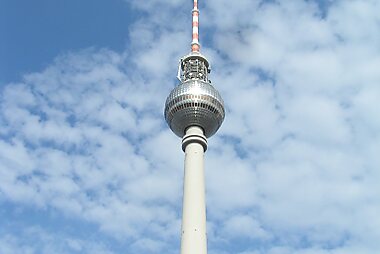
The Berlin TV Tower at Alexanderplatz is the tallest structure in Germany, with an observation deck and revolving restaurant offering the best skyline views in the city. Berlin TV Tower

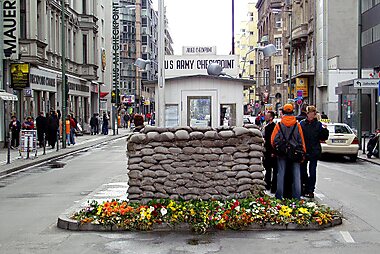
Checkpoint Charlie was the best-known crossing point between East and West Berlin during the Cold War, now a small open-air history exhibit. Checkpoint Charlie

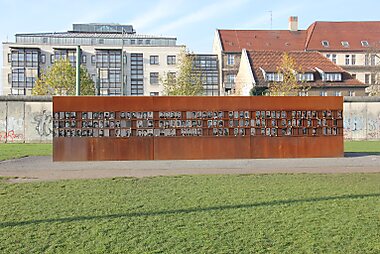
The Berlin Wall Memorial on Bernauer Strasse preserves an original section of the wall and the former death strip, with an outdoor exhibition on the city's division. Berlin Wall Memorial

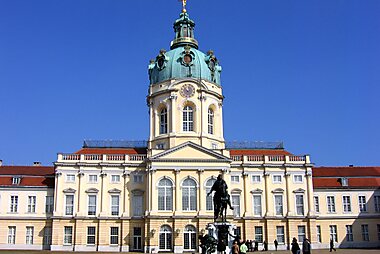
Charlottenburg Palace is Berlin's largest surviving royal residence, a Baroque palace with formal gardens on the western edge of the city center. Charlottenburg Palace

Explore Berlin

Berlin Essentials

Berlin Essentials

Berlin’s landscape reflects its transformation from a Prussian royal seat to a divided Cold War epicenter and a modern European capital. This selection features the neoclassical Brandenburg Gate and the Reichstag’s modern glass dome. Historical landmarks like the East Side Gallery and Checkpoint Charlie document the city's division, while the Jewish Museum and Museum Island preserve centuries of cultural heritage. Green spaces like the Tiergarten contrast with the high-tech architecture of the Sony Center, offering a comprehensive view of Berlin’s architectural and political evolution.

14 places
Editor's Choice

Editor's Choice

Berlin’s identity is shaped by its complex history and creative spirit. This selection highlights the city’s evolution, from the 1933 Nazi book burning memorial at Bebelplatz to the Cold War legacy preserved at the Stasi Museum and the abandoned NSA spy station on Teufelsberg. Beyond historical sites, the list features unique urban spaces like the repurposed Tempelhofer Feld airport and the street art-filled courtyards of Haus Schwarzenberg. Cultural staples include the 19th-century Markthalle Neun, the historic Clärchen's Ballhaus, and the world-renowned dinosaur collections at the Natural History Museum.

15 places
Hidden Gems of Berlin

Hidden Gems of Berlin

Beyond the Brandenburg Gate, Berlin reveals specialized collections and industrial relics. This list features the Renaissance Spandau Citadel, the preserved typography at the Buchstabenmuseum, and the Werkbundarchiv’s 20th-century design objects. Visitors can explore the massive Schwerbelastungskörper concrete cylinder, the mobile community plots of Prinzessinnengarten, and street art galleries like Urban Nation. These sites document the city's architectural evolution, from 19th-century water towers to contemporary alternative cultural hubs.

15 places
Berlin's Historic Landmarks

Berlin's Historic Landmarks

This collection spans Berlin's evolution from a Prussian capital to a reunited metropolis. It features the UNESCO-listed Museum Island, home to neoclassical gems like the Old Museum and the Pergamon Museum. Architectural highlights range from the 13th-century Gothic brickwork of St. Nicholas Church to the modern glass-domed Reichstag. The list also includes significant Cold War sites, such as the East Side Gallery section of the Berlin Wall and the Soviet War Memorial in Tiergarten.

15 places
Berlin's Top Museums

Berlin's Top Museums

Explore Berlin’s premier museums and cultural landmarks, featuring world-renowned art collections, historic palaces, and immersive history museums. This selection includes unique sites such as Museum Island with its five major museums, the iconic Berlin Wall open-air gallery, and royal residences like Charlottenburg Palace. Discover a diverse range of exhibits from ancient artifacts at the Pergamon Museum to contemporary urban art at Urban Nation, reflecting Berlin’s rich heritage and dynamic cultural scene.

17 places
Berlin Memorials & Monuments

Berlin Memorials & Monuments

This collection documents Berlin’s complex 20th-century history, focusing on the legacy of the Third Reich and the city's Cold War division. Highlights include the neoclassical Brandenburg Gate, the preserved border crossing at Checkpoint Charlie, and the East Side Gallery’s murals on the longest remaining Berlin Wall section. Visitors can explore the Stasi’s former headquarters, underground war bunkers, and the site of the 1942 Wannsee Conference. Memorials like Bebelplatz and the Soviet War Memorial in Treptower Park offer dedicated spaces for reflection on World War II and the Holocaust.

16 places
Top Museums & Galleries

Top Museums & Galleries

Berlin’s museum landscape spans millennia, centered on the UNESCO-listed Museum Island with its neoclassical structures like the Altes Museum and the Egyptian collections of the Neues Museum. The city’s complex 20th-century history is preserved at the DDR Museum, the Stasi Museum, and the East Side Gallery’s open-air murals. Art enthusiasts can explore Old Master paintings at the Gemäldegalerie, modern masterpieces at Mies van der Rohe’s Neue Nationalgalerie, or contemporary street art at Urban Nation. From the Baroque Charlottenburg Palace to the subterranean bunkers of the Berlin Underworlds, these institutions document global heritage and German reunification.

20 places
Castles and Palaces of Berlin

Castles and Palaces of Berlin

Berlin’s royal landscape is defined by the architectural ambitions of the Hohenzollern dynasty, ranging from the expansive Baroque wings of Charlottenburg Palace to the Renaissance fortifications of the Spandau Citadel. This collection features UNESCO-listed sites like Babelsberg and Glienicke, alongside urban landmarks such as the neoclassical Brandenburg Gate and the Rococo Ephraim Palace. These sites preserve Prussian history through decorative arts, royal apartments, and manicured gardens, illustrating the city's evolution from a fortified settlement to an imperial capital.

15 places
Historic Churches & Synagogues

Historic Churches & Synagogues

Berlin’s spiritual landmarks span eight centuries, showcasing architectural styles from medieval Gothic brickwork to modern memorials. This collection includes the city's oldest parish church, St. Mary's, and the Moorish Revival New Synagogue. Notable sites range from the ruins of the Kaiser Wilhelm Memorial Church, preserved as a war memento, to the minimalist Chapel of Reconciliation built on the former Berlin Wall 'death strip.' These active places of worship and museums reflect Berlin's complex religious history and its evolution from the Prussian era to the present day.

16 places
Historic Castles & Palaces

Historic Castles & Palaces

Discover Berlin's rich architectural heritage through 16 historic castles, palaces, and museums. The collection features exquisite examples of Baroque, Rococo, Neoclassical, and Renaissance styles, including royal residences like Charlottenburg Palace and hunting lodges such as Jagdschloss Grunewald. Many sites also house internationally renowned museum collections within iconic heritage buildings, reflecting the city's cultural and historical evolution.

16 places
Berlin Food & Dining Highlights

Berlin Food & Dining Highlights

Discover Berlin's diverse food and dining venues, from historic markets like Hackescher Markt and Markthalle Neun offering fresh local produce and gourmet events, to specialty shops such as Fassbender & Rausch Chocolatiers dedicated to fine chocolates. Enjoy traditional beer gardens, lively street food stalls, and unique eateries including the city's first Curry 36 outlet and the award-winning Lemke Brewery.

13 places
Berlin Nightlife & Entertainment

Berlin Nightlife & Entertainment

Berlin’s entertainment landscape spans from the world-renowned acoustics of Hans Scharoun’s Berlin Philharmonic to the historic 1936 Olympic Stadium. The city offers diverse venues including the Staatsoper Unter den Linden and the record-breaking stage of Friedrichstadt-Palast. Nightlife centers around districts like Hackescher Markt and Nollendorfplatz, featuring iconic techno clubs like Watergate and unique rooftop spots like Klunkerkranich. For independent culture, the repurposed Kulturbrauerei and the Renaissance-era Spandau Citadel serve as major hubs for concerts and events.

20 places
Berlin Views & Modern Architecture

Berlin Views & Modern Architecture

This collection showcases Berlin’s architectural evolution alongside its most striking panoramas. It spans from the historic Reichstag dome and the Baroque French Cathedral to modernist icons like Mies van der Rohe’s New National Gallery and Hans Scharoun’s Philharmonic. Visitors can explore unique vantage points, including the Cold War-era Teufelsberg hill, the Funkturm radio tower, and preserved GDR watchtowers, while discovering UNESCO-listed housing estates that defined 20th-century urban design.

17 places
Berlin's Best Parks & Gardens

Berlin's Best Parks & Gardens

Berlin's green landscape spans from the historic Tiergarten, once a royal hunting ground, to the expansive Tempelhofer Feld, a former airfield transformed into a massive public recreation space. The city offers diverse botanical experiences, including the 20,000-species collection at the Botanic Garden and the neo-baroque elegance of Körnerpark. Notable sites include the UNESCO-listed Babelsberg Park, the Soviet War Memorial in Treptower Park, and the community-led urban gardening at Prinzessinnengarten. These spaces reflect Berlin's evolution, from 19th-century landscaped gardens to innovative urban redevelopments along the River Spree.

15 places
Berlin Food & Drink Highlights

Berlin Food & Drink Highlights

Discover Berlin’s diverse culinary landscape through historic beer gardens, iconic fast food stands like Curry 36, vibrant markets such as Markthalle Neun and Hackescher Markt, and specialty shops including Fassbender & Rausch Chocolatiers. This selection highlights authentic local flavors alongside international influences, set in unique venues ranging from heritage buildings to lively outdoor squares.

15 places
Architectural Landmarks

Architectural Landmarks

Berlin’s architectural landscape spans centuries of stylistic shifts, from the 18th-century Prussian Neoclassicism of the Brandenburg Gate and Museum Island to the Baroque opulence of Charlottenburg Palace. This collection features 19th-century Neo-Renaissance landmarks alongside 20th-century milestones, including Mies van der Rohe’s functionalist New National Gallery and Hans Scharoun’s organic Berlin Philharmonic. Contemporary additions like Daniel Libeskind’s deconstructivist Jewish Museum and Helmut Jahn’s high-tech Sony Center illustrate the city’s post-reunification transformation and its commitment to diverse architectural innovation.

18 places
Berlin's Markets & Food Halls

Berlin's Markets & Food Halls

Berlin’s culinary landscape is defined by its historic "Markthallen" and dynamic street markets. Markthalle Neun and Marheineke Markthalle offer regional organic produce and gourmet specialties in restored 19th-century structures. Open-air markets at Maybachufer and Kollwitzplatz showcase the city's multicultural influence and artisanal goods. Complementing these are traditional landmarks like Prater Garten, the city's oldest beer garden, and Zur Letzten Instanz, a historic tavern serving regional German cuisine since the 17th century.

12 places
Zoos & Water Sports

Zoos & Water Sports

This collection features Berlin's notable animal parks including the historic Berlin Zoological Garden, home to over 1500 species, and Tierpark Berlin, established in 1955 on a former royal estate. It also includes Sea Life Berlin aquarium, plus prominent swimming and rowing venues with Olympic heritage and natural lake settings.

6 places

What to experience

  • Watch the sunset from the dome of the Reichstag Building, booked in advance for the best light over the city.
  • Walk the length of the Berlin Wall, taking in murals painted directly onto a surviving stretch of the Berlin Wall.
  • Stand at Brandenburg Gate at dusk, when the floodlit columns and fewer crowds make it feel far more monumental.
  • Ride the elevator up the Berlin TV Tower for a 360-degree view stretching well beyond the city on a clear day.
  • Spend an afternoon among the reconstructed antiquities of the Pergamon Museum on Museum Island.
  • Explore the courtyards and markets around Kreuzberg and Neukölln for Berlin's contemporary food and nightlife scene.

Tours & Activities

Map of Berlin

Day trips

Berlin sits within easy reach of several worthwhile excursions:

  • Potsdam: About 30–40 minutes by S-Bahn, this former Prussian royal seat is home to Sanssouci Palace and its extensive gardens, along with a well-preserved historic center.
  • Sachsenhausen Memorial: Roughly 1 hour by train, this former Nazi concentration camp near Oranienburg is preserved as a memorial and museum, offering a sobering counterpart to Berlin's wartime history.
  • Spreewald: About 1.5 hours by train, this UNESCO biosphere reserve is known for its network of canals, best explored by traditional punt boat, and for its pickled gherkins.
  • Dresden: Around 2 hours by train, this Saxon capital's rebuilt Baroque old town and art collections make it a worthwhile longer day trip or overnight stay.

Getting there

  • By air: Berlin Brandenburg Airport (BER) is the city's main gateway, connected to the center by regional trains (RE/RB) and the S-Bahn in roughly 30–45 minutes.
  • By train: Berlin Hauptbahnhof is one of Europe's largest rail hubs, with direct high-speed connections to Hamburg, Munich, Frankfurt, Prague, Vienna, and Warsaw.
  • By bus: The Zentraler Omnibusbahnhof (ZOB) handles long-distance coach services from across Germany and neighboring countries.

Getting around

  • Berlin's public transport network (BVG) combines U-Bahn (subway), S-Bahn (suburban rail), trams, and buses on a single zoned ticket system. A Tageskarte (day ticket) covering zones AB is usually sufficient for city visits.
  • Tickets can be bought from platform machines, the BVG app, or ticket offices; validate paper tickets before boarding.
  • The city is large, so combining a metro or tram ride with walking is typical rather than relying on foot travel alone. See BVG for official schedules and route planning.
  • Cycling is an excellent way to get around given the flat terrain and extensive bike lane network; bike-share services are widely available.

Food & drink

Berlin's food scene reflects its history as a magnet for migration, blending hearty German staples with cuisines from Turkey, Vietnam, the Middle East, and beyond. Street food is central to the city's identity: currywurst (sliced sausage in curried ketchup) and the Berlin-style döner kebab are both fiercely defended local inventions, best sampled at long-running stalls rather than tourist-oriented outlets.

Traditional German dishes like Eisbein (pork knuckle), Schnitzel, and Kartoffelsalat (potato salad) remain common on menus, especially in older beer halls. Berlin's beer culture centers on Pilsner-style lagers and the Berliner Weisse, a tart wheat beer traditionally served with a shot of fruit syrup. In summer, outdoor Biergarten fill parks like Tiergarten and along the Spree.

Lunch
Doner Kebab  Döner KebabA sandwich of roasted meat, salad, and sauce in flatbread, invented by Turkish immigrants in Berlin and now a national staple.
Dinner
SchnitzelA thin, breaded and fried cutlet, usually pork, served with potatoes or fries and a lemon wedge.
SauerbratenA pot roast marinated for days in vinegar and spices before slow cooking, served with red cabbage and dumplings.
Snacks & street food
BratwurstA grilled or fried pork sausage, often served in a bread roll with mustard, sold at stands nationwide.
CurrywurstSliced sausage topped with curry-spiced ketchup, a Berlin invention now popular across the country.
Pretzel  BrezelA large, chewy salted bread pretzel, especially common in Bavaria, often eaten with butter or cheese.
Sweets & desserts
Black Forest Cake  Schwarzwälder KirschtorteA layered chocolate sponge cake with cherries, cherry liqueur, and whipped cream.
Drinks
Beer  BierGermany brews hundreds of regional styles, from Bavarian Weissbier to Cologne's Kölsch, each tied to its home city.
Gluhwein  GlühweinMulled, spiced red wine served hot, a staple of winter and Christmas markets.
ApfelschorleApple juice mixed with sparkling water, the everyday non-alcoholic drink of choice.

Safety & health

Berlin is generally a safe city for visitors, with violent crime against tourists rare. The main concerns are petty theft and being alert around large crowds.

  • Pickpocketing can occur on crowded U-Bahn and S-Bahn trains and around major sights like Brandenburg Gate and Alexanderplatz.
  • Fare inspections on public transport are frequent and unannounced; always validate and carry your ticket, as fines for riding without one are strictly enforced.
  • Some neighborhoods have areas known for public drug use, particularly around parts of Görlitzer Park and certain U-Bahn stations late at night; ordinary caution is enough for most visitors.
  • Tap water is safe to drink throughout the city.
General emergency112
Police110
Ambulance112
Fire brigade112

History

Berlin's history is inseparable from the upheavals of 20th-century Europe. The city grew into an imperial capital under Prussia, with landmarks like Charlottenburg Palace reflecting its royal era, and Brandenburg Gate built in the late 18th century as a symbol of peace that would later come to represent the city's divisions.

World War II left much of the city in ruins, and its aftermath split Berlin between East and West for over 40 years. The Berlin Wall, erected in 1961, physically divided the city until its fall in 1989; sections survive today at the Berlin Wall and the Berlin Wall Memorial, while Checkpoint Charlie marks one of the most famous former crossing points. The Memorial to the Murdered Jews of Europe stands as a central reminder of the Holocaust. Since reunification, Berlin has rebuilt itself again as a hub for art, technology, and nightlife, with the Reichstag Building's glass dome — added during the 1990s renovation — symbolizing that transparency and renewal.

Country facts

Quick practical facts for Germany at a glance:

Currency
Euro EUR € · Card payments · Commonly accepted
Emergency numbers
112 Ambulance · Fire brigade
Electricity
Type C / Type F
230 V · 50 Hz
Languages
German
Tap water
Safe to drink
Driving side
Right
Calling code
+49
Learn more about Germany
Brandenburg Gate
Walk
Reichstag Building
Drive
Berlin Wall

Plan Your Days in Berlin

Turn the places from this guide into a real itinerary, with smart routing, time estimates, and everything you need for a perfect trip.


3M+ downloads · 4.6 stars · 15 years of trip planning
QR code
Scan to download the app

Related destinations

Other destinations in Germany