



Cambodia
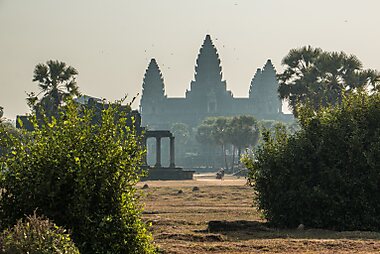
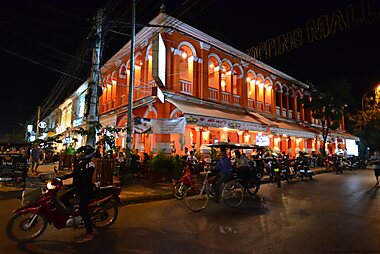
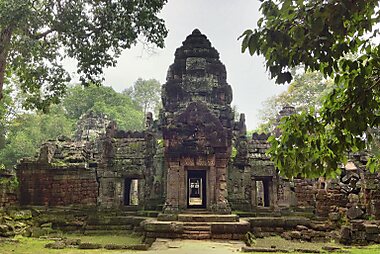
Cambodia is best known for Angkor Wat, the vast temple complex that draws visitors from across the world, but the country has far more to offer: a laid-back capital on the Mekong, quiet fishing towns on the Gulf of Thailand, and jungle-covered highlands near the Vietnamese and Laotian borders. Life still moves at the pace of the rivers that cross the country, and a Buddhist temple anchors almost every town.
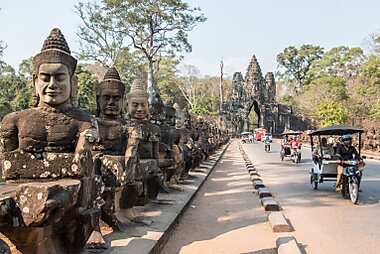
Cambodia's history swings between extremes: the Khmer Empire built Angkor into the largest pre-industrial city on Earth in the 12th century, and the 1970s brought the Khmer Rouge regime and a genocide that shaped the country for a generation. Cambodia has rebuilt quickly since, and now suits travelers who want cultural depth and beach time on a budget that stretches further than almost anywhere else in the region.

Cambodia – Planning a Trip?
Build your day-by-day itinerary in the Tripomatic app.


Money & payments
Cambodia runs on two currencies at once. Prices for hotels, tours, and anything over a dollar or two are usually quoted in US dollars, while the riel comes back as change for smaller amounts.
ATMs in cities dispense US dollars; carry riel or small dollar bills for markets, tuk-tuks, and rural areas where change is limited.
Featured Lists


Tours & Activities
Cambodia — Map

 Open the interactive map
 Tipping
Tipping is a growing habit in Cambodia's tourism industry, but it is never mandatory.
5–10%, sometimes already added as a service charge in tourist restaurants
$1–2 per bag for porters; a small note for housekeeping
round up the fare; $1–2 for a tuk-tuk or remork driver
$5–10 per day for a guide, less for a driver
Rounding up small bills instead of asking for exact change back doubles as a simple tip.
Electricity
Cambodia uses Type A, C, and G sockets at 230 V / 50 Hz — a mix of two-pin and UK-style three-pin outlets, so a universal adapter is worth packing.
Language
Khmer is the official language, written in its own script that shares no roots with Latin, Thai, or Vietnamese writing — street signs and menus outside tourist areas are often Khmer-only. English is spoken in hotels, restaurants, and tour operations in Phnom Penh, Siem Reap, and other tourist towns, but drops off quickly in rural areas.
Staying connected
Prepaid SIM cards from Smart, Cellcard, or Metfone are sold at the airport and phone shops in every town, and cost only a few dollars with a generous data allowance. eSIMs from international providers also work well in the main tourist areas.
Coverage is strong along the coast and in Phnom Penh and Siem Reap, but can thin out in the northeastern highlands around Ratanakiri and Mondulkiri.
Safety & emergencies
Cambodia is generally safe for tourists, and violent crime against visitors is rare. The most common problems are bag-snatching from passing motorbikes in Phnom Penh and Siem Reap, and overcharging or aggressive sales pitches from tuk-tuk drivers and touts. Keep bags on the side away from the road when walking or riding in a tuk-tuk.
Traffic is the biggest everyday risk — road rules are loosely followed and few motorbikes carry passengers safely. Landmines and unexploded ordnance still remain in some rural border areas, a legacy of decades of conflict — stick to marked paths and roads, especially away from major towns. The border with Thailand has also seen periods of military tension; check your government's current travel advisory before traveling near it or crossing overland.
Health
Stick to bottled or filtered water — tap water is not safe to drink, even in Phnom Penh.
Pharmacies are easy to find in cities and larger towns, and many stock familiar international brands; stock up before heading to remote areas like Mondulkiri or Ratanakiri, where options are limited. Dengue fever is present year-round, so mosquito repellent is worth packing everywhere, not just in the countryside. Malaria risk is mostly limited to forested, rural areas near the Thai and Laotian borders. Talk to a doctor or travel clinic about recommended vaccinations before your trip.
Visas & entry
Visitors from Vietnam, Laos, Malaysia, Singapore, Indonesia, and the Philippines can enter Cambodia visa-free for up to 30 days; those from Thailand, Brunei, and Myanmar get 14 days visa-free. Most other nationalities need a visa: apply for an e-visa online before arrival (around $30 for a 30-day tourist visa) or get a visa on arrival at major airports and land borders for a similar fee. Air travelers must also submit an online Cambodia e-Arrival Card within seven days before arrival.
Overland border crossings with Thailand can be affected by periods of border tension — check current conditions before planning a land crossing.
Visa and entry requirements change frequently. Verify current requirements with the official immigration authority or your country's embassy before travel.
Etiquette
Cover your shoulders and knees at temples like Angkor Wat, and at the Royal Palace — sarongs are sold outside most sites for visitors who arrive underdressed. Remove your shoes before entering a temple building or someone's home.
Women should avoid touching monks or handing them anything directly; place items down for a monk to pick up instead. The head is considered sacred and the feet the lowest part of the body, so avoid touching anyone's head and don't point your feet at people, Buddha images, or altars. A slight bow with palms pressed together, called the sampeah, is a polite greeting, though a handshake with foreigners is also normal. Bargaining is expected at markets, but not in shops with marked prices.
Holidays & opening hours
Cambodia follows the Buddhist lunar calendar for several of its biggest holidays, so exact dates shift year to year. Businesses, banks, and government offices close for these, and transport can book out well in advance around Khmer New Year and Pchum Ben, when much of the country travels to its home province.
Shops and markets generally stay open seven days a week with no fixed lunch break, though smaller family-run businesses may close for an hour or two in the early afternoon.
Getting around
Cambodia's official tourism board (Tourism Cambodia) lists current routes and operators. On the ground:
- By bus: The most practical way to cover long distances. Companies like Giant Ibis and Virak Buntham run air-conditioned coaches between Phnom Penh, Siem Reap, Sihanoukville, and most provincial towns, with tickets bookable online a day or two ahead.
- By train: Royal Railway runs two lines — Phnom Penh to Sihanoukville, and Phnom Penh to Battambang — with clean but slow service, better for a scenic trip than for saving time. Extensions toward the Thai border can be suspended during periods of border tension.
- By air: Domestic carriers connect Phnom Penh with Siem Reap and Sihanoukville in under an hour, worth it if a bus or train would eat too far into a short trip.
- By boat: Fast boats cross Tonle Sap between Siem Reap and Battambang in the wet season, and small ferries link the mainland to islands like Koh Rong.
Driving
- Renting a car: Self-driving is uncommon among visitors — most travelers hire a car with a driver, or get around towns by tuk-tuk and moto-taxi. An International Driving Permit is required to rent and drive yourself.
- Road conditions: Main highways between provincial capitals are paved and in decent shape; rural roads can turn to mud in the wet season, roughly May to October.
- Key rules: Motorbike riders and passengers are legally required to wear a helmet, though enforcement is inconsistent outside major cities.
- Parking: Free and informal in most towns; larger hotels and malls in Phnom Penh have dedicated parking areas.
- Fuel: Stations are staffed and take cash; card payment is not always available outside cities.
Food & drink
Cambodians eat three meals built around rice or rice noodles, with a bowl of soup close by at almost any time of day. Breakfast is often a noodle soup from a street stall, lunch is quick and market-based, and dinner tends to be a shared, multi-dish spread eaten at a table with the whole family.
Cambodian food leans on fresh herbs, lime, and fermented fish paste rather than the heavy spice of its neighbors — expect a curry to be fragrant rather than fiery. The Mekong and Tonle Sap keep freshwater fish and crab on nearly every menu, especially in coastal towns like Kep. Markets and night-market stalls are where most people actually eat, alongside simple open-air restaurants; sit-down dining rooms are mostly a city and tourist-town feature.
Where to explore
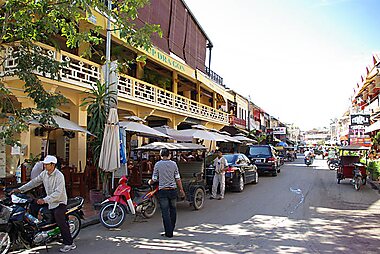
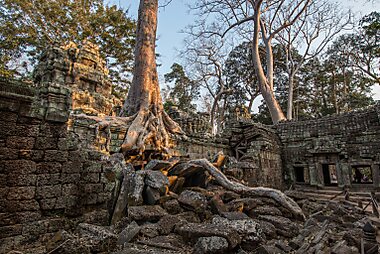
Most visits start in Phnom Penh, the riverside capital, and Siem Reap, the gateway to Angkor's temples — between them they cover most travelers' first week.
On the coast, Sihanoukville is the jumping-off point for boats to Koh Rong and other beach islands, while Kampot and Kep offer a quieter, small-town version of the same coastline, known for pepper farms and crab. Further west, Koh Kong sits near the Cardamom Mountains rainforest and the Thai border.
Battambang has Cambodia's best-preserved French-colonial center and a laid-back arts scene, Kampong Cham anchors the Mekong further east, and Kratie is the base for spotting rare Irrawaddy river dolphins. In the eastern highlands, Ban Lung and Sen Monorom are the main towns for waterfalls, crater lakes, and hill-tribe communities in Ratanakiri and Mondulkiri provinces.
Cambodia – Plan Your Trip
Pick the places you want to see and Tripomatic turns them into a day-by-day route, with smart routing, time estimates, and everything you need for a perfect trip.


Related destinations


Data: © OpenStreetMap contributors, Wikidata, Wikipedia, Tripomatic, Official websites, geoBoundaries (CC BY 4.0). Tours by GetYourGuide. We earn commission from bookings. Travel guide generated with AI.