



Phnom Penh
Phnom Penh is Cambodia's capital and largest city. It sits where the Mekong, Tonle Sap, and Bassac rivers meet, a confluence known locally as Chaktomuk, "four faces." For most travelers it is the country's other stop, the one before or after Angkor Wat. A working royal palace and gilded pagodas sit a short ride from sobering memorials to the Khmer Rouge years, and the city rewards travelers who want to understand that history, not just see landmarks.
Wide French-colonial boulevards and shophouses trace the city's time as a colonial capital. A handful of striking 1960s buildings by architect Vann Molyvann show a briefer, more hopeful era before 1975. Traffic is heavy and the heat is real, but two or three days is enough to see the highlights and eat well.

Phnom Penh – Planning a Trip?
Build your day-by-day itinerary in the Tripomatic app.


When to visit
Phnom Penh is hot and humid year-round, so timing is mostly about rain and heat rather than cold. The dry season, roughly November through February, is the most comfortable, with lower humidity and only occasional showers. March through May is the hottest stretch, often reaching the high 30s °C before the rains break. The wet season runs June to October, with heavy afternoon downpours but still plenty of sunny hours.
Plan around Bon Om Touk, the Cambodian Water Festival, held over three days in November when the Tonle Sap river's flow reverses. It is the single biggest event on the city's calendar. Hundreds of thousands of people fill Sisowath Quay for boat races, fireworks, and an all-night riverside party.
Top sights
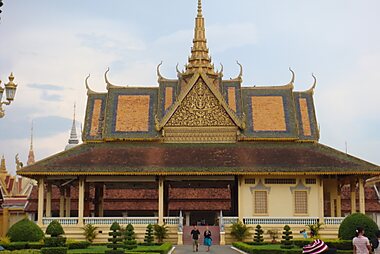
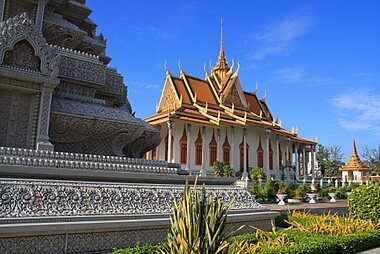


Royal Palace is the working residence of Cambodia's king. King Norodom moved the capital here in 1866 and built its gilded roofs and spires. Inside the same walled compound, Silver Pagoda houses a solid-gold Buddha statue set with thousands of diamonds. It takes its name from the silver tiles covering its floor.
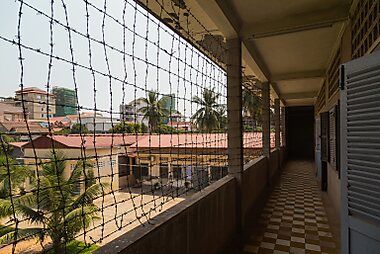
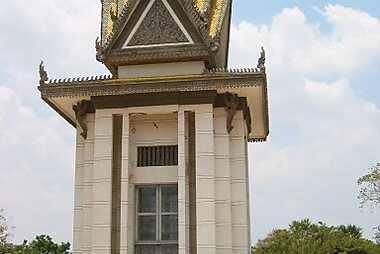
Tuol Sleng Genocide Museum is a former secondary school turned Khmer Rouge prison, known as S-21. It is one of the most direct ways to understand Cambodia's 1975–1979 period. Many visitors continue on to Choeung Ek Genocidal Center, the best known of the country's Killing Fields, where a memorial stupa holds the remains of thousands of victims.
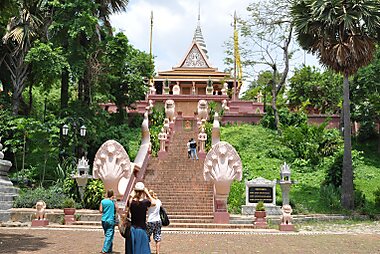
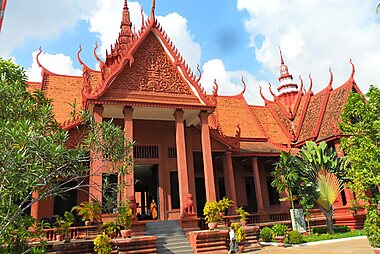
Wat Phnom Pagoda sits on the city's only hill and gives Phnom Penh its name, after the legend of a woman who found Buddha statues washed up on the riverbank. National Museum of Cambodia, just north of the palace, holds the country's finest collection of Khmer sculpture in a terracotta building from 1920.
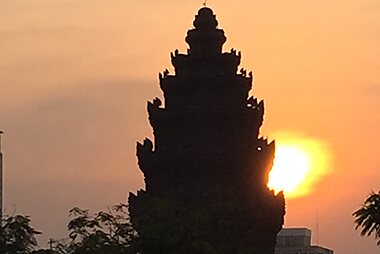
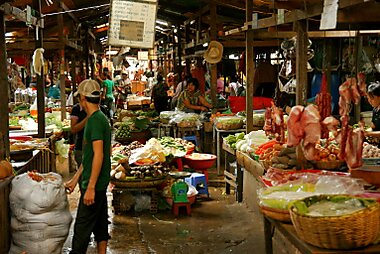
For a break from history, Central Market is an Art Deco market hall from 1937 with a soaring central dome, and Phsar Toul Tom Poung is the better spot to haggle over silk, silver, and souvenirs. Independence Monument marks Cambodia's 1953 independence from France with a lotus-shaped stupa, and Wat Ounalom, founded in 1443, is the headquarters of Cambodian Buddhism and one of the city's oldest pagodas.
Featured Lists


What to experience
- Join the riverside at dusk: every evening, locals gather in the parks along Sisowath Quay and around Independence Monument for free, open-air aerobics and dance sessions set to loud music — join in or just watch from a bench.
- Take a sunset cruise on the river: boats leave from the riverside for short trips out to Chaktomuk, the point where the Mekong, Tonle Sap, and Bassac rivers meet, with the Royal Palace lit up on the return.
- Ride a cyclo through the old quarter: Phnom Penh is one of the last Cambodian cities where pedal-powered cyclos still operate; a slow ride through the French colonial streets near the Post Office is a different way to see the city than by tuk-tuk.
Tours & Activities
Phnom Penh — Map

 Open the interactive map
 Day trips
A single free day from Phnom Penh stretches from a village visit just across the river to a cool hilltop pine forest.
- Koh Dach, also known as Silk Island — about 30–45 minutes by remorque and a short ferry crossing. A rural island of silk-weaving villages and quiet lanes, best explored by bicycle.
- Boeung Tonle Bati — about 45 minutes to an hour by car, roughly 35 km south. A lake ringed with picnic spots, next to the 12th-century Angkorian temple ruins of Ta Prohm and the smaller Yeay Peau shrine.
- Oudong — about an hour by road, roughly 40 km northwest. Cambodia's royal capital for two centuries before Phnom Penh, marked today by a ridge of stupas with views over the countryside.
- Kirirom National Park — about 1.5–2 hours southwest. Cambodia's oldest national park, a plateau of pine forest and waterfalls that runs noticeably cooler than the city, worth the longer drive for the change of scenery.
Where to explore
Phnom Penh is usually one stop on a wider Cambodia trip. Siem Reap, home to Angkor Wat, is the most common pairing. It is reachable by a short flight or a five-to-six-hour road trip. On the coast, boats to Cambodia's southern islands leave from Sihanoukville, and Kampot offers a slower riverside town known for its pepper farms. West of the capital, Battambang keeps the country's best-preserved French colonial streetscape and a lively contemporary art scene.
Getting there
- By air: Techo International Airport (KTI), about 30 km south of the city, opened in 2025 and now handles all of Phnom Penh's commercial and international flights. An airport express bus runs between the airport and the city centre; taxis and ride-hailing apps take roughly 45–60 minutes depending on traffic.
- By bus: Long-distance coaches connect Phnom Penh to every major Cambodian town and to neighbouring Vietnam and Thailand, arriving at several private bus stations around the city.
- By boat: Fast boats run seasonally along the Tonle Sap between Phnom Penh and Siem Reap, though the road or a flight is faster and more reliable, especially in the dry season when river levels drop.
- By train: Royal Railway runs passenger trains south from Phnom Penh to Sihanoukville and Kampot most days, and a weekend service northwest to Battambang and the Thai border at Poipet. Trains are slower than the bus but a scenic option — check current timetables before relying on one.
Getting around
- Tuk-tuks and remorques: motorbike-drawn carriages are the standard way to get around. Hail one on the street and agree a price first, or book through a ride-hailing app for a fixed fare.
- Ride-hailing: Grab and PassApp both operate widely in Phnom Penh and are usually the easiest, most transparent way to book a ride or a motorbike taxi.
- On foot: the riverside strip and the streets around the Royal Palace and National Museum are walkable, but heat, humidity, and heavy traffic make longer walks tiring — plan short stretches rather than crossing the whole city on foot.
Driving
- Is a car worth it?: No — chaotic traffic, few road signs, and constant motorbike traffic make self-driving stressful and unnecessary in the city. Tuk-tuks and ride-hailing cover everything in town.
- For day trips: hiring a car with a driver is the easiest way to reach Tonle Bati, Oudong, or Kirirom National Park, and costs little more than a full day of tuk-tuk negotiating.
- Parking: hotels and shopping malls have their own car parks; informal street parking with an attendant is common elsewhere and normally costs a small cash tip.
Food & drink
Cambodian food centres on rice, freshwater fish, and a lighter hand with spice than its neighbours. Look for amok, a steamed fish curry set in a banana leaf, and bai sach chrouk, grilled pork over rice eaten as a breakfast staple from street stalls across the city. Kampot pepper, grown a few hours south, turns up in much of the local cooking.
For eating out, head to the streets around Sisowath Quay Riverwalk, where riverside restaurants serve Khmer food alongside Mekong views, or the BKK1 neighbourhood south of the palace, which has the city's densest cluster of cafes and modern Cambodian restaurants. For cheap, authentic everyday food, the stalls around Phsar Toul Tom Poung draw as many locals as visitors.
Safety & health
Phnom Penh is generally safe for tourists, and violent crime against visitors is rare. The most common problems are petty: bag and phone snatching by passing motorbikes, especially along the riverside at night, and occasional overcharging by tuk-tuk drivers who steer visitors toward commission-paying shops. Keep bags on the side away from the road and agree prices before getting in a tuk-tuk.
Traffic is the bigger everyday risk — crossing the street takes a steady pace and constant awareness, since vehicles do not reliably stop, and motorbikes sometimes travel against the flow of traffic.
History
Legend places Phnom Penh's founding in 1372, when a woman named Penh is said to have found four Buddha statues washed up on the riverbank and built a shrine on the city's only hill, now Wat Phnom Pagoda. The city served on and off as a royal capital for centuries before King Norodom made it permanent in 1866 and built Royal Palace on the riverfront.
Under the French protectorate, from 1863 to 1953, Phnom Penh grew into a colonial capital of wide boulevards and market halls, including Central Market. Independence came in 1953, marked today by the Independence Monument. The 1960s brought a burst of ambitious new architecture, before the Khmer Rouge captured the city in April 1975 and forcibly emptied it within days.
Between 1975 and 1979, the Khmer Rouge turned a former school into Tuol Sleng Genocide Museum, an interrogation and torture centre. Prisoners were trucked to Choeung Ek Genocidal Center for execution, part of a genocide that killed an estimated 1.5 to 2 million Cambodians. Vietnamese forces ousted the regime in 1979, and the city has been rebuilding and growing ever since.
Country facts
Quick practical facts for Cambodia at a glance:
- Currency
- Cambodian Riel KHR ៛ · Card payments · Commonly accepted
- Electricity
- 230 V · 50 HzType A / Type C / Type G
- Languages
- Khmer
- Tap water
- Not safe to drink
- Driving side
- Right
- Calling code
- +855


Phnom Penh – Plan Your Days
Turn the places from this guide into a real itinerary, with smart routing, time estimates, and everything you need for a perfect trip.


Related destinations


Data: © OpenStreetMap contributors, Wikidata, Wikipedia, Tripomatic, Official websites, geoBoundaries (CC BY 4.0). Tours by GetYourGuide. We earn commission from bookings. Travel guide generated with AI.