



Siem Reap
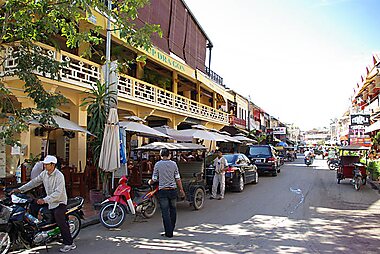
The Khmer Empire made this region its capital more than a thousand years ago, and its temples still draw travelers from every corner of the world. Siem Reap city itself is compact and easy to navigate. Tree-lined streets and a slow river run past colonial-era shophouses turned into cafes and guesthouses. Most visitors come for one reason: the Angkor temples spread across the countryside just north of town. But the city has grown into a destination in its own right, with a serious food scene, night markets, and a circus troupe founded by genocide survivors.
This is a trip for travelers who want a few days of temple exploring balanced with easy city life. It suits first-time visitors to Southeast Asia as well as return travelers chasing sunrise over a specific temple. Bring good walking shoes and sun protection — most of the best sights involve stone steps and open courtyards with little shade.

Siem Reap – Planning a Trip?
Build your day-by-day itinerary in the Tripomatic app.


When to visit
Cambodia has three seasons: cool and dry from November to February, hot and dry from March to May, and rainy from June to October. November through February is the most comfortable stretch, with lower humidity and cooler mornings.
Plan around Khmer New Year in mid-April for water-throwing, traditional games, and family gatherings across the city. It is the country's most festive time, though also its hottest.
Afternoon downpours are common from May through October, but they rarely last long, and the temples look striking in the mist afterward.
Top sights

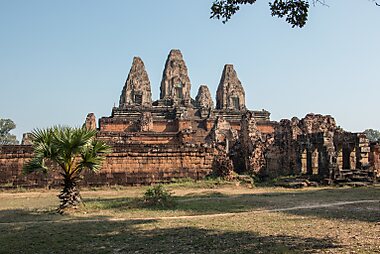
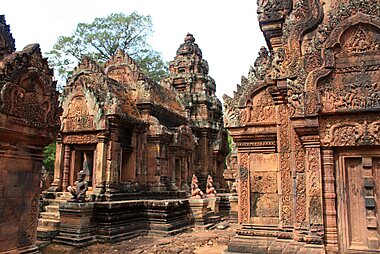
Most Angkor temples require a pass, sold at the official ticket office: $37 for one day, $62 for three days, or $72 for seven days. Cover your shoulders and knees to enter any temple.
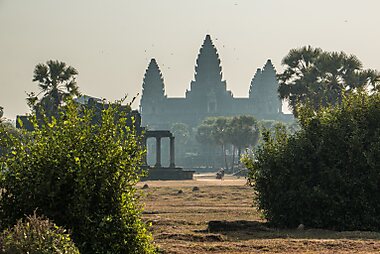
Angkor Wat is the largest religious monument on Earth and the reason most travelers come to Siem Reap. Arrive before sunrise to watch its five towers turn gold behind the reflecting pools.
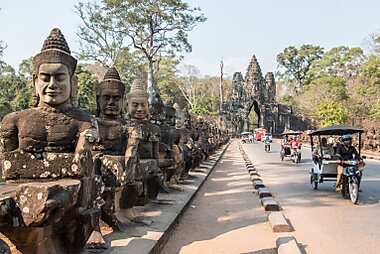
Angkor Thom is the last great walled capital of the Khmer Empire, built by King Jayavarman VII. Its five gates and the Bayon temple at its center are carved with giant stone faces. Climb to Bayon's upper terrace for a close look at the carvings.
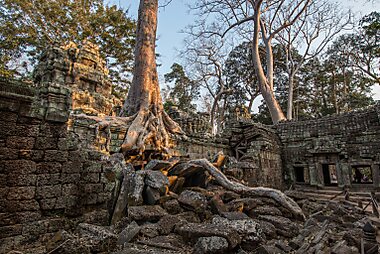
Ta Prohm is the temple where giant fig and silk-cotton trees grow through the stone walls, left largely as it was found when explorers rediscovered it. It featured in the film Tomb Raider and remains one of the most photographed temples in the complex.
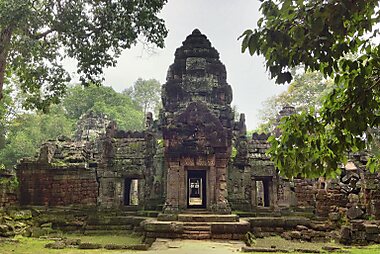
Preah Khan was built by King Jayavarman VII to honor his father and draws far smaller crowds than the temples nearby. Its ruined, tree-covered corridors reward slow exploring.
Banteay Srei sits 25 km from the main temple group and is carved from pink sandstone with detail so fine it's often called the jewel of Khmer art. Go early to beat the tour groups.
Climb Phnom Bakheng for one of the best sunset views over the jungle canopy, with Angkor Wat's silhouette visible in the distance. Space at the top is limited, so arrive early.
Angkor National Museum is a good stop before or after the temples, with well-organized galleries that explain the history and religion behind what you're about to see.
Featured Lists


What to experience
- Watch a performance by Phare, The Cambodian Circus, a circus troupe founded by genocide survivors that blends acrobatics, live music, and Cambodian storytelling — proceeds fund a free arts school for local children.
- Take a sunrise or sunset boat ride on Tonle Sap Lake to see the floating villages up close as fishing families start or end their day.
- Join a Khmer cooking class to learn dishes like amok and lok lak before eating what you make.
- Get a traditional foot or full-body massage at one of the many spas near the town center after a day of walking temple grounds.
- Attend an Apsara dance dinner performance, a classical Khmer dance form depicting royal court traditions and Hindu mythology, offered at restaurants around town.
Tours & Activities
Siem Reap — Map

 Open the interactive map
 Day trips
Siem Reap sits close to several worthwhile trips beyond the main temple circuit.
- Kbal Spean, about an hour's drive north, is a riverbed carved with hundreds of Hindu carvings, reached by a short jungle hike.
- Tonle Sap Lake, roughly 45 minutes south by tuk-tuk, is Southeast Asia's largest freshwater lake and home to floating villages like Chong Kneas, where houses, schools, and shops rise and fall with the water level.
- Phnom Kulen National Park, about 1.5 hours away, holds a waterfall and a mountaintop reclining Buddha carved into rock. Kbal Spean, described above, sits inside the same park.
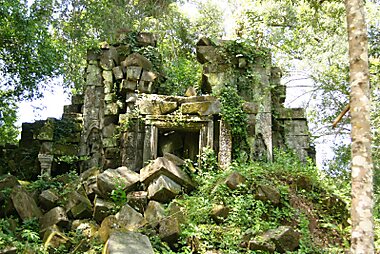
- Beng Mealea, around 1.5 hours east, is a jungle temple left almost entirely unrestored. It feels like discovering a lost ruin, with fallen stone blocks you can climb over.
- Battambang, around 3 hours by car, is one of Cambodia's largest cities, known for French colonial architecture, a bamboo train ride, and a lively arts scene.
Where to explore
Two protected natural areas within Siem Reap province are easy add-ons to a temple-focused trip.
Tonle Sap Lake is Southeast Asia's largest freshwater lake and floods to many times its dry-season size every year, supporting fishing villages that float on its surface. Phnom Kulen National Park is considered the birthplace of the Khmer Empire and mixes forest hiking with sacred carvings and a waterfall popular with local families on weekends.
Getting there
- By air: Siem Reap Angkor International Airport (SAI), around 45 km east of the city center, is the main gateway. A taxi into town usually takes 60–90 minutes depending on traffic.
- By road from Phnom Penh: buses and shared taxis run the route along National Road 6, several times a day.
- By road from Thailand: travelers arriving overland from Bangkok typically cross at the Poipet border and continue to Siem Reap by bus.
Getting around
- Tuk-tuks and remork-motos are the main way to get around and to reach the temples. Agree on the fare before you get in, or ask your guesthouse to arrange a driver for a half or full day covering multiple temples.
- Bicycles work well for the town center and for confident riders heading to the closer temples; many hotels rent bikes.
- Ride-hailing apps such as Grab operate in Siem Reap and are a reliable way to book a car or tuk-tuk without negotiating the fare yourself.
- On foot, the town center around Old Market and the river is easily walkable, but the temples are spread over a wide area and need a vehicle between sites.
Driving
- Is a car worth it? No — nearly every visitor gets around Siem Reap and the temples with a hired tuk-tuk driver or a private car with driver, both inexpensive compared to self-driving.
- Self-driving: renting a car is uncommon for tourists here and not recommended; local road rules and driving habits differ from what most international visitors are used to.
- Motorbike rental: scooters can be rented, but Cambodia has a high rate of traffic accidents and many travel insurance policies exclude scooter injuries — a licensed driver is the safer choice.
Food & drink
Siem Reap's food scene ranges from street-side noodle stalls to ambitious modern-Khmer restaurants that draw visitors from across the region. Try fish amok, a coconut curry steamed in a banana leaf, alongside other Khmer staples like lok lak and fresh spring rolls.
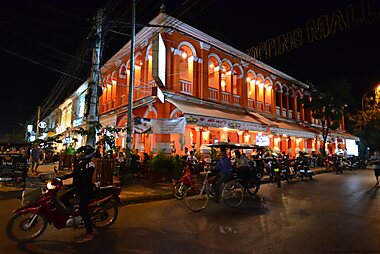
For a concentrated taste of the city, head to the streets around Old Market, where market stalls, juice bars, and small local restaurants cluster together, or browse the food stands at Angkor Night Market in the evening. Pub Street is livelier and more geared toward late-night drinking than serious eating.
Safety & health
Siem Reap is generally safe for tourists, and violent crime against travelers is rare. The most common issues are overcharging by tuk-tuk drivers and vendors, and occasional bag-snatching from motorbikes in busier areas — keep bags on the side away from the road.
Stick to bottled or filtered water; tap water is not safe to drink here. Watch your step at temple sites — stone stairs are steep, uneven, and can be slippery after rain.
Landmines remain in some rural areas away from marked tourist paths, a legacy of the country's past conflicts. Stay on marked paths at all times when visiting Phnom Kulen or other rural sites.
History
Siem Reap grew around Angkor Wat and the wider Angkor Archaeological Park, the capital region of the Khmer Empire from the 9th to the 15th century. At its height, Angkor was one of the largest pre-industrial urban centers in the world, supported by a vast network of canals and reservoirs.
King Jayavarman VII, who built Ta Prohm and Preah Khan in the late 12th century, expanded the empire and covered it in Buddhist monuments after converting from Hinduism. The empire declined after repeated invasions, and the capital was largely abandoned by the 15th century, leaving the temples to the jungle until French explorers popularized them in the 19th century.
The region's more recent history is darker: Siem Reap suffered under the Khmer Rouge regime in the late 1970s, and the temples were sometimes used as military positions during the decades of conflict that followed. Restoration and tourism picked up seriously only from the 1990s onward, and the temples were named a UNESCO World Heritage Site in 1992.
Country facts
Quick practical facts for Cambodia at a glance:
- Currency
- Cambodian Riel KHR ៛ · Card payments · Commonly accepted
- Electricity
- 230 V · 50 HzType A / Type C / Type G
- Languages
- Khmer
- Tap water
- Not safe to drink
- Driving side
- Right
- Calling code
- +855
Most prices in Siem Reap are quoted and paid in US dollars, with Cambodian riel used mainly for small change under a dollar.


Siem Reap – Plan Your Days
Turn the places from this guide into a real itinerary, with smart routing, time estimates, and everything you need for a perfect trip.


Related destinations


Data: © OpenStreetMap contributors, Wikidata, Wikipedia, Tripomatic, Official websites, geoBoundaries (CC BY 4.0). Tours by GetYourGuide. We earn commission from bookings. Travel guide generated with AI.