



Karlovy Vary Region
The Karlovy Vary Region fills the far west of Bohemia, along the German border, and is the heart of Czech spa culture. Its three great spa towns — Karlovy Vary, Mariánské Lázně, and Františkovy Lázně — grew up around natural mineral springs and are recognized together as a UNESCO World Heritage site. Beyond the colonnades, the region is dense forest, the Krušné Hory (Ore Mountains) along the border, and small medieval towns built on mining and river trade.
This is a region for a slower trip: taking the waters, walking wooded spa parks, and exploring a scattering of castles rather than checking off one big city. It suits travelers who want a quieter, greener counterpart to Prague, ideally with a few nights based in one spa town and day trips to the others.

Karlovy Vary Region – Planning a Trip?
Build your day-by-day itinerary in the Tripomatic app.


When to visit
Summers are warm and pleasant, spring and autumn are mild and quieter, and winters are cold with reliable snow in the Krušné Hory highlands.
The Karlovy Vary International Film Festival, held every July, is the region's biggest event and one of the world's oldest film festivals; expect the spa town to fill up and hotels to book out months ahead.
Best time to visit: August
July and August bring the warmest, driest weather for walking the spa colonnades and forest trails, though this is also when the film festival brings the heaviest crowds to Karlovy Vary itself.
Top sights

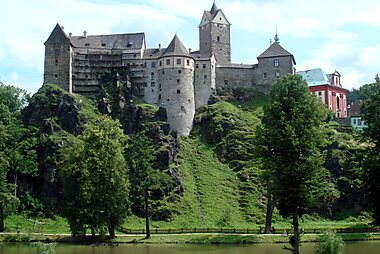



Loket Castle rises on a rocky spur almost encircled by the Ohře River in Loket. First built in Romanesque style in the 12th century, it is one of the oldest stone castles in the country.
Cheb Castle in Cheb began as a Romanesque imperial palace built for Holy Roman Emperor Frederick Barbarossa; its black-stone tower is the oldest structure still standing in Cheb's old town.
Bečov nad Teplou Castle holds one of the region's greatest treasures, a Romanesque gold reliquary casket that was hidden under the chapel floor after the Second World War and rediscovered only in the 1980s.
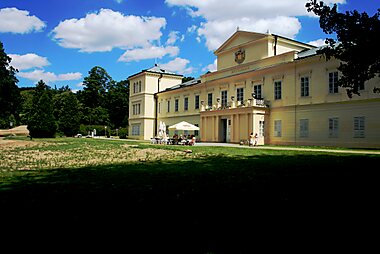
Kynžvart Castle is a neoclassical chateau that was the country retreat of Klemens von Metternich, the Austrian statesman who shaped 19th-century Europe; its library and cabinet of curiosities remain much as he left them.
Svatošské skály, a cluster of granite rock towers rising above the Ohře valley near Loket, is a popular spot for a short hike and a riverside picnic.
Kolonáda Maxima Gorkého is the elegant cast-iron colonnade at the heart of Mariánské Lázně, wrapping around mineral springs that visitors can still taste for free.
Komorní hůrka is one of only a handful of extinct volcanoes in Central Europe, an easy walk from Františkovy Lázně with trailside panels explaining the region's volcanic past.
Featured Lists


What to experience
- Take the cure: sip the free mineral water from a colonnade spring in Karlovy Vary or Mariánské Lázně using a lázeňský pohárek, the traditional spouted spa cup sold in every souvenir shop in town.
- Watch the Singing Fountain perform a synchronized water, light, and music show several times a day in season at Zpívající fontána in Mariánské Lázně.
- Hike or ski the Krušné Hory ridge, the mountain range along the German border, on marked summer trails or at one of the region's small winter ski resorts.
- Walk an old mining tunnel at Důl Mauritius, following passages once dug by hand for the tin ore that built the region's early wealth.
Tours & Activities
Karlovy Vary Region — Map

Day trips
Beyond the spa towns and castles covered above, these destinations make a good day out, ordered from closest to farthest.
- Waldsassen, just across the German border about 15–20 minutes' drive from Cheb, has a grand Baroque basilica and a Cistercian abbey library often described as one of the finest in Europe.
- Bad Elster, a small German spa town about 30 minutes from Františkovy Lázně or Aš, makes an easy add-on if you are already crossing the border, with its own historic bathhouses and colonnade.
- Plzeň, about 90 minutes by car (slower by train), is home to the original Pilsner Urquell brewery and a lively historic square, worth a half or full day.
- Saxon Switzerland National Park, roughly 2 hours north by car from Karlovy Vary or Ostrov, is a dramatic landscape of sandstone towers and river gorges above the Elbe in Germany, a flagship trip for hikers willing to go a little farther.
Where to explore
The region's other towns cluster into two groups: the spa triangle and a handful of historic market towns.
Spa towns: Beyond Karlovy Vary, the region's largest and most visited spa town, Mariánské Lázně is quieter and more genteel, laid out in sweeping parkland, and Františkovy Lázně is the smallest and least visited of the three, known for its pastel Empire-style buildings.
Historic towns: Cheb has a well-preserved medieval square and centuries of history as a border trading post between Bohemia and Bavaria. Loket is a small walled town wrapped by a loop of the Ohře River, best known for the castle above it. Ostrov pairs a Baroque chateau park with the Sacred District, an unusual walled group of three chapels and a former monastery.
Getting there
- By air: Prague's Václav Havel Airport (PRG) is the main gateway, about 130 km and roughly 1.5 hours by car from Karlovy Vary; a direct bus service also runs from the airport straight to Karlovy Vary. Karlovy Vary Airport (KLV) has some seasonal charter flights, mainly to Mediterranean beach destinations, but no year-round scheduled service, so most travelers still arrive via Prague.
- By train: Regional trains reach Karlovy Vary and Cheb from Prague, but the journey is slow, around 3 to 3.5 hours, since there is no direct fast line. Cheb also sits on the route linking Nuremberg, Germany, with Prague.
- By bus: Express coaches are usually the fastest and cheapest way in from Prague, taking around 1.5 to 2 hours to Karlovy Vary or Cheb, with frequent daily departures.
Getting around
- Public transit: Regional buses, part of the IDOK integrated transport system, link the region's towns, but service outside the main spa towns and Cheb thins out significantly, especially on weekends, so check timetables before planning a rural day out. Karlovy Vary and Cheb also run local town buses with on-board ticket purchase from the driver. IDOK journey planner
- Taxi / ride-hailing: Bolt operates in Karlovy Vary and Cheb; coverage is thin elsewhere in the region.
- On foot / cycling: The spa towns themselves are compact and walkable, but distances between them call for a car or train. The Ohře River cycle route links Cheb, Loket, and Karlovy Vary along a mostly flat, well-marked path.
Driving
- Is a car worth it?: Yes — many castles, viewpoints, and smaller spa towns sit well outside the rail network, and a car is the easiest way to link them in a single day.
- Parking: All three spa towns have paid car parks near their centers; Karlovy Vary and Mariánské Lázně fill up on summer weekends, so arrive early or use a park-and-ride lot on the edge of town.
- Restrictions: None beyond the usual pedestrian-only zones in the spa town centers; the region has no low-emission or congestion charge zone.
Food & drink
Spa cuisine is the region's specialty: light, easily digestible dishes originally prescribed alongside the mineral-water cure, plus the wafer-thin lázeňské oplatky (spa wafers), a sweet treat sold warm from bakeries across Karlovy Vary and Mariánské Lázně.
The region is also home to Becherovka, an herbal liqueur first distilled in Karlovy Vary in 1807 and usually drunk as a digestif; order it as a Beton, the local mix of Becherovka and tonic water, if you want the everyday version rather than a shot. Away from the spa towns, expect the same hearty Czech pub food found across the country.
Safety & health
The Karlovy Vary Region is very safe for travelers, including at night in the spa towns. The main risk is overcharging rather than crime: some private parking operators and unofficial currency exchange booths near the spa colonnades charge well above market rates, so use official car parks and banks or ATMs instead of street kiosks.
Tap water is safe to drink everywhere in the region. The mineral spring water at the colonnade taps is different — it is meant to be sipped in small amounts as part of the cure, not drunk freely, and can taste strongly mineral or sulphurous.
History
The region's story starts with water. Its mineral springs were used since the Middle Ages, and legend credits Charles IV, Holy Roman Emperor and King of Bohemia, with founding Karlovy Vary in the 14th century after a hunting dog is said to have flushed a stag into a hot spring. By the 19th century the spa towns had become a fashionable meeting place for European royalty, artists, and composers, and in 2021 Karlovy Vary, Mariánské Lázně, and Františkovy Lázně were jointly inscribed as a UNESCO World Heritage Site, the Great Spa Towns of Europe.
Mariánské Lázně has its own literary legend: the German poet Johann Wolfgang von Goethe returned there summer after summer in old age, and in 1823 fell in love with a much younger woman, Ulrike von Levetzow. Her family turned down his marriage proposal, and the heartbreak inspired his Marienbad Elegy, one of his last major poems.
Long before the spas, the region's wealth came from mining. Tin and silver drawn from the Krušné Hory funded towns such as Loket, where Loket Castle is one of the oldest stone castles in the country, and Cheb, where Cheb Castle was once a residence of Holy Roman Emperor Frederick Barbarossa.
Country facts
Quick practical facts for the Czech Republic at a glance:
- Currency
- Czech Koruna CZK Kč · Card payments · Commonly accepted
- Emergency numbers
- 112
- Electricity
- 230 V · 50 HzType C / Type E
- Languages
- Czech
- Tap water
- Safe to drink
- Driving side
- Right
- Calling code
- +420
Karlovy Vary Region – Plan Your Trip
Pick the places you want to see and Tripomatic turns them into a day-by-day route, with smart routing, time estimates, and everything you need for a perfect trip.




