


Florence
Florence is the birthplace of the Renaissance, a city where five centuries of art and architecture fill a walkable historic center. The Medici banking family funded many of the painters, sculptors, and architects who built its churches and palaces, leaving Florence with one of the highest concentrations of Renaissance art anywhere in the world. The historic center sits along the Arno river and is small enough to explore mostly on foot.
The poet Dante Alighieri was born here in 1265, and his exile from the city still shapes how Florentines tell their own history. Florence suits travelers who want deep art and architecture in a compact space rather than a fast-paced modern city. Expect crowds at the major sights, especially in summer, and book tickets for the busiest museums ahead of time.

Florence – Planning a Trip?
Build your day-by-day itinerary in the Tripomatic app.
When to visit
Spring and autumn are mild and the best time to visit, with fewer crowds than summer. Summer is hot, humid, and the most crowded season, while winter is cold but quiet, with shorter museum lines.
Plan around Calcio Storico Fiorentino, a fierce, centuries-old costumed football tournament played on three weekends in June and capped by fireworks on June 24, the feast of Florence's patron saint.
Best time to visit: May, September, October
Top sights
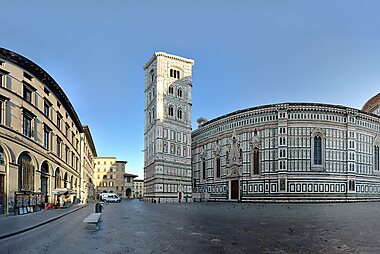
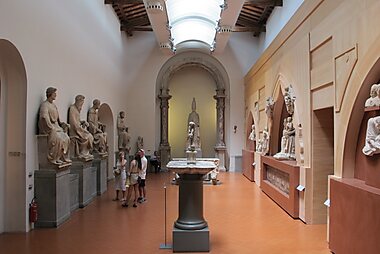
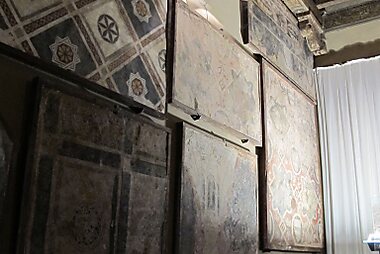
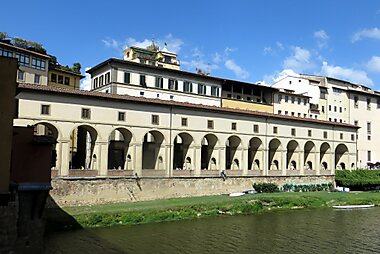
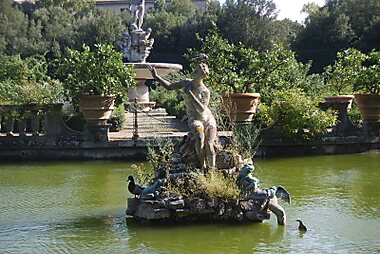
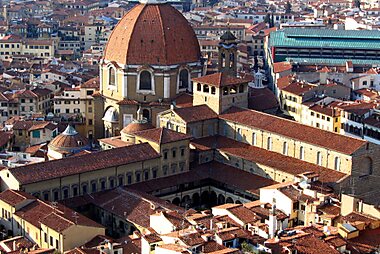
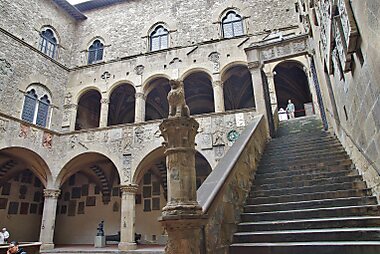
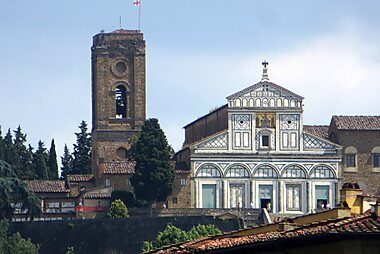
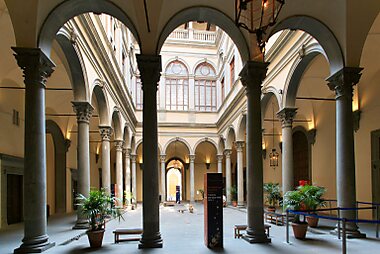
Florence Cathedral dominates the skyline with Brunelleschi's dome, a Renaissance engineering feat you can still climb for views over the rooftops. Next to it, Florence Baptistery holds Lorenzo Ghiberti's bronze doors, nicknamed the Gates of Paradise by Michelangelo.
Uffizi Gallery holds a major collection of Renaissance painting, including works by Botticelli and Leonardo da Vinci. Book tickets in advance to skip the line.
Ponte Vecchio is the only bridge in Florence that survived the Second World War, and its shops have sold gold jewelry since the 16th century.
Palazzo Vecchio is Florence's fortress-like town hall, still the seat of city government, with a museum inside covering Medici-era art and politics.
Accademia Gallery houses Michelangelo's David, carved from a single block of marble and moved here from Piazza della Signoria in 1873.
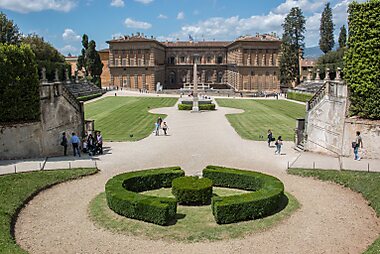
Pitti Palace was the Medici family's later residence, now home to several museums and the Renaissance gardens behind it.
Basilica of the Holy Cross is the burial place of Michelangelo, Galileo, and Machiavelli, and its frescoed chapels are among the city's finest.
Featured Lists


Florence's Sacred Masterpieces
Florence's greatest churches, basilicas and chapels, rich in Renaissance and Gothic art.
16 places


Audio Guides – Florence
Explore on foot with a self-guided audio tour that narrates each stop as you reach it.

Best of Florence: Must-See Places
69 min2.8 km9 stops
Walk through the heart of Renaissance Florence, from Michelangelo's David to the golden dome of the cathedral, the civic square where the Medici ruled, the world's greatest Renaissance art collection, and the shop-lined Ponte Vecchio over the Arno. This compact, mostly flat loop through the historic centre starts near the Accademia Gallery and finishes across the river in the authentic Oltrarno quarter, taking in the city's unmissable landmarks in the order a first-time visitor should see them.

Florence: The Medici Murders
65 min2.8 km8 stops
Florence built its Renaissance glory on Medici money and Medici blood. This documentary-style walk follows the family's darkest chapters: the 1478 Pazzi conspiracy's attempt to slaughter the Medici during Easter Mass at the Duomo, the brutal public reprisals at Palazzo Vecchio, a duke murdered by his own cousin, and a Grand Duke's unexplained death that closed the dynasty's first great line. The walk begins at the Medici family crypt near San Lorenzo, an easy walk from the Duomo, and ends across the Arno at the Pitti Palace.

Hear Florence's audio tours
2 walks in Audio Guides by Tripomatic


What to experience
- Catch sunset from Piazzale Michelangelo, a panoramic square across the Arno where locals and visitors gather to watch the city turn gold.
- Join the evening aperitivo ritual: order a drink at a bar around Piazza Santo Spirito or the Sant'Ambrogio market and get a plate of snacks included in the price.
- Watch leather workers, goldsmiths, and bookbinders at their benches in small Oltrarno workshops, a craft tradition that has continued here for centuries.
Tours & Activities
Florence — Map

 Open the interactive map
 Day trips
Florence sits at the heart of Tuscany, so some of Italy's most famous towns and wine country are within easy reach.
- Fiesole — ≈20 min by bus. A hill town above Florence with Etruscan and Roman ruins and sweeping views back over the city.
- Chianti wine country, centered on Greve in Chianti — ≈35 min by car (over an hour by public bus). Rolling vineyards, wine tastings, and a relaxed break from museum-going.
- Pisa — ≈1 hr by direct train. Home to the Leaning Tower and its cathedral square, easily seen in half a day.
- San Gimignano — ≈1 hr 15 min by bus (change at Poggibonsi) or by car. A walled medieval town famous for its stone towers, once a status symbol for its wealthiest families.
- Siena — ≈1 hr 15 min by direct bus, or 1 hr 30 min by train via Empoli. A Gothic rival city to Florence, built around a shell-shaped main square and known for the Palio horse race.
Getting there
- By air: Florence Airport (Amerigo Vespucci, FLR) is about 5 km from the center, with a tram taking roughly 20 minutes downtown. It has limited international routes, so many travelers fly into Pisa Airport (Galileo Galilei, PSA) instead, connected to Florence by a short shuttle to Pisa's main train station and then a regional train, about 1 hr in total.
- By train: Santa Maria Novella Train Station is Florence's main station, with frequent high-speed trains to Rome (≈1 hr 30 min), Milan (≈1 hr 45 min), Venice, and Bologna.
- By bus: Regional and long-distance coaches to Tuscan towns depart from the bus station next to the train station.
Getting around
- Public transit: The historic center is compact, but ATAF buses and tram lines connect it to the outskirts. Buy tickets from tabacchi shops, vending machines, or the official app before boarding — buses do not sell tickets on board. Autolinee Toscane journey planner
- Taxi / ride-hailing: Uber in Florence works only as a licensed chauffeur service (Uber Black/Van), not standard ride-hailing; hailing a taxi at a stand or by phone is usually faster and cheaper.
- On foot: The historic center is small, largely pedestrian, and best explored on foot. Streets are cobblestone in many places, so wear comfortable shoes.
Driving
- Is a car worth it?: No. Florence's historic center bans most private traffic, and the city is easiest on foot or by public transit. A car is only useful for day trips into the Tuscan countryside.
- Parking: Park at a guarded lot outside the center — for example near the train station or Piazzale Michelangelo — and walk or take a bus in; street parking inside the center is scarce and heavily restricted.
- Restrictions: The historic center is a ZTL (limited traffic zone), enforced by cameras, with heavy fines for unauthorized entry, even for a brief stop to drop off luggage.
Food & drink
Florence's signature dish is bistecca alla fiorentina, a thick T-bone steak grilled rare over charcoal and sold by weight — expect to share one between two or three people. Other local specialties include ribollita, a hearty bread-and-vegetable soup, and lampredotto, a tripe sandwich sold from carts around the city.
For a concentrated taste of local food, browse the stalls at Central Market, an indoor food hall with produce, meat, cheese, and casual eating counters. The Oltrarno district, south of the river, has a denser cluster of small, traditional trattorias than the busier streets near the Duomo.
Safety & health
Florence is safe for tourists; violent crime against visitors is rare. The main risks are pickpocketing and bag-snatching in crowded areas — around the Duomo, on buses, and near the main train station — so keep bags zipped and in front of you. Watch for the common scam of a stranger offering a free bracelet or flower and then demanding payment; walk away without engaging.
Free public drinking-water fountains are common around the historic center, so bring a reusable bottle to refill instead of buying bottled water.
History
Florence began as the Roman colony of Florentia, founded around 59 BCE along the Arno river. It grew into a wealthy medieval trading and banking city, and by the 15th century the Medici banking family had become its unofficial rulers. Their wealth funded the artists and architects — Filippo Brunelleschi, Michelangelo, Sandro Botticelli, Leonardo da Vinci — who built and decorated Florence Cathedral, Palazzo Vecchio, and the other churches and palaces that still define the city today.
Not every era was peaceful. In 1497, the friar Girolamo Savonarola staged the "Bonfire of the Vanities" in Piazza della Signoria, burning books, art, and luxury goods he judged sinful, before being executed there himself the following year. Florence later served briefly as the capital of a newly unified Italy, from 1865 to 1871, while Rome was still outside Italian control.
Country facts
Quick practical facts for Italy at a glance:
- Currency
- Euro EUR € · Card payments · Widely accepted
- Emergency numbers
- 112
- Electricity
- 230 V · 50 HzType C / Type F / Type L
- Languages
- Italian
- Tap water
- Safe to drink
- Driving side
- Right
- Calling code
- +39


Florence – Plan Your Days
Turn the places from this guide into a real itinerary, with smart routing, time estimates, and everything you need for a perfect trip.




