


San Gimignano
San Gimignano is a small walled hill town in the Tuscan countryside between Florence and Siena. It is famous for its medieval skyline. Rich merchant families once built dozens of stone tower houses here, and 14 of them still stand. The historic centre has been a UNESCO World Heritage Site since 1990.
Inside the walls, the town is compact and mostly car-free, with two linked main squares, frescoed churches and long views over vineyards and olive groves. It is also the home of Vernaccia di San Gimignano, a crisp white wine. Most visitors come on a day trip, so staying overnight lets you see the streets quiet in the early morning and evening. It suits a slow stop on a Tuscan road trip, with good walking and wine country all around.

San Gimignano – Planning a Trip?
Build your day-by-day itinerary in the Tripomatic app.


When to visit
Late spring (May and June) and early autumn (September and October) are the best times, with warm days and green or harvest-coloured hills. July and August are hot and the town is very crowded at midday. Winter is cool and damp, and many shops and restaurants keep shorter hours.
The biggest annual event is the Ferie delle Messi, a medieval harvest festival on the third weekend of June. Hundreds of people in costume parade through the streets. The weekend ends with the Giostra dei Bastoni, a contest between the four town quarters in the park of Rocca di Montestaffoli.
Best time to visit: May, June, September, October
Top sights
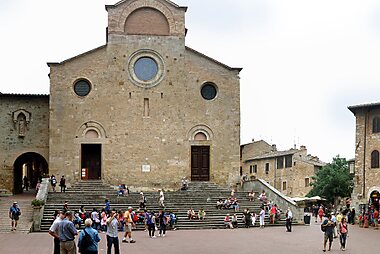
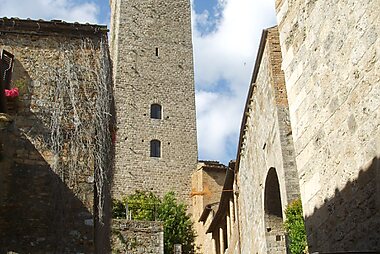
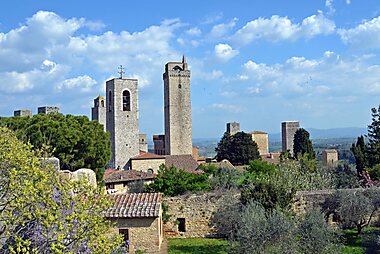
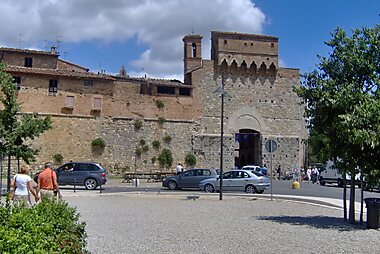
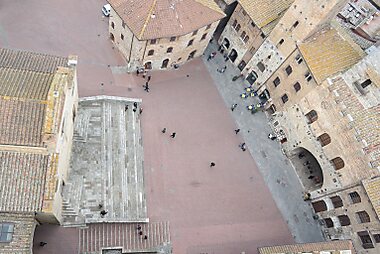
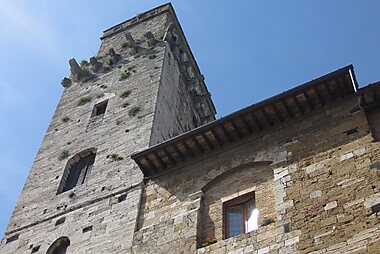
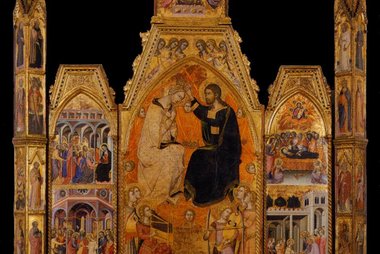
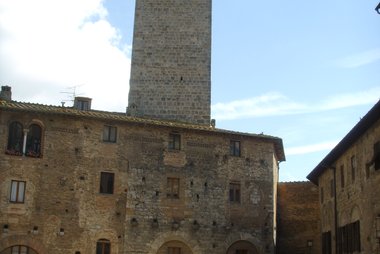
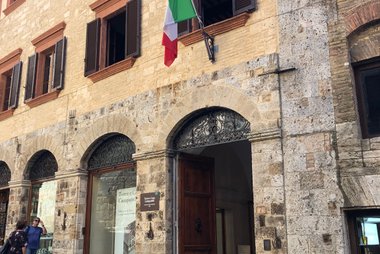
Collegiata di Santa Maria Assunta is the main church of the town. Its plain facade hides an interior covered in 14th-century frescoes of Old and New Testament scenes, plus the Chapel of Santa Fina painted by Domenico Ghirlandaio.
Piazza del Duomo is the civic and religious heart of the town, framed by the Collegiata, the town hall and several towers.
Piazza della Cisterna is a sloping triangular square around an old stone well, ringed by tower houses. It is the town's favourite meeting point.
Museo Civico fills the upper floors of the medieval town hall. Highlights are the Sienese and Florentine paintings and the large Maestà fresco by Lippo Memmi in the council hall named after Dante.
Torre Grossa is the tallest tower in town at 54 metres. The same ticket as the museum lets you climb it for the best view over the rooftops and the Elsa valley.
Chiesa di Sant'Agostino is a large 13th-century church at the quiet northern end of town. Its choir holds Benozzo Gozzoli's fresco cycle of the life of Saint Augustine.
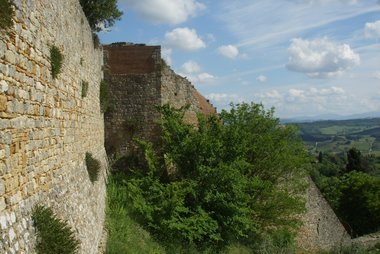
Rocca di Montestaffoli is the ruined hilltop fortress next to the Collegiata. Its walls enclose a small park, and the remaining tower gives a classic view of the town's skyline.
Torre dei Campatelli is a medieval tower house with its later family home, run by the Italian heritage trust FAI. It shows how a tower family lived over the centuries.
Porta San Giovanni is the main southern gate, completed in 1262. Most visitors enter the town here.
Featured Lists

San Gimignano's Timeless Towers and Medieval Heart
Known as the "Town of Fine Towers," San Gimignano keeps 14 of its medieval tower houses inside a ring of 13th-century walls. This UNESCO World Heritage site centres on two linked squares, Piazza del Duomo and Piazza della Cisterna, with the frescoed Collegiate Church, the town hall museums and the 54-metre Torre Grossa. Highlights also include the Sant'Agostino church with its Renaissance frescoes, the Rocca di Montestaffoli viewpoint and the Porta San Giovanni gateway.
14 places


What to experience
Some of the best moments here are tied to the town's walls, wine and seasons.
- Climb a tower at sunset: go up Torre Grossa late in the day, when the light turns the towers and hills gold.
- Taste Vernaccia where it is made: the white wine of San Gimignano was the first Italian wine to get DOC status, in 1966. Try it at Museo del Vino Vernaccia di San Gimignano or visit one of the wineries in the hills just outside town.
- Walk the countryside below the walls: a path leads down from the Porta delle Fonti to Fonti medievali, the old stone washing fountains. Longer walkers can follow a stage of the Via Francigena pilgrim route, which passes through town.
- See the town after the day-trippers leave: tour buses leave in the late afternoon. Stay for an evening walk through the empty squares.
- Join the Ferie delle Messi: in June, the four town quarters compete in archery and other games in medieval costume.
Tours & Activities
San Gimignano — Map

 Open the interactive map
Day trips
San Gimignano sits in the middle of Tuscany, so many famous towns are an easy day out. Public transport usually means a change in Poggibonsi, so a car gives the most freedom.
- Colle di Val d'Elsa — ≈20 min by car. A two-level hill town known for its crystal glass workshops and quiet upper old town.
- Certaldo — ≈20 min by car or bus. The upper town, reached by funicular, is the brick village of the writer Giovanni Boccaccio.
- Monteriggioni — ≈30 min by car. A tiny village completely enclosed by a ring of 13th-century walls and towers.
- Volterra — ≈40 min by car, or a seasonal direct bus. An Etruscan and medieval hilltop town famous for alabaster carving and wide views.
- Siena — ≈1 hour by car or bus. The great Gothic city of the Campo square and the Duomo.
- Greve in Chianti — ≈1 hour by car through vineyards. The market town at the heart of the Chianti wine region.
- Florence — ≈1 hour 15 min by car, or train and bus. The Renaissance capital of Tuscany.
Where to explore
San Gimignano is one of many classic stops in Tuscany. These destinations combine well with it on a longer trip.
- Nearby cities: Florence, Siena, Pisa and Lucca.
- Hill towns: Volterra, Montepulciano, Pienza and Cortona.
- Wine country: Greve in Chianti in the Chianti hills and Montalcino, home of Brunello.
Getting there
San Gimignano has no railway station. The usual gateway is Poggibonsi, about 12 km away in the valley below.
- By air: Florence Airport (FLR) is the closest, about 1 hour by car. Pisa Airport (PSA) has more flights and is about 1.5 hours by car. From either airport, take the train into the city and continue by train and bus as below.
- By train: take a regional train to Poggibonsi-San Gimignano station. It is about 1 hour from Florence (some trains need a change at Empoli) and about 30 minutes from Siena. You can buy one combined train and bus ticket to "S. Gimignano Centro Storico". Trenitalia
- By bus: Autolinee Toscane buses run from the square in front of Poggibonsi station to the town gates in about 20 minutes. From Florence, the 131 express bus to Poggibonsi is a good alternative to the train. From Siena, bus 130/A sometimes runs through to San Gimignano without a change. On board you can tap a contactless bank card; tap it when you get on and when you get off. Autolinee Toscane
- By car: the town is about 15 minutes from the Florence–Siena expressway, exit Poggibonsi Nord.
Getting around
- On foot: the walled centre is small and best seen on foot. From the southern gate to the northern gate is about 1 km, with some steep and cobbled streets.
- Buses: Autolinee Toscane buses stop at the main gates, Porta San Giovanni and Porta San Matteo. Buy tickets in the at bus app or at a ticket office, or tap a contactless bank card on board when you get on and again when you get off. Autolinee Toscane
- Cycling: the town itself is too steep and crowded for bikes. The surrounding hills are popular with fit road cyclists and e-bike tours.
Driving
- Is a car worth it? yes, if you want to explore the countryside, wineries and nearby hill towns. You do not need a car inside the town.
- Restrictions: the walled centre is a limited traffic zone (ZTL) enforced by cameras. Only residents and guests of hotels inside the walls with a permit may drive in.
- Parking: use the paid car parks outside the walls. Giubileo (P1) is closest to Porta San Giovanni, and Montemaggio (P2) and Bagnaia (P3) are a short walk away. Car parks fill up by late morning in summer, so arrive early.
Food & drink
San Gimignano's own specialties are Vernaccia white wine and saffron, which has been grown around the town since the Middle Ages. Local menus also feature Tuscan classics such as pici pasta, wild boar, pecorino cheese and cured meats.
For something distinctive, queue for an ice cream at Gelateria Dondoli on Piazza della Cisterna. Its owner, Sergio Dondoli, is a gelato world champion, and flavours use local saffron and Vernaccia. For meals, the quieter side streets away from Via San Giovanni have better value than the main squares. The farm restaurants and wineries in the surrounding hills are worth the drive for a long lunch.
Safety & health
San Gimignano is very safe. Violent crime is rare, and the main nuisance is crowding at midday in high season. Keep an eye on bags and phones in the busy squares and on crowded buses.
The streets are steep and cobbled, so wear good shoes and carry water on hot summer days. Climbing the towers involves many narrow steps.
History
A small Etruscan village stood on this hill as early as the 3rd century BC. The town grew rich in the Middle Ages from the Via Francigena, the pilgrim road to Rome, and from trade in saffron and wine.
Rival families built tower houses to show their wealth and to defend themselves, and at its peak the town had around 72 of them. The commune built its own tower, Torre Grossa, finished in 1311 next to the town hall. Dante Alighieri came here in 1300 as an ambassador of the Tuscan Guelph League and spoke in the council hall that now carries his name, inside Museo Civico.
The Black Death of 1348 killed about half of the townspeople, and soon afterwards San Gimignano came under the rule of Florence. The Florentines built Rocca di Montestaffoli to control the town. Trade moved elsewhere, and the town was left almost unchanged. That decline is why the medieval skyline survived. Today San Gimignano 1300 shows a scale model of the town as it looked around 1300.
Country facts
Quick practical facts for Italy at a glance:
- Currency
- Euro EUR € · Card payments · Widely accepted
- Emergency numbers
- 112
- Electricity
- 230 V · 50 HzType C / Type F / Type L
- Languages
- Italian
- Tap water
- Safe to drink
- Driving side
- Right
- Calling code
- +39


San Gimignano – Plan Your Days
Turn the places from this guide into a real itinerary, with smart routing, time estimates, and everything you need for a perfect trip.


Related destinations


Data: © OpenStreetMap contributors, Wikidata, Wikipedia, Tripomatic, Official websites, geoBoundaries (CC BY 4.0). Tours by GetYourGuide. We earn commission from bookings. Travel guide generated with AI.
Plan your trip with Tripomatic
- AI-Powered PlanningGet a ready-made day in one tap, let AI spread your shortlist across your trip, or plan everything by chatting.
- Travel AlertsOfficial advisories, severe weather, strikes, and natural hazards for the places on each day of your trip.
- Public Holidays & EventsSee holidays, festivals, and closures on the days of your trip, and what they mean for your plans.
- Cost EstimationAI-powered trip cost breakdowns so you know what to budget before you go.
- Tours & TicketsBook tours, skip-the-line tickets, and activities directly in your plan.