



Hanoi
Hanoi is Vietnam's capital and one of Southeast Asia's oldest continuously inhabited cities, with roots stretching back over a thousand years. Its Old Quarter has narrow streets still named after the goods once traded there, packed with street food stalls, workshops and motorbikes. French colonial buildings sit beside Buddhist pagodas and Soviet-era monuments, giving the city a layered, unpolished character that is different from Ho Chi Minh City's newer skyline.
A few days here suits travelers who want history, food and genuine city atmosphere rather than a resort experience. Hanoi is also the natural base for trips to Ha Long Bay, Ninh Binh and the countryside north of the city. Ho Chi Minh, the founder of modern Vietnam, made Hanoi his base for decades, and the mausoleum built in his memory remains one of the city's most visited sites.

Hanoi – Planning a Trip?
Build your day-by-day itinerary in the Tripomatic app.


When to visit
Spring (Feb–Apr) and autumn (Sep–Nov) are the most comfortable times to visit, with milder temperatures and less rain. Summer (May–Aug) is hot, humid and prone to sudden downpours, while winter (Dec–Jan) is cool, dry and often grey.
Time a trip around Tết, Vietnamese Lunar New Year, in late January or February, to see the city's flower markets and festive lights — though many shops, restaurants and sights close for several days around the holiday itself, so plan carefully if traveling then.
Best time to visit: January, February, November, December
Even in the better months, expect overcast, drizzly spells; Hanoi rarely gets the bright dry-season sun of southern Vietnam.
Top sights
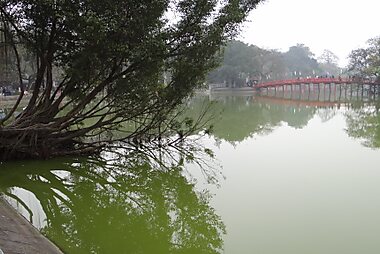
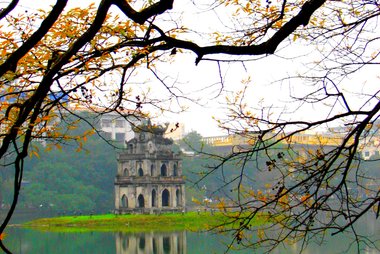
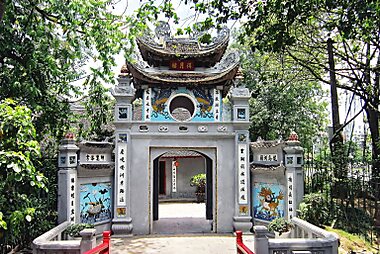
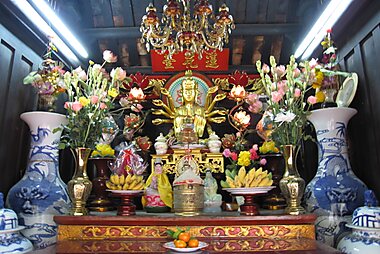
Ho Hoan Kiem is the historic heart of the city, a small lake ringed by walking paths and legend. On its northern islet, Ngoc Son Temple is reached by a small red wooden bridge and honors a 13th-century military leader.
The tangle of streets that makes up Old Quarter dates back nearly a thousand years, with each street traditionally selling a single trade good. It is still dense with shophouses, street food stalls and cafes.
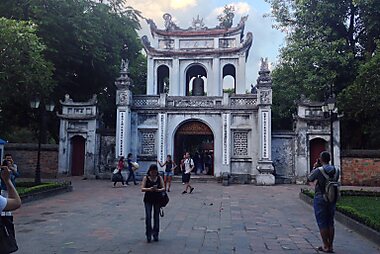
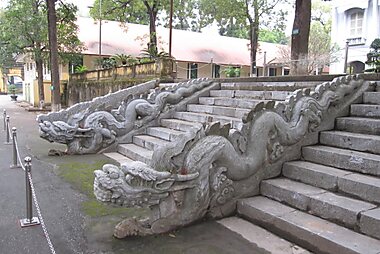
Temple of Literature was founded in 1070 as a temple to Confucius; the Imperial Academy inside it, which opened six years later, was Vietnam's first national university. Its courtyards and stone stelae honoring scholars make it one of the best-preserved examples of traditional Vietnamese architecture.
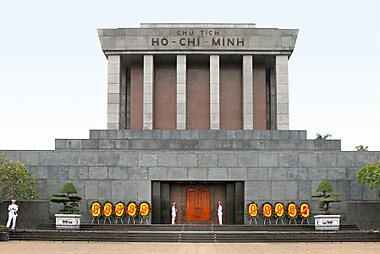
Ho Chi Minh Mausoleum holds the embalmed body of Vietnam's independence leader and draws long queues; go early and dress modestly, since the site enforces strict rules on both. Nearby, One Pillar Pagoda is a small wooden pagoda built on a single stone pillar to resemble a lotus flower rising from a pond.
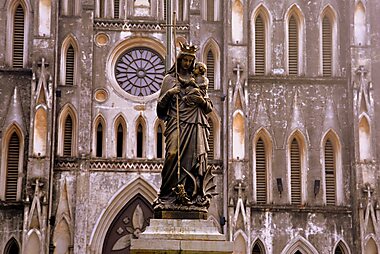
St Joseph's Cathedral is a neo-Gothic church built by French colonists in the 1880s; its twin bell towers still dominate the surrounding streets.
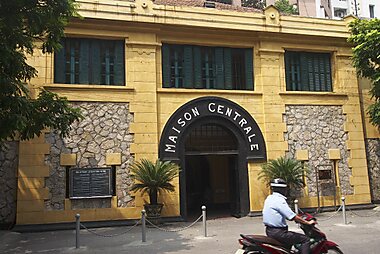
Hoa Lo Prison was originally a French colonial prison for Vietnamese political prisoners and later held American pilots during the Vietnam War. The museum inside covers both chapters.
Featured Lists


Iconic Temples & Churches
Hanoi's spiritual landscape is defined by centuries of cultural fusion, from the 11th-century Temple of Literature to the lotus-shaped One Pillar Pagoda. Tran Quoc Pagoda stands as the city's oldest Buddhist site on the shores of West Lake, while Ngoc Son Temple occupies a scenic island in Hoan Kiem Lake. Colonial history is preserved in the Neo-Gothic Saint Joseph Cathedral. Beyond the city center, the vast cave shrines of the Perfume Pagoda and the hilltop Tay Phuong Pagoda showcase traditional Vietnamese architecture and intricate Buddhist sculpture.
7 places
What to experience
A short list of things worth doing, not just seeing, while in Hanoi:
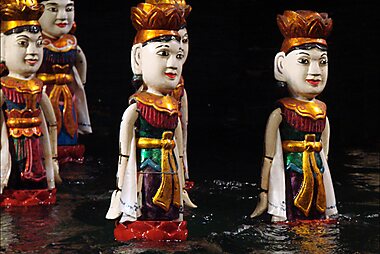
- Watch a traditional water puppet show at the Thang Long Water Puppet Theatre, an art form that originated in the rice paddies of the Red River Delta.
- Join locals for bia hơi (fresh draft beer) on low plastic stools around the Ta Hien Street corner of the Old Quarter in the evening.
- Time a visit to Hanoi's Train Street for the daily train passing just meters from front doors and café tables — stand well back behind the marked line, since the area is periodically fenced off over safety concerns.
- Join the locals doing morning tai chi and badminton around Ho Hoan Kiem at sunrise.
- Cycle or walk the promenade around West Lake at sunset, when it is busiest with locals out for a walk.
Tours & Activities
Hanoi — Map

 Open the interactive map
 Day trips
Hanoi sits within easy reach of ancient citadels, craft villages and dramatic limestone landscapes, so it is worth setting aside at least one day for a trip outside the city.
- Co Loa Citadel — ≈40 min by car or bus. Earthen ramparts and moats from Vietnam's ancient Au Lac kingdom, tied to a well-known founding legend of a magic crossbow.
- Duong Lam Ancient Village and Son Tay — ≈1–1.5 h by car or bus. A preserved rural village of laterite-brick houses and communal temples, near the old citadel town of Son Tay.
- Bat Trang Ceramic Village — ≈45 min by car, bus or boat. A centuries-old pottery village with workshops open to visitors and a Bat Trang National Ceramic Museum.
- Perfume Pagoda (Chùa Hương) — ≈1.5–2 h by car plus a short boat ride. A network of Buddhist shrines built into limestone cliffs, especially lively during its spring pilgrimage festival.
- Ninh Binh Province (Trang An, Tam Coc, Hoa Lu) — ≈2 h by car or train. A UNESCO World Heritage landscape of limestone karsts and rice paddies, explored by rowboat; often described as "Ha Long Bay on land."
Ha Long Bay is also reachable from Hanoi, but at roughly 2.5–3.5 hours each way it works far better as an overnight cruise than a single-day trip.
Getting there
- By air: Noi Bai International Airport (HAN) is the main gateway, about 25–30 km north of the centre. A metered taxi or ride-hailing car takes around 45 minutes in normal traffic (up to 90 minutes at peak times); airport shuttle buses run into the centre for a fraction of the cost.
- By train: Hanoi's main station, Ga Hà Nội, connects to Ho Chi Minh City on the Reunification Express (around 32–36 hours) and to Lao Cai for onward travel to Sa Pa (overnight sleeper, roughly 8 hours).
- By bus: Long-distance coaches to Ninh Binh Province, Ha Long Bay, Sa Pa and other northern destinations depart from stations including Giáp Bát (south of the city) and Mỹ Đình (west).
Getting around
- Public transit: Two metro lines are running (Cat Linh–Ha Dong and Nhon–Hanoi Station), alongside an extensive bus network. The Cat Linh–Ha Dong line now accepts a direct contactless bank-card or phone-wallet tap at the gate; otherwise buy a QR ticket at the counter or through the Ha Noi Metro app. Hanoi Metro
- Taxi and ride-hailing: Xanh SM, an electric-car and -bike app, has overtaken Grab as the most-used ride-hailing service in the city; both work well for a fair, metered price. Metered street taxis from established firms (Mai Linh, Vinasun) are also reliable.
- On foot and cycling: The Old Quarter and lakeside areas are walkable, but pavements are often blocked by parked motorbikes and crossing the street takes a steady, predictable pace. Cycling is not a practical way to get around given the traffic, though a ride around West Lake is pleasant.
Driving
- Is a car worth it?: No. Hanoi's traffic is dense and largely rule-of-thumb rather than rule-of-law; almost no visitor drives here. Use taxis, ride-hailing or a hired driver instead, including for day trips.
- Parking: Scarce and informal in the Old Quarter; most travelers rely on their hotel or a paid guarded motorbike/car lot rather than street parking.
- Restrictions: Some Old Quarter streets close to traffic in the evening and on weekends for pedestrian and night-market use.
Food & drink
Phở most likely originated in northern Vietnam near Nam Dinh, but Hanoi is where the classic clear-broth style is centered, and the city is a good place to eat well without spending much. Street-side stalls and family-run shops, often with plastic stools and a single specialty, are usually better than a formal restaurant for the classics.
Bun Cha Huong Lien became internationally known after a 2016 visit from a sitting US president and is worth seeking out for bún chả. For a general area, the streets and stalls throughout the Old Quarter, especially around Tạ Hiện and Hàng Buồm, cluster together everything from noodle soups to grilled skewers.
Safety & health
Hanoi is generally safe for tourists, including at night in the main visitor areas. The most common issues are petty theft — bag-snatching by passing motorbike and pickpocketing in crowded markets or the Old Quarter — rather than violent crime. Keep bags zipped and worn across the body, and be cautious with phones near open windows or road-side tables.
The biggest everyday hazard is traffic: crossing the street means walking at a steady, predictable pace so motorbikes can flow around you, rather than stopping or running. Use only metered taxis from recognized companies, or the Grab or Xanh SM apps, to avoid fare scams.
History
Hanoi has been a seat of power for close to a thousand years. In 1010, King Ly Thai To founded his capital here and named it Thang Long, or "Ascending Dragon"; the Imperial Citadel of Thang Long marks that original imperial centre and its many centuries of successive dynasties.
French colonial rule from the late 19th century reshaped the city with wide boulevards and European-style buildings, including the prison later nicknamed the "Hanoi Hilton" by the American prisoners of war held there, Hoa Lo Prison. Ho Chi Minh declared Vietnam's independence from French rule in 1945 at Ba Dinh Square, and after his death in 1969 the country built Ho Chi Minh Mausoleum to hold his embalmed body, completing it in 1975 as the reunified country's most solemn monument.
Country facts
Quick practical facts for Vietnam at a glance:
- Currency
- Vietnamese Dong VND ₫ · Card payments · Commonly accepted
- Electricity
- 220 V · 50 HzType A / Type C / Type F
- Languages
- Vietnamese
- Tap water
- Not safe to drink
- Driving side
- Right
- Calling code
- +84
Hanoi – Plan Your Trip
Pick the places you want to see and Tripomatic turns them into a day-by-day route, with smart routing, time estimates, and everything you need for a perfect trip.


Related destinations


Data: © OpenStreetMap contributors, Wikidata, Wikipedia, Tripomatic, Official websites, geoBoundaries (CC BY 4.0). Tours by GetYourGuide. We earn commission from bookings. Travel guide generated with AI.