



Jamaica
Jamaica is a mountainous island in the Caribbean Sea, best known worldwide as the birthplace of reggae music and the Rastafari movement. Green interior hills rise sharply from a coastline that mixes famous white-sand beaches with quiet fishing villages. The island has been independent from Britain since 1962, and its food, music, and language remain distinctly its own.
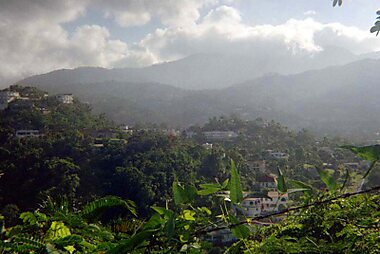
Jamaica suits travelers who want more than a beach chair, although it delivers that well too. Resort towns along the north coast offer all-inclusive comfort and easy swimming, while the Blue Mountains and the south coast reward those who venture inland or off the main tourist strip. Music fans can follow the story of reggae from Kingston's recording studios to the hills where Bob Marley grew up.


Jamaica – Planning a Trip?
Build your day-by-day itinerary in the Tripomatic app.
Money & payments
The Jamaican dollar (JMD) is the official currency, but US dollars are accepted almost everywhere tourists go — resorts, tour operators, and taxis often quote prices in USD. Carry some JMD cash for route taxis, small local restaurants, and rural markets, where card payment is not always possible.
ATMs are common in Kingston, Montego Bay, and other main towns, but scarce in rural areas — withdraw what you need before heading inland. When an ATM or card machine asks you to choose a currency, pick Jamaican dollars: paying in USD usually applies a worse exchange rate.


Featured Lists


Best Beaches
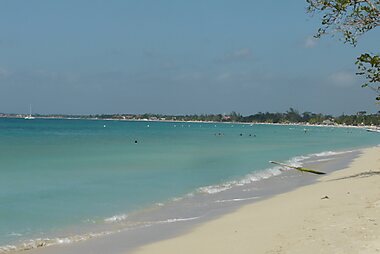
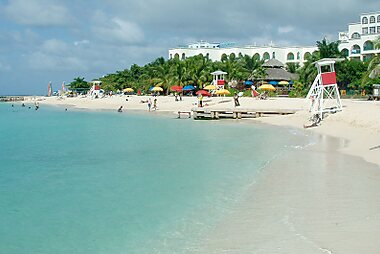
Jamaica’s coastline features varied terrain, from the seven-mile stretch of white sand in Negril to the mineral-rich waters of Doctors Cave in Montego Bay. This list highlights Crab Key Beach, a filming site for the James Bond movie Dr. No, and the Blue Flag-certified Bluefields Beach. Cultural landmarks include Hellshire Beach, known for its traditional seafood stalls, and the dark-sand fishing shores of Calabash Bay. Snorkeling opportunities are found at the coral reefs near Ocho Rios and the protected waters of the south coast.
8 places

Waterfalls and Nature Parks
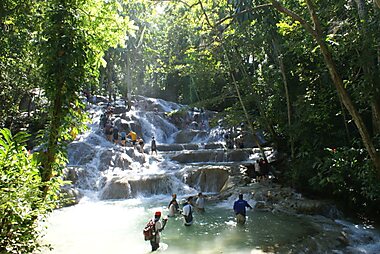
Jamaica’s landscape features diverse natural attractions ranging from the 600-foot terraced Dunn’s River Falls near Ocho Rios to the seven-tiered Y.S. Falls in St. Elizabeth. The Glistening Waters Luminous Lagoon in Falmouth showcases rare bioluminescence caused by microscopic organisms. In urban Kingston, the seven-acre Emancipation Park serves as a green space dedicated to national history, while Konoko Falls combines cascading water with botanical gardens and a museum focused on the island's indigenous Taino heritage.
5 places Tours & Activities
Jamaica — Map

Tipping
Tipping is customary in restaurants and for tour guides, though many all-inclusive resorts already add a service charge to the bill — check before tipping again. Round up taxi fares rather than calculating a percentage. Hotel porters and housekeeping appreciate a small daily cash tip.
10-15% if not already included
round up
round up
small daily cash tip for housekeeping/porters
USD 5-10 per day
Electricity
Jamaica uses Type A/B plugs at roughly 110-120 V / 50 Hz, the same style as North America. Travelers from Europe and most of the rest of the world will need a plug adapter and, for devices that aren't dual-voltage, a voltage converter.
Language
English is Jamaica's official language, so getting by is easy for most visitors. Everyday conversation between Jamaicans often switches into Jamaican Patois, an English-based Creole with its own rhythm and vocabulary — don't worry if you can't follow it, standard English works everywhere tourists go. Picking up a phrase or two of Patois, like wah gwaan (what's going on) or irie (all good), is a friendly icebreaker.
Staying connected
Prepaid SIM and eSIM plans from Digicel or FLOW, Jamaica's two main carriers, are sold at the airport and in phone shops islandwide; bring your passport, since ID is required to register a SIM. Coverage is strong along the coast and in the main towns, but can thin out in the Blue Mountains and other rural interior roads.
Safety & emergencies
Most visits to Jamaica's resort areas and tourist zones are trouble-free, but petty theft and scams targeting tourists do happen — keep an eye on belongings on beaches and avoid walking alone at night outside well-lit resort and hotel areas. Certain inner-city neighborhoods in Kingston, Montego Bay, and Spanish Town see higher crime and are best avoided by visitors; ask your hotel which areas to skip.
Swim only at beaches with a lifeguard or a visible local crowd, since currents can be strong on parts of the north and west coasts. Buying drugs from unlicensed street vendors is illegal and risky — try Jamaica's legal cannabis products only through a licensed dispensary, and never carry any of it out of the country.
Health
Tap water in Kingston and most resort towns is treated, though some travelers prefer bottled water in rural areas or after heavy rain. Pharmacies are easy to find in every town and stock many familiar over-the-counter brands; bring prescription medication in its original packaging.
Mosquito-borne illness risk is low but not zero — use repellent in the evenings, especially away from the coast. No special vaccinations are required for most travelers, though routine vaccines should be up to date, and a yellow fever certificate is needed only if arriving from a country with risk of transmission.
Visas & entry
Citizens of the US, Canada, the UK, most EU countries, and many other nations can enter Jamaica visa-free for stays of up to 30 or 90 days, depending on nationality, with a passport valid for the length of the stay and a return or onward ticket. Travelers from countries without visa-free access need to apply for a visa in advance through a Jamaican embassy or consulate.
Visa and entry requirements change frequently. Verify current requirements with the official immigration authority or your country's embassy before travel.
Etiquette
Greetings matter — a warm "good morning" or "good afternoon" before starting a conversation, even a quick question to a stranger, is expected and appreciated. Dress is casual almost everywhere, but swimwear should stay at the beach or pool; cover up when entering shops, churches, or towns.
Photographing people, especially in local neighborhoods, without asking first is considered rude. Bargaining is normal at craft markets and with street vendors, but not in shops with marked prices. Rastafari is a genuine religious and cultural movement, not a costume — treat dreadlocks, the colors, and cannabis use within that context with respect rather than as a photo prop.
Holidays & opening hours
Public holidays can close banks, government offices, and many shops for the day, especially in smaller towns — supermarkets and pharmacies in tourist areas usually stay open. Independence Day (August 6) follows close behind Emancipation Day (August 1), and the stretch between them is one of the biggest celebration periods on the island, with events across the country.
Most shops and businesses keep shorter hours on Sundays, and some close entirely outside the main resort towns.
Getting around
- By air: Domestic flights connect Kingston's Norman Manley International Airport and Montego Bay's Sangster International Airport — worth considering only if the several-hour drive between the north coast and Kingston doesn't appeal.
- By coach: Private coach operators run air-conditioned intercity buses between Kingston, Montego Bay, Ocho Rios, Negril, and other main towns, bookable online in advance.
- By route taxi: Shared taxis, recognizable by red license plates, run set routes between and within towns; agree on the fare before getting in, since they rarely use meters.
- By local bus: The state-run JUTC network covers greater Kingston; elsewhere, minibuses and route taxis fill the same role.
Jamaica drives on the left, a holdover from British rule — worth knowing before planning a self-drive trip between towns.
Driving
- Speed limits: 50 km/h in towns, 80 km/h on rural main roads, up to 110 km/h on the Highway 2000 tollways.
- Driving side: Jamaica drives on the left, a legacy of British colonial rule — most rental cars are already set up for it.
- Key rules: Seatbelts are mandatory in every seat, and using a handheld phone while driving is illegal — both are actively enforced at police checkpoints.
- Tolls: Highway 2000, the tollway linking Kingston, Mandeville, and Ocho Rios, charges per-segment tolls at staffed booths — cash (JMD) and card are both accepted, with no vignette to buy in advance.
- Parking: Metered street parking exists in Kingston's and Montego Bay's downtown areas; elsewhere, hotels and attractions have their own free or paid lots.
- Fuel: Stations are staffed — an attendant pumps the fuel — and card payment is standard in towns. Ask for "Regular" or "Premium" unleaded, or "Diesel."
Food & drink
Breakfast often means ackee and saltfish with fried dumpling or festival; lunch is the day's main meal for many Jamaicans, taken at a local "cook shop" over stewed or curried meat with rice and peas. Dinner tends to be similar or lighter, and eating out at a casual sit-down restaurant is common in the evenings in tourist towns.
Jerk — chicken or pork marinated in scotch bonnet pepper and allspice, then slow-cooked over pimento wood — is the dish most associated with the island, alongside curry goat, oxtail, and escovitch fish (fried and topped with pickled vegetables). Bammy, a flatbread made from grated cassava, is a common side.
Beef or vegetable patties are the go-to snack, sold everywhere from bakeries to gas stations, often paired with coco bread. Sorrel, a spiced red drink made from hibiscus flowers, appears around Christmas, while Blue Mountain coffee, grown in the hills above Kingston, and Red Stripe beer are the island's best-known exports to try locally.
Where to explore
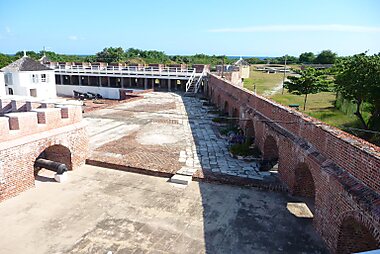
Kingston, the capital, is where reggae was born. Bob Marley Museum and Trench Town Culture Yard trace the music's roots, and the National Gallery of Jamaica covers Jamaican art from the Taino period onward. Kingston is also the gateway to the Blue Mountains, where coffee farms and hiking trails climb into cooler air, and to the 17th-century ruins of Port Royal on the harbor.
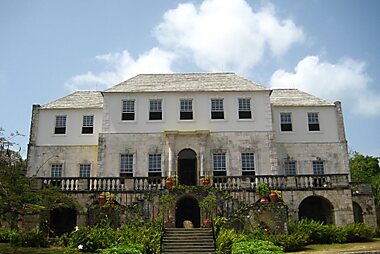
The north coast holds Jamaica's classic resort towns. Montego Bay has the island's main international airport, beaches like Doctors Cave Beach, and the plantation-era Rose Hall Great House (1770). Ocho Rios is built around Dunn's River Falls and Park, a terraced waterfall visitors climb straight through the river, and is also a popular cruise stop. Falmouth, another cruise port, keeps a well-preserved Georgian town center. Negril, on the western tip, is known for Seven Mile Beach and its cliffside sunset bars.
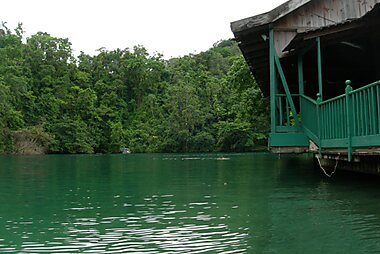
For a quieter trip, Port Antonio on the wetter east coast has the Blue Lagoon and far fewer visitors. Mandeville sits in cool highland hills away from the coast, and Spanish Town preserves the island's Spanish and British colonial capital, before Kingston took over that role.
Jamaica – Plan Your Trip
Pick the places you want to see and Tripomatic turns them into a day-by-day route, with smart routing, time estimates, and everything you need for a perfect trip.




