


Litomyšl
Litomyšl is a small town in eastern Bohemia built around one of the finest Renaissance chateaus in the Czech Republic. Its arcaded main square and pastel townhouses have changed little in two centuries, giving the historic centre an unusually complete, lived-in feel rather than a museum-piece one.
The composer Bedřich Smetana was born here in 1824, and the town still celebrates that link every summer with an international opera festival held in the chateau courtyard. Litomyšl suits travelers who want a quiet, walkable base for a day or two, with easy detours into the rolling countryside of the Pardubice Region.

Litomyšl – Planning a Trip?
Build your day-by-day itinerary in the Tripomatic app.
When to visit
Spring and autumn are mild and pleasant for walking the old town, summer is warm with the best conditions for outdoor sightseeing, and winter turns cold with occasional snow. Plan a visit around Smetana's Litomyšl, an international opera festival staged in the chateau courtyard each June — it is the town's biggest annual event, and accommodation books up well in advance.
Best time to visit: June, August
Top sights
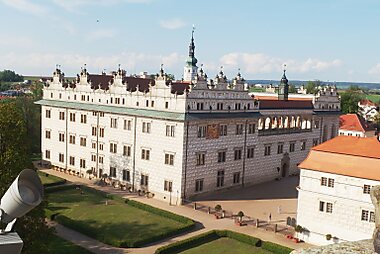


Litomyšl Castle is the reason most travelers come to Litomyšl. Built between 1568 and 1581 for the Pernštejn family, its exterior is covered in sgraffito decoration in a diamond pattern found on almost no other Czech castle, and it became a UNESCO World Heritage Site in 1999.
On the arcaded Smetana Square, Baroque, Classicist and Empire-style houses stand side by side under a continuous covered walkway, a layout that has barely changed since the 18th century.
True Cross Church is a High-Baroque church built between 1716 and 1726, with a viewing terrace between its two towers and sculptural work by Matyáš Bernard Braun.
Smetana Birth House occupies the ground-floor apartment in the former castle brewery where Bedřich Smetana was born in 1824, with original furniture and a small multimedia exhibition on his childhood.
Portmoneum is a single house whose rooms the outsider artist Josef Váchal covered floor to ceiling in murals and carved furniture between 1920 and 1924 — one of the more unusual small museums in the country.
Litomyšl Regional Museum, housed in the former Piarist gymnasium, covers the town's history, natural science and archaeology in one compact building.
Klášterní zahrady is a quiet formal garden behind the chateau, a good spot to rest between sights.
Kostel Povýšení sv. Kříže is the town's original Gothic parish church, dating back to around 1400.
Featured Lists


Parks and Leisure
Litomyšl features diverse green spaces ranging from the formal French garden and English-style landscape of the UNESCO-listed castle grounds to the contemporary Monastery Gardens. These gardens, situated between the Piarist and Holy Cross churches, house sculptures by Olbram Zoubek and a mist fountain. For recreation, the town offers a modern indoor swimming facility with award-winning architecture, alongside smaller urban parks such as Jiráskovo náměstí located near the historic center.
6 placesAudio Guides – Litomyšl
Explore on foot with a self-guided audio tour that narrates each stop as you reach it.


Hear Litomyšl's audio tours
1 walk in Audio Guides by Tripomatic


What to experience
- Catch a performance during Smetana's Litomyšl, an international opera festival held every June in the courtyard of Litomyšl Castle — a rare chance to hear opera performed outdoors against a Renaissance facade.
- Walk or cycle the Klácelka, a wooded path laid along a disused narrow-gauge rail line just outside town, popular with locals for an easy afternoon outing.
- Browse the small Christmas market that fills Smetana Square in December, with the arcades strung with lights.
Tours & Activities
Litomyšl — Map

Day trips
Litomyšl sits in a quiet corner of the Pardubice Region, with several rewarding day trips nearby.
- Polička (~20 min by car or train): a small walled town with its medieval fortifications almost fully intact, and the birthplace of composer Bohuslav Martinů.
- Svitavy (~15 min by car or train): a quieter neighboring town with a renovated historic square and a museum exhibit on Oskar Schindler, who was born there.
- Pardubice (~45 min by car or train): the region's capital, with its own Renaissance chateau, a gingerbread museum, and the Velká pardubická steeplechase held every October.
- Kunětická hora (~50 min by car): a Gothic castle on an isolated hill near Pardubice, visible for miles across the surrounding flat countryside.
- Kutná Hora (~1.5–2 hours by car or train): a UNESCO World Heritage town famous for St. Barbara's Church and the Sedlec Ossuary, worth the longer trip for anyone interested in Czech history.
Where to explore
Litomyšl belongs to the Svitavy district, alongside two other well-preserved historic towns worth combining with a visit.
Getting there
- By air: Prague Airport (PRG) is the nearest international gateway, about 150 km away. There is no direct train to Litomyšl; take a bus or the metro into central Prague, then a direct long-distance coach or a train connecting via Choceň (roughly 2.5–3 hours total).
- By train: Litomyšl's station sits on a regional branch line. Trains run to Choceň in about 30 minutes, connecting there to the Prague–Pardubice–Olomouc mainline.
- By bus: Direct long-distance coaches link Litomyšl with Prague (about 2.5 hours), and regional buses connect it with Pardubice and Svitavy for shorter trips.
Getting around
- Public transit: The historic centre is small enough that most visitors will not need it; a few local town bus lines connect the train and bus stations to the centre.
- On foot: Everything worth seeing sits within a 10–15 minute walk of Smetana Square; the old town has almost no car traffic on its main streets.
- Cycling: Regional cycling routes, including the wooded Klácelka trail along a former railway line, start just outside town, though a bike is not necessary for sightseeing in the centre itself.
Driving
- Is a car worth it?: Not necessary for the town itself, but useful for reaching nearby castles and countryside day trips like Kunětická hora at your own pace.
- Parking: A few car parks sit just outside the pedestrian-priority old town, including near Smetana Square; expect an hourly fee during the day.
- Restrictions: None beyond pedestrian priority on the main square — no congestion charge or low-emission zone applies.
Food & drink
Litomyšl's restaurants and cafés cluster around the arcades of Smetana Square, where you will find straightforward Czech pub food alongside a few more modern cafés. There is nothing here that strays far from the country's usual repertoire of roast pork, dumplings and goulash, so treat a meal in town as a chance to try the classics rather than seek out something Litomyšl-specific.
Safety & health
Litomyšl is a small, quiet town with very little crime affecting visitors. The only real friction point is crowds and tight parking during the summer opera festival, when booking both tickets and accommodation early is worth doing.
History
Litomyšl grew up around a Premonstratensian monastery founded in 1145, and by the 14th century it had briefly become the seat of its own bishopric. Its oldest surviving church, Kostel Povýšení sv. Kříže, dates from around this period.
The town's present character comes largely from the Renaissance, when Litomyšl Castle was built for the Pernštejn family in an arcaded style imported from Italy and adapted across Bohemia and Moravia. In 1824, the composer Bedřich Smetana was born in an apartment inside the castle's own brewery, now preserved as Smetana Birth House; the town has celebrated that connection ever since, most visibly through its annual opera festival.
Country facts
Quick practical facts for the Czech Republic at a glance:
- Currency
- Czech Koruna CZK Kč · Card payments · Commonly accepted
- Emergency numbers
- 112
- Electricity
- 230 V · 50 HzType C / Type E
- Languages
- Czech
- Tap water
- Safe to drink
- Driving side
- Right
- Calling code
- +420


Litomyšl – Plan Your Days
Turn the places from this guide into a real itinerary, with smart routing, time estimates, and everything you need for a perfect trip.




