



Luang Prabang
Luang Prabang sits on a narrow peninsula where the Nam Khan River meets the Mekong, its streets lined with gilded temples and weathered French colonial shophouses. UNESCO listed the old town in 1995 for this rare mix of traditional Lao architecture and 19th- and 20th-century European buildings, kept almost untouched since. The town was the royal capital of the Lan Xang kingdom and later of the Kingdom of Laos, until the monarchy ended in 1975. It still moves at a slower pace: monks in saffron robes cross quiet streets at dawn, and the main road turns into a night market every evening.
Luang Prabang suits travelers who want a few unhurried days of temples, river views and good food, rather than a fast-paced city stop. Most of the old town is walkable, so a short stay covers the highlights, while a longer one leaves room for a boat trip or a day in the surrounding hills.

Luang Prabang – Planning a Trip?
Build your day-by-day itinerary in the Tripomatic app.


When to visit
Laos has three seasons: a cool dry season from November to February, a hot dry season from March to May, and a rainy season from June to October. Late November through February is the most comfortable time to visit, with mild days and cool nights.
Plan around Pi Mai (Lao New Year) in mid-April if possible: for several days, residents douse each other and any passerby with water, which is festive but also falls in the hottest, driest stretch of the year.
Best time to visit: January, December
Top sights
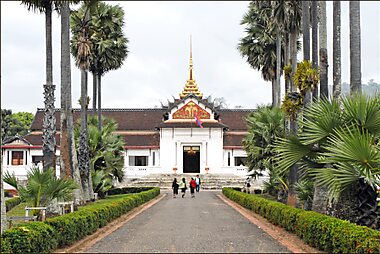
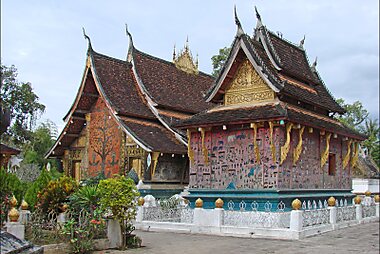
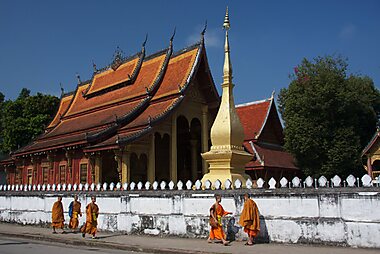
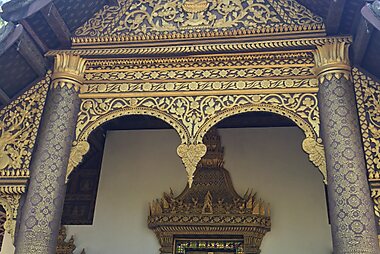
Wat Xieng Thong is Luang Prabang's finest temple, built in the 16th century and covered in gilded reliefs depicting Buddhist and local legends. Its sweeping, low roofline is the classic image of Luang Prabang temple architecture.
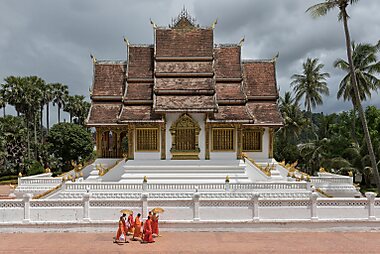
Royal Palace (Haw Kham) was built in 1904 for the royal family and now houses the former throne room, royal regalia and gifts from foreign governments; it was converted into a museum after the monarchy ended in 1975.
Phou Si is a steep hill in the middle of the old town, reached by a stairway of around 300 steps. The gilded stupa at the summit gives the best sunset view over the town and the two rivers.
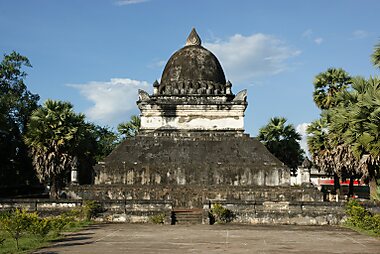
Wat Wisunalat is the town's oldest surviving temple, easy to recognize by its stupa shaped like a watermelon.
Wat Sene Souk Haram is an 18th-century monastery known for its maroon-and-gold decoration and richly carved windows.
Haw Pha Bang stands inside the former palace grounds and holds the Pha Bang, the gold Buddha image the town is named after; it is brought out and paraded through the streets during Pi Mai.
Every evening, vendors set up stalls the length of Sisavangvong Road for the Night Food Market, selling textiles, crafts and street food; it is one of the best places to shop and eat after dark.
Featured Lists


Buddhist Temples
Luang Prabang's spiritual landscape is defined by its collection of centuries-old wats, characterized by the distinct Luang Prabang architectural style of low-sweeping roofs and intricate gold stenciling. This selection features Wat Xieng Thong, a 16th-century royal temple, and Wat Visoun, the city’s oldest religious site. Highlights include the vibrant murals of Wat Pa Huak, the maroon and gold facade of Wat Sene Souk Haram, and the hilltop shrines of Mount Phousi. These sites offer insight into the region's Lan Xang heritage and ongoing Buddhist traditions.
9 placesWhat to experience
- Watch the Tak Bat, the dawn alms-giving procession, when monks walk in silent lines along the main streets to collect food from kneeling residents. Keep a respectful distance if you are only observing, and skip vendors who pressure tourists into buying overpriced sticky rice to hand out.
- Climb Phou Si for sunset, when the golden light over the Mekong and Nam Khan draws a small crowd to the summit stupa.
- Take a Lao cooking class, most of which start with a walk through a local market to pick ingredients before cooking dishes like laap and jeow.
- Join an evening boat trip on the Mekong, watching the riverbanks and temples from the water as the sun goes down.
- Sit in on a Big Brother Mouse reading session, a local literacy project where visitors have informal English conversations with Lao students and young monks.
Tours & Activities
Luang Prabang — Map

 Open the interactive map
 Day trips
Luang Prabang's countryside is easily worth a day (or more), and most sights are close enough to combine into a half- or full-day trip.
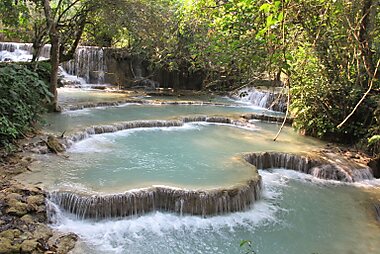
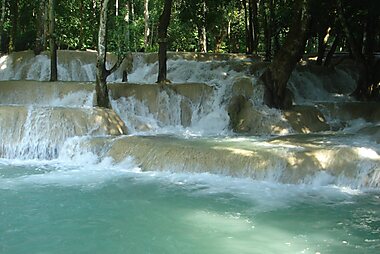
- Kuang Si Large Waterfall – ≈45–60 min by road. Turquoise, tiered pools below a 60-meter waterfall; several pools are open for swimming, and a rescue center for Asiatic black bears sits at the entrance.
- Tad Sae Waterfall – ≈45 min by road. A quieter, less crowded alternative to Kuang Si, though its flow drops sharply in the dry season.
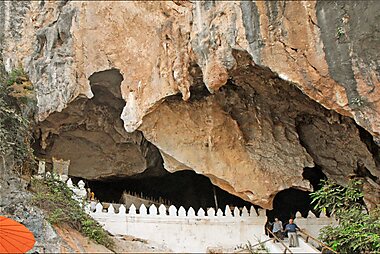
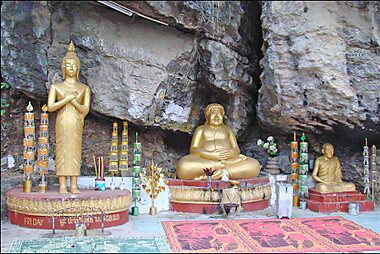
- Pak Ou Cave and Ban Xang Hai – ≈1–1.5 hours by boat up the Mekong. The caves hold thousands of small Buddha statues left by pilgrims over centuries; most trips stop at the whiskey-making village on the way.
- An elephant sanctuary – ≈30–45 min by road. Several camps around the town focus on observing and bathing rescued elephants rather than riding them; choose one with a no-riding policy.
- Vang Vieng – ≈1 hour by the Laos–China Railway, or ≈4–6 hours by road. Known for its limestone karst scenery, caves and the Nam Song river; the fast train makes it a realistic, if long, day trip.
Getting there
- By air: Luang Prabang International Airport (airport code LPQ) is about 4 km from the old town. Flights connect from Vientiane, Bangkok, Chiang Mai, Siem Reap and, seasonally, several Chinese cities. A tuk-tuk into town takes about 10–15 minutes; agree the fare before you get in, as there are no meters.
- By train: the Laos–China Railway station serves Luang Prabang with express trains to Vientiane in about 2 hours and north toward the Chinese border. It is the fastest and most comfortable way to reach the town from the capital.
- By road: buses and minivans run to Vientiane along Route 13, a winding mountain road that takes 8–9 hours; most travelers now prefer the train.
Getting around
- On foot: the old town peninsula is small and flat. Most temples, the museum and the night market are within a 15–20 minute walk of each other.
- Bicycle: a popular and easy way to cover more ground; bikes are widely available to rent by the day.
- Tuk-tuk: the standard option for reaching the airport, the bus station or nearby waterfalls. Fares are negotiated up front rather than metered.
Driving
- Is a car worth it?: not for the old town itself, which is compact and best explored on foot or by bicycle. A car or hired driver is useful for reaching Kuang Si Falls or the whiskey village independently, though boats and shared minivans cover most day trips.
- Parking: most guesthouses have space for a car or motorbike; parking on the street is informal.
- Restrictions: Sisavangvong Road, the old town's main street, closes to vehicle traffic every evening for the night market.
Food & drink
Luang Prabang has its own take on Lao cooking, distinct from the food in Vientiane or further south. Look for khao soi Luang Prabang, a tomato-based noodle soup unrelated to the Thai dish of the same name, sai oua (herb-packed grilled sausage), and kaipen, a dried and fried Mekong riverweed snack served with a spicy dip.
For breakfast, the Morning Food Market is where locals shop for produce, sticky rice and snacks. In the evening, the food stalls that set up alongside the Night Food Market are the easiest way to try a wide range of dishes cheaply in one place.
Safety & health
Luang Prabang is one of the safer, more relaxed towns to visit in Southeast Asia; violent crime against tourists is rare. Keep an eye on bags on overnight buses and boats, where opportunistic theft occasionally happens.
The main road risk is Route 13 to Vientiane, a narrow mountain road with sharp curves; if you are traveling by road rather than train, a bus or hired driver is safer than a self-driven motorbike, especially after dark. Use mosquito repellent in the evenings, particularly during the rainy season, when dengue fever cases rise.
History
Luang Prabang was founded as Muang Sua and became the first capital of the Lan Xang kingdom after King Fa Ngum unified the Lao principalities in 1353. It took its current name from the Pha Bang, a gold Buddha image gifted by the Khmer court and now kept at Haw Pha Bang. The royal court later moved to Vientiane, but Luang Prabang remained a royal seat and, after 1893, the capital of a separate kingdom under French protection.
Royal Palace (Haw Kham) was built in 1904 for King Sisavang Vong, whose descendants remained on the throne until the Pathet Lao ended the monarchy in 1975 and turned the palace into a museum. The old town's temples, among them Wat Xieng Thong, survived largely intact through the turbulence of the 20th century, which is part of why UNESCO recognized the whole peninsula as a World Heritage Site in 1995.
Country facts
Quick practical facts for Laos at a glance:
- Currency
- Laotian Kip LAK · Card payments · Cash preferred
- Electricity
- 230 V · 50 HzType A / Type B / Type C / Type E / Type F
- Languages
- Lao
- Tap water
- Not safe to drink
- Driving side
- Right
- Calling code
- +856


Luang Prabang – Plan Your Days
Turn the places from this guide into a real itinerary, with smart routing, time estimates, and everything you need for a perfect trip.

