



North Macedonia
North Macedonia is a small, landlocked country in the southern Balkans, built around the deep, ancient Lake Ohrid and the Vardar river valley. Its capital, Skopje, mixes Ottoman-era bazaars with a wave of grand, statue-lined boulevards built in the 2010s. Outside the capital, life slows down: whitewashed monasteries sit on lakeshores and mountainsides, and small towns still run on coffee, produce markets, and family wineries.
The country suits travelers who want history and nature without crowds or high prices. Saint Clement of Ohrid and Saint Naum shaped the region's Orthodox Christian heritage over a thousand years ago, and their churches and monasteries are still active today. Mother Teresa was born in Skopje in 1910, and her memory is honored across the city. A trip here works well as a slower add-on to a Balkans itinerary, mixing lakeside relaxation with hiking, wine tasting, and day trips between compact historic towns.




North Macedonia – Planning a Trip?
Build your day-by-day itinerary in the Tripomatic app.


Money & payments
Cash still matters here. Cards work in most hotels, restaurants, and shops in Skopje and Ohrid, but smaller towns, local markets, and rural guesthouses often expect cash. ATMs are common in every town of any size. Some taxi drivers and private hosts accept euros, but you get a better rate paying in denars.
Prices for food, transport, and accommodation are among the lowest in Europe. A backpacker can get by on a modest daily budget; a mid-range trip with restaurant meals and a rental car costs more but still stays affordable by Western European standards.
Featured Lists


North Macedonia's Sacred Sites
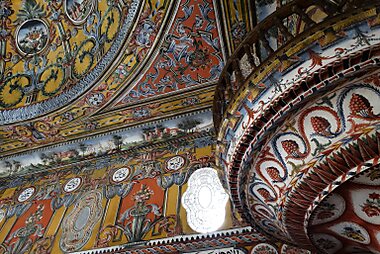
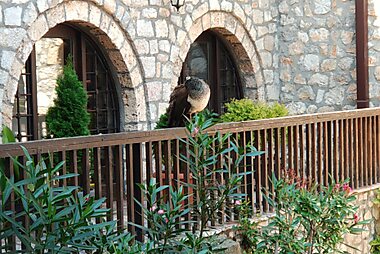
North Macedonia’s spiritual landscape is defined by centuries of Byzantine, Ottoman, and Orthodox history. This collection features the 13th-century Church of St. John Kaneo overlooking Lake Ohrid and the 11th-century Church of St. Sophia, a former cathedral housing rare medieval frescoes. The list also includes Ottoman-era sites like the 16th-century Arabati Baba Tekke dervish monastery and the vibrantly painted Pasha’s Mosque in Tetovo. From secluded 14th-century cave churches in Kalishta to the expansive, multi-domed Osogovo Monastery, these sites showcase the region's diverse architectural and religious evolution.
13 places
Tours & Activities
North Macedonia — Map

 Open the interactive map
 Tipping
Tipping is appreciated but never demanded. In restaurants, rounding up the bill or adding around 10% is common when you're happy with the service, though it's not expected the way it is in the US. Bars and cafés don't expect a tip. Taxi drivers appreciate a rounded-up fare, and hotel staff or tour guides welcome a small tip for good service.
round up or ~10%
round up
small amount for housekeeping/porters
a few euros per day
Electricity
North Macedonia uses Type C and F plugs at 230 V / 50 Hz — the standard continental European socket, so most chargers work without an adapter.
Language
Macedonian, written in Cyrillic, is the main official language, alongside Albanian in areas with a large Albanian population, including Tetovo and parts of Skopje. Road signs are usually written in both Cyrillic and Latin script, but menus and shop signs in smaller towns may be Cyrillic only, so it helps to recognize a few letters before you go. English is spoken well in hotels, restaurants, and tourist sites in Skopje and Ohrid, and less reliably in villages and rural areas.
Staying connected
North Macedonia is not part of the European Union, so EU/EEA phone plans that roam free within the bloc will still be charged for use here — check your carrier's rates, or buy a local prepaid SIM or eSIM on arrival, both widely available and inexpensive from carriers at Skopje airport and in any city center.
Safety & emergencies
North Macedonia is one of the safer countries in the Balkans for visitors. Violent crime targeting tourists is rare; the most common issues are petty theft in crowded markets and overcharging by unmetered taxis, so agree on a fare or insist on the meter before you get in. Driving standards can be erratic and mountain roads are winding and poorly lit, so exercise more caution than you would at home if driving after dark. Stray dogs are common in cities and generally not aggressive, but keep your distance from packs.
Health
Pharmacies (marked with a green cross) are easy to find in every town and can advise on minor ailments without a doctor's visit; most keep standard business hours, with a rotating late-night pharmacy in larger cities. No special vaccinations are required for entry, though routine vaccines should be up to date as anywhere. Tap water is heavily chlorinated and generally fine to drink in Skopje and Ohrid, but many travelers stick to bottled water in smaller towns and rural guesthouses, where supply comes from local wells rather than a municipal system.
Visas & entry
Citizens of the EU, UK, US, Canada, Australia, and many other countries can enter North Macedonia visa-free for up to 90 days. North Macedonia is not in the Schengen Area, so even travelers arriving from a Schengen country get a separate passport stamp, and the 90-day limit is calculated independently of any Schengen allowance. Travelers who need a visa can usually apply online through the country's e-visa system or at a Macedonian embassy in advance.
Visa and entry requirements change frequently. Verify current requirements with the official immigration authority or your country's embassy before travel.
Etiquette
Cover your shoulders and knees when visiting an active church or mosque, and women may be asked to cover their hair when entering a mosque — a scarf is usually available to borrow at the door. A handshake is the standard greeting; close friends and family often greet with a kiss on each cheek. Being offered coffee, rakija (fruit brandy), or a seat at the table is a genuine gesture of hospitality, and it's polite to accept at least briefly, even if you don't finish it. Ask before photographing people, especially in villages and at religious sites. The country's name changed from the Republic of Macedonia to North Macedonia in 2019 after a long dispute with Greece — using the current name is appreciated.
Holidays & opening hours
Public holidays can close banks, government offices, and some shops for the day, and bus and train schedules may run on a reduced timetable — check ahead if you're traveling on one.
Most shops open through the middle of the day without a lunch break, though smaller towns tend to quiet down on Sundays. Because the country has a large Muslim minority alongside its Orthodox Christian majority, both Christian and Muslim holidays are widely observed depending on the region, especially around Tetovo.
Getting around
- By bus: An extensive, inexpensive inter-city bus network connects nearly every town, with Skopje's main bus station as the hub. Buses to Ohrid, Bitola, and other major towns run frequently; buy tickets at the station counter shortly before departure.
- By train: Macedonian Railways runs a limited, slow network — mainly Skopje to Bitola and Skopje toward the northern border — that's more scenic than practical for most itineraries. Buy tickets at the station.
- By car: distances between towns are short, but Ohrid, Mavrovo, and rural monasteries are easiest to reach with your own car. Roads between major cities are in good condition; mountain roads are narrower and slower than they look on a map.
Driving
- Speed limits and rules: headlights must stay on at all times, even during the day. The legal blood alcohol limit is 0.5 g/L, similar to much of continental Europe, but new and professional drivers face zero tolerance. Winter tires or chains are mandatory nationwide from November 15 to March 15.
- Tolls: motorways use staffed toll booths rather than a prepaid vignette — pay by cash or card as you exit.
- Parking: city centers in Skopje and Ohrid use paid street parking with ticket machines or a parking app; free parking is easy to find outside the center.
- Fuel: stations are self-service in cities and often attended in rural areas; card payment is standard, but keep some cash for smaller stations.
- Electric vehicles: charging infrastructure is still limited and concentrated mostly in Skopje, so plan charging stops carefully outside the capital.
Food & drink
Meals in North Macedonia are hearty and built around fresh vegetables, grilled meat, and homemade bread. Breakfast is often burek, a flaky pastry filled with cheese or meat, eaten on the way to work with a coffee or drinking yogurt. Lunch is the main meal for many families, built around soup, a meat or bean dish, and a big plate of shopska salad — the everyday mix of tomato, cucumber, pepper, and grated cheese found on nearly every menu.
Grilled meats dominate dinner menus, especially at a skara (grill house): kebapi, sausages, and mixed grills served with ajvar, the roasted red pepper relish that appears on almost every table. Tavče gravče, oven-baked beans in a clay pot, is the closest thing to a national dish. Coffee culture runs deep — locals linger for hours over a single cup at a café — and rakija, a strong fruit brandy, is offered as a welcome drink or after a meal. The Tikveš wine region south of Skopje produces good, affordable reds worth seeking out. Most everyday eating happens at family-run restaurants, grill houses, and bakeries rather than chains.
Where to explore
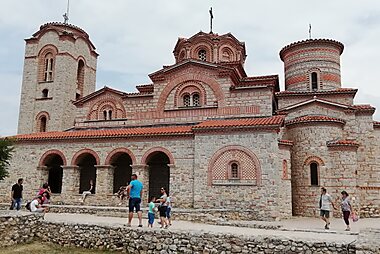
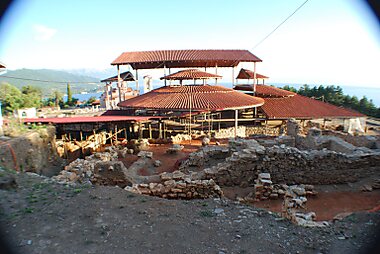
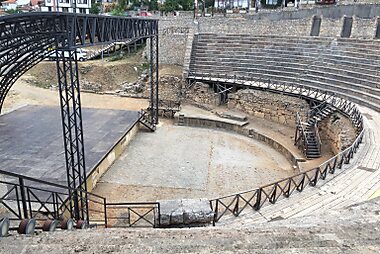
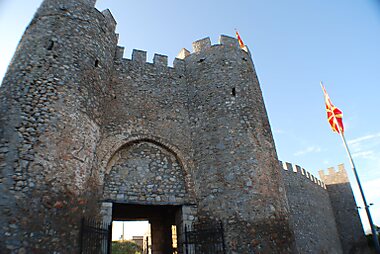
Lake Ohrid, one of Europe's oldest and deepest lakes, anchors the southwest of the country. Ohrid is a UNESCO-listed old town of cobbled lanes and lakeside churches, including Church of St. Sophia, Plaoshnik and the neighboring St. Clement and Panteleimon, Samuil's Fortress, and the Ancient Theatre. A short drive south, the Monastery of Saint Naum sits right on the water, and the Bay of Bones recreates a Bronze Age stilt village on the lakeshore. Across the lake, Struga is quieter and known for its summer poetry festival, and nearby Vevčani is a mountain village built around the Vevchani Springs, a series of cave springs, with a raucous carnival every New Year.
Skopje, the capital, is worth two or three days on its own. Cross the Ottoman-era Stone Bridge into the Old Bazaar, still the city's trading heart after eight centuries, then climb to Skopje Fortress for a view over the Vardar river. The Memorial House of Mother Teresa marks the site where Mother Teresa was baptized, and the Millennium Cross on Mount Vodno is one of the tallest crosses in the world. Just outside the city, Lake Matka draws hikers and kayakers to a narrow limestone canyon dotted with cave monasteries.
Southeast of the lake, Bitola is an elegant former consular town with Neoclassical mansions along its pedestrian main street, and the Roman ruins of Heraclea Lyncestis just outside the city. Prilep is known for tobacco fields and the wind-carved hilltop ruins of Marko's Towers. Krushevo, the highest town in the country, is home to the striking Makedonium, commemorating the short-lived 1903 Kruševo Republic.
In the west, Tetovo is the gateway to the Šar Mountains and home to the brightly decorated Šarena Mosque, while the Saint Jovan Bigorski Monastery sits in the hills further south, one of the country's most important Orthodox monasteries. Kičevo is the usual base for Mavrovo National Park, a mountain area of forests, ski slopes, and the country's largest artificial lake.
Further east, Kumanovo is close to Kokino Megalithic Observatory, a Bronze Age megalithic observatory, and Veles sits on the Vardar river near the Roman ruins of Stobi.
North Macedonia – Plan Your Trip
Pick the places you want to see and Tripomatic turns them into a day-by-day route, with smart routing, time estimates, and everything you need for a perfect trip.


Related destinations


Data: © OpenStreetMap contributors, Wikidata, Wikipedia, Tripomatic, Official websites, geoBoundaries (CC BY 4.0). Tours by GetYourGuide. We earn commission from bookings. Travel guide generated with AI.