



Poland
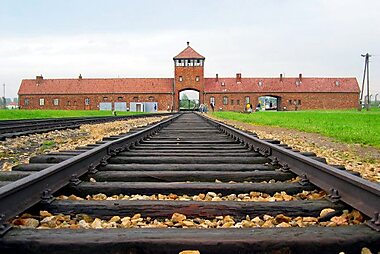
Poland stretches from Baltic beaches in the north to the Tatra Mountains in the south, with medieval old towns, dense forests, and a turbulent modern history in between. Kraków's royal past, Warsaw's rebuilt center, and Gdańsk's maritime heritage each tell a different chapter of the country's story, and the 20th century's wars and shifting borders left deep marks that visitors encounter at sites like Auschwitz-Birkenau and the Warsaw Rising Museum.
The country suits travelers who want strong history and architecture without Western European prices, plus easy access to mountain hiking and lake districts. Poland is part of the Schengen area, so EU travelers cross the border without checks, and its cities connect well by train for a multi-stop itinerary.





Poland – Planning a Trip?
Build your day-by-day itinerary in the Tripomatic app.


Money & payments
Bring złoty, not euros — Poland has not joined the eurozone despite EU membership. ATMs are common in cities and towns; machines run by well-known banks tend to charge lower fees than standalone currency-exchange-style kiosks. A few rural markets, small food stalls, and older regional buses still expect cash.
Budget travelers will find Poland noticeably cheaper than Western Europe for meals, transport, and mid-range hotels.
Featured Lists


Castles and Palaces
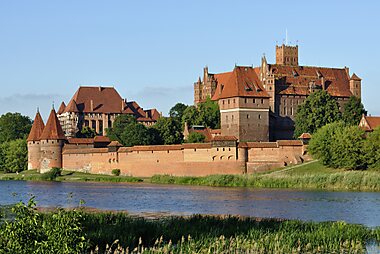
This collection spans centuries of Central European history, featuring architectural landmarks ranging from medieval brick fortresses to Baroque royal residences. It highlights significant sites such as Malbork Castle, the world's largest brick castle, and the Renaissance-style Wawel Castle in Kraków. The list encompasses diverse structures including the Mannerist Baranów Sandomierski, the ruined medieval walls of Ogrodzieniec, and the 20th-century socialist realism of Warsaw’s Palace of Culture and Science. Historic city gates in Gdańsk and the 19th-century fortifications of Brest Fortress further illustrate the region's defensive and royal heritage.
20 places


Nature and Parks
This collection highlights diverse natural sites across Poland and its borders, from the 148-meter Pančavský waterfall to the shifting dunes of Słowiński National Park. It includes the UNESCO-listed Muskau Park, the 76-hectare Royal Baths Park in Warsaw, and the ancient Bartek Oak. Notable water features include Morskie Oko, the largest lake in the Tatra Mountains, and the turquoise-colored waters of a former chalk quarry on Wolin Island.
8 places

Monuments & Memorials
Poland's historical landscape is defined by its medieval origins and the somber legacy of the 20th century. This selection spans centuries, featuring Kraków’s 13th-century Main Market Square and Warsaw’s 17th-century Sigismund’s Column. It includes significant Holocaust memorials such as the Belzec and Gross-Rosen camps, alongside Oskar Schindler's Enamel Factory. Cultural landmarks like the historic Tykocin Synagogue and the contemporary, massive Christ the King statue in Świebodzin highlight the diverse architectural and religious heritage found across the country.
7 placesTours & Activities
Poland — Map

 Open the interactive map
 Tipping
round up or ~10%
round up
a few złoty per bag/day
10-15% for a multi-hour tour
Restaurant tipping is common but not obligatory: round up the bill or add about 10% for good service, ideally stated to the server when paying rather than left on the table. Taxi drivers and hotel porters appreciate a small round-up. Tour guides on a longer, multi-hour tour are usually tipped a bit more generously.
Electricity
Poland uses Type C and E plugs at 230 V / 50 Hz, standard European sockets, so most phone and laptop chargers work without an adapter.
Language
Polish is the official language and uses the Latin alphabet, though its spelling includes unfamiliar combinations (sz, cz, rz, ł) that can make reading street signs and menus slower than in many other European countries. English is common among younger people and in tourism-facing jobs in Kraków, Warsaw, and Gdańsk, but far less so in small towns and among older residents.
Staying connected
EU/EEA travelers with roaming plans typically get standard data allowances at no extra cost under EU roam-like-at-home rules. UK travelers lost that coverage after Brexit and now depend on their carrier's own EU roaming rates, which vary widely — check before you go. Prepaid Polish SIM and eSIM plans from operators like Play, Orange, and Plus are sold at airports, kiosks, and phone shops. Buying one requires showing a passport, since Poland registers prepaid SIM cards to an identity.
Safety & emergencies
Poland is generally safe for visitors, with low rates of violent crime. The main risks are pickpocketing and bag-snatching in crowded tourist areas — Kraków's Main Square, Warsaw's Old Town, and busy train stations — plus occasional taxi drivers overcharging tourists at airports. Use an official taxi rank or a ride-hailing app rather than accepting a ride offered by a tout.
Health
Tap water is generally safe to drink across Poland, though many locals prefer bottled water for taste. Pharmacies (apteka) are widespread in cities and towns, with a rotating night pharmacy in most larger cities for after-hours needs. No special vaccinations are required for most travelers beyond routine immunizations.
Visas & entry
Poland is part of the Schengen Area. Citizens of the EU/EEA can enter freely with a valid ID card or passport. Visitors from the United States, United Kingdom, Canada, Australia, and many other visa-exempt countries can enter Schengen countries, including Poland, for stays of up to 90 days within a 180-day period. The EU's ETIAS pre-travel authorization for visa-exempt travelers has been delayed multiple times and had not launched as of mid-2026; check the official ETIAS site closer to your trip in case it takes effect before you travel. Citizens of countries without a visa-waiver agreement need a Schengen visa, arranged in advance through a Polish consulate or visa application center.
Visa and entry requirements change frequently. Verify current requirements with the official immigration authority or your country's embassy before travel.
Etiquette
Poles typically greet with a handshake in business settings and a cheek kiss among friends and relatives. When invited to a Polish home, bring an odd number of flowers unless it's a bouquet already wrapped — an even number is traditionally associated with funerals. Modest dress (shoulders and knees covered) is expected when visiting churches, many of which remain active places of worship rather than pure tourist sites. On public transport, giving up a seat for elderly passengers is a strongly held norm.
Holidays & opening hours
Most large supermarkets and shopping malls close on all but a few designated Sundays each year, under a national trading-ban law; smaller, owner-run shops and city-center convenience stores stay open as usual. Expect reduced public transport schedules and closed offices on public holidays.
Getting around
- By train: PKP Intercity's EIP and EIC services connect major cities quickly and comfortably; book ahead through PKP Intercity for lower fares.
- By air: domestic flights with LOT Polish Airlines can save time between far-apart cities, such as Warsaw and Gdańsk, though the train network covers most common routes well on its own.
- By bus: long-distance coaches reach smaller towns not served directly by rail, often at lower prices than trains.
Trains link Warsaw, Kraków, Gdańsk, and Wrocław well, with frequent daily departures.
Driving
- Key rules: dipped headlights must stay on at all times, even in daylight; drink-driving enforcement is strict, with an effectively zero-tolerance blood alcohol limit.
- Tolls: a few motorway sections use staffed barriers where you pay directly; others bill heavier vehicles automatically through the electronic e-TOLL system, which usually doesn't apply to an ordinary rental car.
- Congestion: a few large cities, including Warsaw, are introducing low-emission zones that can restrict older diesel vehicles from parts of the center — check current rules before driving in.
- Parking: paid zones cover most city centers on weekdays, usually paid by ticket machine or app; parking is free once you're outside the core.
- Fuel: petrol is labeled Pb95 or Pb98 and diesel is labeled ON (olej napędowy) on pumps; stations are almost always self-service and take card payment at the pump.
- Electric vehicles: charging stations cluster around major cities and motorway service stations; Orlen Charge and GreenWay are the most widespread networks, and most chargers need an app or RFID card to start a session.
Food & drink
Poles typically eat a hearty breakfast, a substantial lunch (often the main meal, eaten mid-afternoon rather than at noon), and a lighter dinner. Sunday lunch with extended family remains a strong tradition, often centered on soup followed by meat and potatoes.
National dishes worth trying include pierogi (stuffed dumplings, sweet or savory), bigos (a slow-cooked hunter's stew of cabbage and meat), and żurek (a sour rye soup often served in a bread bowl). In the Tatra Mountains region, look for oscypek, a smoked sheep's-milk cheese traditionally grilled and served with cranberry sauce. Street stalls sell zapiekanka (an open-faced baguette with mushrooms and cheese) and pączki, a filled doughnut especially popular on the Thursday before Lent.
Vodka is closely tied to Polish drinking culture, often flavored with bison grass, honey, or fruit, and served ice-cold in small glasses. Milk bars (bar mleczny) are a distinctive, budget-friendly way to eat: canteen-style cafeterias serving simple, home-style Polish food at low prices, a holdover from the socialist era that remains popular today.
Where to explore
Major cities
Warsaw, the capital, was rebuilt almost entirely after wartime destruction and is recognized by UNESCO for that reconstruction. It mixes the reconstructed Old Town with the modern Palace of Culture and Science, the Royal Castle, and green escapes like Łazienki Park and the Baroque Wilanów Palace.
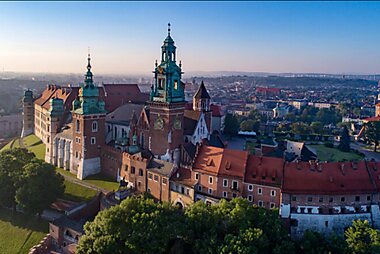
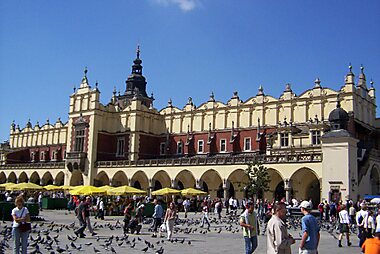
Kraków escaped major wartime destruction and keeps its medieval core intact, centered on Main Market Square, the Renaissance Sukiennice (Cloth Hall) trading hall, and the hilltop Wawel Castle alongside Wawel Cathedral.
Gdańsk is the gateway to the Baltic coast, with a rebuilt merchant Old Town along the river and sights like St. Mary's Church and the Neptune Fountain. Nearby, the seaside resort of Sopot has Europe's longest wooden pier.
Wrocław pairs a large market square ringed with colorful facades with small bronze dwarf statues scattered through the streets, plus the cathedral quarter of Ostrów Tumski and the modernist Centennial Hall.
Poznań, one of Poland's oldest cities, has a restored Renaissance old town and a cathedral linked to the country's earliest history.
Historic towns
Toruń's red-brick old town is a UNESCO World Heritage site and the birthplace of astronomer Nicolaus Copernicus; it's also known for its gingerbread. Malbork is home to Malbork Castle, the largest brick castle in the world. Częstochowa draws pilgrims to Jasna Góra, the monastery holding Poland's most revered religious icon. Zamość is a Renaissance new town built to an Italian architect's plan, its arcaded square largely unchanged since the 16th century. Lublin anchors the country's east, with a well-preserved old town and easy access to the surrounding countryside.
Mountains and nature
Zakopane is the base for the Tatra Mountains, with trails to the turquoise lake Morskie Oko and Poland's highest peak, Rysy. Białowieża Forest, on the border with Belarus, protects one of Europe's last primeval forests and its free-roaming European bison. Bieszczady National Park, in the southeast, has quieter trails through the Bieszczady range.
Poland – Plan Your Trip
Pick the places you want to see and Tripomatic turns them into a day-by-day route, with smart routing, time estimates, and everything you need for a perfect trip.




