



Tirana
Tirana is Albania's capital, and probably its most colorful city. Many of the concrete apartment blocks from the communist era are now painted in bright patterns, a project started when Edi Rama was mayor before he became prime minister. Ottoman mosques, Italian-built government buildings, and Cold War bunkers all sit within a few streets of each other, showing how fast the city has changed direction over the last century.
The compact center suits a stay of two or three nights, either on its own or combined with day trips to the coast or nearby historic towns. Tirana works well as a first stop in Albania: it has the country's main airport, its best museums, and an easy introduction to Albanian food and coffee culture before heading further afield.

Tirana – Planning a Trip?
Build your day-by-day itinerary in the Tripomatic app.


When to visit
Spring (April–May) and early autumn (September–October) are the most comfortable seasons, with warm days and cooler evenings. Summer gets very hot, and many locals leave the city for the coast in July and August. Winter is cold and wet, though rarely severe.
The biggest annual event to plan around is the Tirana Beer Fest each August, when Skanderbeg Square and the main boulevard fill with free concerts and food stalls.
Best time to visit: May, October
Expect summer highs into the mid-30s°C with little rain, while winter days stay cool and nights can drop close to freezing.
Top sights
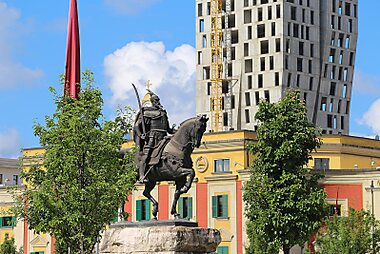



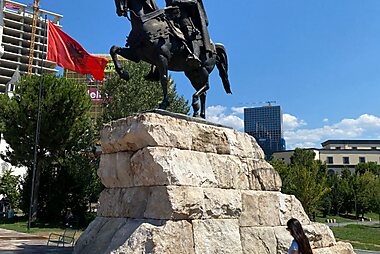

Skanderbeg Square is the heart of the city, a wide plaza ringed by government buildings, the mosque, and the clock tower. It was fully pedestrianized in 2017 and is the natural starting point for exploring on foot.
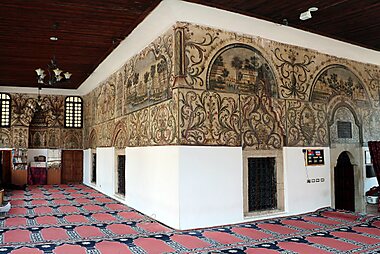
Next to the square, Et'hem Bey Mosque is one of the few mosques to survive Albania's decades of enforced atheism under communism. Its painted frescoes of trees and waterfalls are unusual for Ottoman religious architecture in the region.
Beside the mosque, Clock Tower dates to the early 19th century and can still be climbed for a view over the square and the surrounding hills.
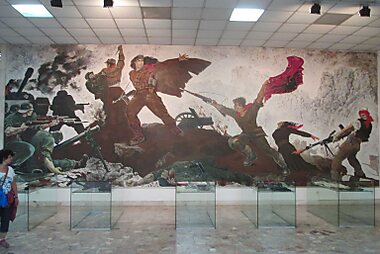
National Historical Museum is Albania's largest museum, with a large mosaic mural on its facade that has become a symbol of the city in its own right. The museum itself has been closed for renovation since 2024 and is not expected to reopen until 2028, but the mosaic and the building are still worth seeing from Skanderbeg Square.
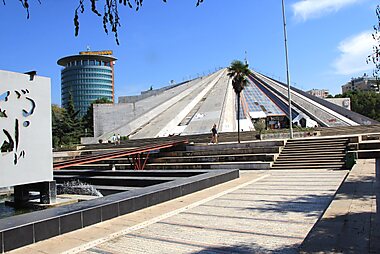
Pyramid of Tirana began life as a museum honoring dictator Enver Hoxha, spent years as a crumbling ruin after 1991, and reopened in 2023 as a youth technology center with a striking angular redesign. Climbing its sloped roof is part of the experience.
Bunk'Art 2 is a former nuclear bunker built to shelter the Ministry of Internal Affairs, now a museum on the surveillance methods of Albania's secret police during communist rule.
On the square itself, Skanderbeg Monument honors the 15th-century national hero who gives the square its name and who led Albanian resistance against the Ottomans for over two decades.
Featured Lists


What to experience
- Ride Dajti Ekspres, a cable car that climbs to Dajti Mountain in about fifteen minutes, for views over the whole city and cooler air on a hot day.
- Spend an evening in Blloku, once an off-limits district guarded for communist-era officials and closed to ordinary citizens, and now the city's main area for cafés, bars, and restaurants.
- Browse the stalls of the New Bazaar (Pazari i Ri), a restored covered market that mixes fresh produce with small bars and street food.
- Sit down for a slow Albanian coffee — locals treat it as a social ritual rather than a quick stop, and cafés stay full well into the evening.
Tours & Activities
Tirana — Map

 Open the interactive map
 Day trips
Tirana sits close to castle towns, the coast, and one of Albania's UNESCO-listed old towns, so a rental car or a handful of day trips are easy to combine with a stay here.
- Petrelë Castle — about 30 minutes by car southeast of the city, a small hilltop fortress with sweeping views over the valley below. A good half-day trip.
- Krujë — around 45 minutes by car or bus, this hill town was the base of national hero Skanderbeg in his resistance against the Ottomans. Its restored castle, museum, and old Ottoman-era bazaar make for an easy morning or afternoon out.
- Durrës — about 40 minutes by car or bus, Albania's main port city has a Roman amphitheater, a long sandy beach, and seafood restaurants along the waterfront.
- Berat — roughly 2 to 2.5 hours by car or bus, this UNESCO World Heritage town is known as the "town of a thousand windows" for the rows of Ottoman-era houses climbing its hillside. It is a longer trip, but worth an overnight stay if time allows.
Getting there
- By air: Tirana International Airport Nënë Tereza, also called Rinas, is the country's main gateway, about 17 km northwest of the center. A shuttle bus runs to the center in around 30–40 minutes; a direct taxi is often a little faster but costs more.
- By train: Albania's passenger rail network is very limited and slow. Most travelers coming from other Albanian cities use the bus instead.
- By bus: Regional and international coaches connect Tirana with Durrës, Berat, and other Albanian cities, as well as destinations in Kosovo, North Macedonia, Montenegro, and Greece. Buses leave from several private terminals rather than one central station, so confirm the departure point when booking.
Getting around
- Public transit: City buses cover most of Tirana, though routes are not always clearly signed for visitors. Pay the driver or conductor in cash; there is no unified travel card yet.
- Taxi / ride-hailing: Local taxi apps operate alongside traditional taxi ranks. Agree on or confirm the fare before the trip if the taxi has no meter.
- On foot: The center is compact and walkable, though pavements can be uneven and some crossings lack signals, so cross carefully.
Driving
- Is a car worth it?: Not for the city itself — traffic is heavy and parking is limited, and most sights are within walking distance of each other. A car becomes useful for day trips outside the center.
- Parking: Paid street parking zones cover much of the center, marked with blue lines; pay by SMS or through the city's parking app. A few paid garages sit near the main boulevard.
- Restrictions: Skanderbeg Square and parts of the main boulevard are pedestrianized and closed to general traffic.
Food & drink
Albanian food leans on grilled meats, fresh vegetables, and dairy, with strong Ottoman and Italian influences. In Tirana specifically, look for byrek sold fresh from small bakeries in the morning, and qofte (grilled meatballs) as a common lunch option.
For a concentrated area to eat and drink, head to Blloku, where restaurant terraces and bars cluster along a few pedestrian-friendly blocks. For a more local, less touristy scene, the streets around the New Bazaar mix produce stalls with small, inexpensive eateries.
Safety & health
Tirana is a safe city for tourists by regional standards, and violent crime against visitors is rare. The most common issues are pickpocketing in crowded spots like the New Bazaar and on buses, and occasional overpriced menus or fares aimed at tourists — agree on the price before ordering or getting into an unmetered taxi.
Traffic is the bigger everyday risk: drivers do not always yield to pedestrians and some crossings have no signals, so cross carefully even at marked crossings.
History
Tirana's oldest visible structure is Fortress of Justinian, a fortress dating to before 1300 that marked the crossing of two old trade roads. The city itself was founded in 1614 by an Ottoman noble, Sulejman Pasha, who built a mosque, a bakery, and a hammam around what is now the old bazaar.
Tirana became Albania's capital only in 1920, after independence, and grew quickly under Italian-influenced urban planning in the 1930s — the wide main boulevard and Mother Teresa Square both date from this period. After the Second World War, Enver Hoxha's communist government isolated Albania from the outside world for more than four decades and built thousands of defensive bunkers across the country, some of which are now museums in the city.
Since the fall of communism in 1991, Tirana has changed its skyline repeatedly, from the painted apartment blocks of the early 2000s to the 2023 redevelopment of Pyramid of Tirana.
Country facts
Quick practical facts for Albania at a glance:
- Currency
- Albanian Lek ALL L · Card payments · Commonly accepted
- Emergency numbers
- 112
- Electricity
- 220 V · 50 HzType C / Type F
- Languages
- Albanian
- Tap water
- Drink with caution
- Driving side
- Right
- Calling code
- +355


Tirana – Plan Your Days
Turn the places from this guide into a real itinerary, with smart routing, time estimates, and everything you need for a perfect trip.


Related destinations


Data: © OpenStreetMap contributors, Wikidata, Wikipedia, Tripomatic, Official websites, geoBoundaries (CC BY 4.0). Tours by GetYourGuide. We earn commission from bookings. Travel guide generated with AI.