



Trieste
Trieste sits where the Adriatic meets the edge of the Karst plateau, tucked into Italy's northeastern corner just a few kilometers from Slovenia. It belonged to the Habsburg Empire for more than five centuries and, after being declared a free port in 1719, grew into that empire's main gateway to the sea. That history still shapes the city: grand Habsburg-era squares open straight onto the water, the coffeehouses feel closer to Vienna than to Rome, and Italian, Slovenian, and Central European influences sit side by side in the streets and menus.
That mixed identity, plus dramatic scenery where limestone cliffs drop into the sea, makes Trieste a rewarding stop for travelers who want handsome architecture and a strong coffee culture without the crowds of Venice or Florence, a short drive or train ride away. James Joyce lived here for over a decade and began writing Ulysses during that time, and the poet Umberto Saba ran a bookshop that is still open today.

Trieste – Planning a Trip?
Build your day-by-day itinerary in the Tripomatic app.


When to visit
Spring and autumn are the most comfortable seasons for walking the city. Summers are warm and can turn humid near the water, and winters are cold, occasionally with the Bora, a powerful wind off the Karst plateau that can gust well over 100 km/h and disrupt ferries and walks along the harbor. Plan around the Barcolana regatta on the second Sunday of October — a Guinness World Record holder as the largest sailing race by number of boats, filling the Gulf of Trieste and turning the whole waterfront into a weekend-long festival.
Best time to visit: May, June, September
Top sights
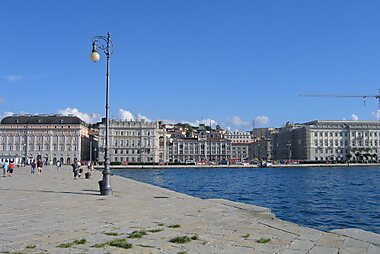



Piazza Unità d'Italia is the natural starting point: one of the largest seafront squares in Europe, open on one side straight to the Adriatic and lined on the others with grand former government buildings from the Habsburg era.
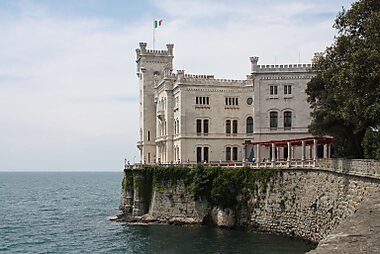
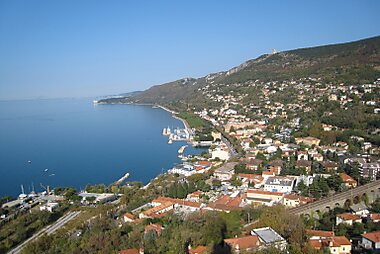
A short trip north along the coast, Miramare Castle is a white limestone castle built in the 1850s for the Habsburg archduke Maximilian, with terraced gardens and sweeping sea views that make it worth the trip on its own.
On the hill above the old town, San Giusto Castle is a compact medieval fortress with the best panorama over the city and gulf, standing right beside Cattedrale di San Giusto, a cathedral built by joining two older churches, with faded mosaics inside from its earliest years.
Cutting into the neoclassical Borgo Teresiano district, the Canal Grande was dug so cargo boats could unload close to the warehouses that once lined it; the domed Serbian Orthodox church at its head is one of the best-known views in the city.
On the southern edge of town, Risiera di San Sabba is a former rice-husking plant that the occupying German forces converted into a concentration and transit camp during the Second World War, the only one of its kind on Italian soil. It is now a national monument and museum — a sober visit, but one of the most important sites in the city.
On the waterfront, Teatro Lirico Giuseppe Verdi is the city's grand opera house, an elegant theatre dating to 1801 and still in active use for opera and ballet.
For a wider view, climb to the Faro della Vittoria, a lighthouse and First World War memorial on a rise above the port, with one of the best lookout points over the city and the sea.
Featured Lists


Karst Wonders and Caves
The Trieste Karst plateau is defined by its dramatic limestone geology, featuring thousands of caves, sinkholes, and vertical shafts known as abysses. This collection highlights significant subterranean sites, from the archaeological Duino Mithraeum, housing an ancient Roman altar, to the Grotta delle Torri di Slivia, known for its massive stalagmite towers. Many sites, such as the Grotta dei Partigiani, hold historical significance from World War II, while the numerous abysses around Basovizza showcase the region's characteristic vertical karst formations.
19 places


Viewpoints and Peaks
This collection highlights the diverse topography surrounding the Gulf of Trieste, ranging from the historic 246-meter Molo Audace pier to the limestone heights of the Karst Plateau. It includes specialized 'vedette' (lookout towers) like the 19th-century Liburnia, prehistoric sites such as the Castelliere di Slivia, and the rugged glacial scenery of Val Rosandra. These locations provide distinct perspectives on the Adriatic coastline, the Istrian peninsula, and the Julian Alps.
17 placesWhat to experience
- Order coffee like a local. Trieste has its own coffee vocabulary, left over from its port-city past — a "capo in b" is a small cappuccino in a glass, not a cup. Try it standing at the counter of Caffè San Marco, a 19th-century literary café still furnished much as it was in Joyce's day.
- Join the evening swim at Barcola. On warm evenings, locals head down to the concrete platforms along Barcola to swim straight off the rocks after work, a ritual that runs all summer.
- Walk a stretch of the Napoleonica Trail. This flat path traces an old carriage route along the rim of the Karst plateau above the city, with steady views down over the gulf and none of the climbing a hiking trail would normally require.
- Ride the historic tram to Opicina. The Trieste–Opicina line climbs the escarpment behind the city on a route that mixes tram and funicular sections, with the view opening up over the gulf partway up.
Tours & Activities
Trieste — Map

 Open the interactive map
 Day trips
Trieste sits close to both the wild Karst plateau above it and the Slovenian coast, so a rental car or a short bus ride opens up several good day trips.
- Muggia (~20 min by bus or, in season, by ferry) — a small former Venetian port with a Venetian-Gothic town hall and cathedral on its main square, one of the few places on this coast that kept its own distinct identity outside Trieste.
- Grotta Gigante (~25 min by car or bus) — one of the largest tourist show caves in the world, a single chamber over 100 metres high.
- Duino Castle (~25 min by car or bus) — a clifftop castle above the sea in Duino-Aurisina, where the poet Rainer Maria Rilke began his Duino Elegies; a scenic coastal path connects it back toward Trieste.
- Aquileia and Grado (~45–55 min by car, or by train plus local bus) — the first was a major Roman city and holds a UNESCO-listed archaeological area and an early Christian basilica with extensive mosaic floors; the second is a small lagoon resort town with a walkable old center and beaches.
- Piran, Slovenia (~40 min by car or bus; bring a passport or ID card even though there is no routine border check) — a walled Venetian-era town on the Slovenian coast, with a bell tower and a central square that slopes down to the harbor.
- Ljubljana, Slovenia (~1–1.5 hours by car, bus, or train) — Slovenia's small, walkable capital, with a hilltop castle reached by funicular and a lively riverside old town.
Where to explore
Udine is the largest city in inland Friuli Venezia Giulia and an easy add-on to a Trieste trip, known for its arcaded main square and a castle hill with frescoes by Giambattista Tiepolo.
Getting there
- By air: Trieste – Friuli Venezia Giulia Airport (TRS) is in Ronchi dei Legionari, about 30 km northwest of the city, with a limited schedule of flights to a handful of Italian and European cities; a shuttle bus and regional trains connect it to Trieste Centrale in roughly 40–50 minutes. Many travelers instead fly into Venice Marco Polo Airport, about 2 hours away by car or bus, or Ljubljana Airport in Slovenia, about 1 hour away, both of which offer far more international connections.
- By train: Trieste Centrale is the main station, with direct trains to Venice (around 2 hours) and Udine, plus connections on toward Vienna and Ljubljana.
- By bus: Long-distance coaches run from the bus station next to Trieste Centrale to Ljubljana, and to other cities in Friuli Venezia Giulia and along the Slovenian and Croatian coast.
Getting around
- Public transit: Trieste Trasporti runs the city's bus network (plus one historic tram-funicular line up to Opicina); buy tickets in advance from tobacconists, newsstands, or the operator's app rather than expecting to pay the driver directly. Trieste Trasporti
- Taxi: Regular taxis wait at ranks around Piazza Unità d'Italia and the station; ride-hailing apps have limited presence, so a phone-booked or rank taxi is the more reliable option.
- On foot / cycling: The seafront and city center are flat and easy to explore on foot; reaching San Giusto hill or the district above it involves a steady climb, best avoided by taking a bus partway up. A coastal path connects the center to Barcola and on to Miramare and is popular with both walkers and cyclists.
Driving
- Is a car worth it?: Not for the city center, which is compact and largely pedestrian around the main sights — but a car pays off for exploring the Karst plateau and the coast toward Slovenia at your own pace.
- Parking: Several multi-story car parks sit just outside the historic center; on-street blue-line spaces are paid and metered, payable by app or at nearby machines.
- Restrictions: A limited-traffic zone (ZTL) covers parts of the historic center and is camera-enforced; check your hotel's access rules before driving in, since visitor exemptions vary.
Food & drink
Trieste's kitchen carries its Austro-Hungarian and Adriatic past in equal measure: goulash, strudel, and boiled meats share menus with fresh Adriatic seafood and Italian pasta. Jota, a thick soup of beans, sauerkraut, and potato, is the classic cold-weather dish to look for.
Coffee is treated with particular seriousness here — Trieste has been one of Italy's main coffee-importing ports for two centuries, and several historic roasters and blenders are still based in the city. Outside town, look out for an osmiza: a farmhouse on the Karst plateau that opens seasonally to sell its own wine, cured meats, and cheese directly to visitors, marked by a branch or wreath hung at the gate.
Safety & health
Trieste is one of the safer Italian cities for travelers, with little of the aggressive pickpocketing found in bigger tourist centers; ordinary caution around the train station and in crowds during the Barcolana weekend is enough. Take a severe Bora wind warning seriously if one is issued during your stay — gusts can exceed 100 km/h, and locals avoid the exposed waterfront and steep streets near the sea until it passes.
History
Trieste's fortunes have always followed whoever controlled its port. The hill now occupied by San Giusto Castle was settled from Roman times onward, and the ruins of a Roman theatre still sit at its foot. The city's modern shape dates to 1719, when the Habsburgs made it a free port, triggering a boom that filled the flat land below the old town with the neoclassical streets around Piazza Unità d'Italia and the Canal Grande.
That status ended with the empire's collapse after the First World War, and the following decades were harder: during the Second World War, occupying German forces ran Risiera di San Sabba as a concentration and transit camp, the only one of its kind in Italy. Trieste's future stayed unsettled for almost a decade after the war, disputed between Italy and Yugoslavia, before it was returned to Italy in 1954.
Country facts
Quick practical facts for Italy at a glance:
- Currency
- Euro EUR € · Card payments · Widely accepted
- Emergency numbers
- 112
- Electricity
- 230 V · 50 HzType C / Type F / Type L
- Languages
- Italian
- Tap water
- Safe to drink
- Driving side
- Right
- Calling code
- +39


Trieste – Plan Your Days
Turn the places from this guide into a real itinerary, with smart routing, time estimates, and everything you need for a perfect trip.




