



Vaduz
Vaduz is the capital of Liechtenstein, a tiny principality wedged between Switzerland and Austria in the Alps. With around 5,700 residents, it feels more like a small town than a national capital, and most of it can be explored on foot in half a day. The pedestrian street Städtle runs through the centre, lined with museums, government buildings, and cafés. Vineyards and forested hills climb straight up behind it to Vaduz Castle, perched on a rocky outcrop above the rooftops.
Most travelers see Vaduz as a half-day stop on a longer Switzerland or Austria trip rather than a standalone destination. Staying a night lets you catch the mountains at sunset and use the town as a base for hiking or driving into the Alps, but a few hours are enough to see the centre itself.

Vaduz – Planning a Trip?
Build your day-by-day itinerary in the Tripomatic app.


When to visit
Spring and autumn are mild and good for walking, summer is warm with occasional afternoon thunderstorms, and winter is cold with regular snow. Because Vaduz sits in a narrow Alpine valley, winter nights are noticeably colder than the daytime highs suggest.
The town's biggest date on the calendar is 15 August, Liechtenstein's National Day: fireworks light up the valley, and the reigning Prince opens the grounds of Vaduz Castle to the public for one evening a year.
Top sights

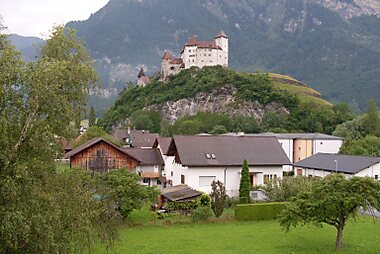





Vaduz Castle is Vaduz's defining landmark and the private home of the reigning Prince of Liechtenstein. It is closed to the public, but the walk up through the vineyards for a close view and the panorama over the town is worth the climb on its own.
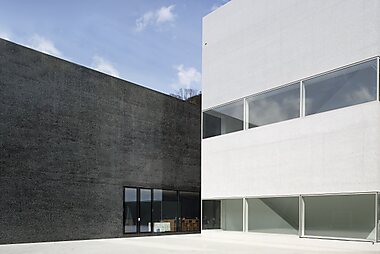
Kunstmuseum Liechtenstein is the country's main art museum, a black basalt-concrete cube holding a collection of modern and contemporary art alongside pieces from the Prince's own collection.
Vaduz Cathedral is a neo-Gothic church that has served as the seat of the Archdiocese of Vaduz since 1997, and its slender spire is one of the first things you notice arriving in town.
Liechtenstein National Museum covers Liechtenstein's history and natural history, from archaeological finds to displays on the ruling princely family, housed in a former inn expanded into a modern museum complex in 2003.
Rotes Haus is a cluster of dark red medieval buildings, including a stepped-gable house and an old wine-press tower, that once anchored the vineyards below the castle.
Regierungsgebäude is the seat of Liechtenstein's government, a Renaissance Revival building from 1905 that still houses the prime minister's office.
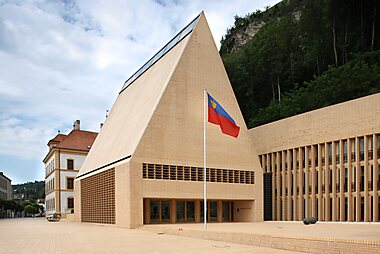
Landtag of the Principality of Liechtenstein is Liechtenstein's national parliament, a striking modern brick building completed in 2008 right next to the older government building.
Postal Museum traces Liechtenstein's history as a stamp-issuing microstate: the tiny country has long relied on stamp sales to collectors as a source of revenue, and the collection here explains why collectors still seek out its issues.
Featured Lists


What to experience
- Join the crowds at Vaduz Castle's open gates on 15 August, when the reigning Prince hosts a public garden party for National Day, followed by fireworks over the valley.
- Taste the Prince's own Pinot Noir at Hofkellerei, one of the smallest wine estates in the world, tucked into the vineyards below the castle.
- Follow the vineyard path that climbs from the town centre toward the castle for the best view back over Vaduz and the Rhine valley.
- Cross into Switzerland or Austria on a bike ride along the flat Rhine valley cycle path, an easy way to see three countries in one afternoon.
Tours & Activities
Vaduz — Map

 Open the interactive map
 Day trips
Vaduz makes a good base for day trips into the mountains and across two borders.
- Gutenberg Castle, in Balzers about 15 minutes away by car or bus, is a well-preserved hilltop castle with gardens and courtyards open to visitors.
- Feldkirch, across the border in Austria, is roughly 20 minutes away and has one of the best-preserved medieval old towns in the region, built around its own hilltop castle.
- Malbun, roughly 30 minutes by bus or car up into the mountains above Triesenberg, is Liechtenstein's own ski and hiking resort, with a cable car up to Sareiserjoch and trails along the ridge into Austria.
- St. Gallen, in Switzerland, is about 45 minutes by train or car and home to the Abbey of St. Gall, a UNESCO World Heritage site with a well-known Baroque library.
Where to explore
Vaduz is one of eleven communes that make up all of Liechtenstein, most of them only a few minutes' drive away.
- Schaan, just north of Vaduz, is the country's largest town and its transport hub, home to Liechtenstein's main railway station.
- Triesen, to the south, is a quieter residential town with easy access to Rhine valley walking and cycling paths.
- Triesenberg, up on the mountainside, is the gateway to Malbun and keeps its own distinct Walser dialect and traditions.
- Balzers, at the southern tip of the country, is home to Gutenberg Castle and some of Liechtenstein's vineyards.
Getting there
- By air: The nearest major airport is Zurich Airport (ZRH) in Switzerland, around 115 km away. It takes roughly 1 hour 30 minutes by car, or around 2 hours by train and bus via Sargans or Buchs.
- By train: The most useful of Liechtenstein's small stations, Schaan-Vaduz, sits on the Feldkirch-Buchs line. It gets around a dozen regional trains a day each way, connecting to Feldkirch (Austria) and Buchs (Switzerland). From the station it is a short bus or taxi ride into central Vaduz, about 3.5 km away.
- By bus: LIEmobil buses run directly into Vaduz's central bus station from Sargans, Buchs, and Feldkirch, connecting there with Swiss and Austrian regional trains.
Getting around
- Public transit: LIEmobil buses cover the whole country. Pay the driver directly by cash or card, or buy a ticket through the SBB Mobile or FAIRTIQ app; a day pass covering all zones costs 9 CHF. LIEmobil
- Taxi / ride-hailing: Local taxi firms operate in Vaduz; international ride-hailing apps have little to no presence.
- On foot / cycling: The town centre is compact and flat, and the Städtle promenade is pedestrian-only, so walking covers most sights easily. A local bike-rental scheme and the Rhine valley cycle path make cycling a practical way to reach neighbouring towns.
Driving
- Is a car worth it?: Not for the town itself, since central Vaduz is entirely walkable, but useful for reaching Malbun, Gutenberg Castle, or the wider Rhine valley at your own pace.
- Parking: Car parks near Städtle charge by the hour; street parking in the centre is metered and time-limited.
- Restrictions: None. There is no congestion charge or low-emission zone in Vaduz.
Food & drink
Vaduz's food scene is small but reflects the Alpine, German-speaking region it sits in. Look for Käsknöpfle, Liechtenstein's national dish of small cheese dumplings topped with fried onions, and Ribel, a slow-cooked cornmeal dish often eaten for breakfast.
For eating out, head to Städtle, Vaduz's pedestrian main street, where most of the town's cafés and restaurants cluster within a few minutes of each other.
Safety & health
Vaduz is very safe by any standard measure. Violent crime is essentially unheard of, and petty theft is rare outside busy periods like the National Day crowds. Normal precautions, such as keeping an eye on bags at the bus station, are enough.
History
Vaduz takes its name from Vaduz Castle, first built in the 12th century as the seat of local counts. The Liechtenstein family, wealthy Austrian nobles, bought the neighbouring lordship of Schellenberg in 1699 and the county of Vaduz in 1712. The combined territory became the Principality of Liechtenstein in 1719, and it has kept its name and borders unchanged ever since, unusual for Europe.
For over two centuries the ruling princes governed from Vienna and rarely visited, leaving Vaduz a small farming and vineyard town below the castle. That changed in 1938, when Franz Joseph II became the first prince to make the castle his full-time home, a tradition the family keeps today. Government buildings like the Regierungsgebäude and, later, the Landtag of the Principality of Liechtenstein followed as Liechtenstein built up its own state institutions through the 20th century. Banking and manufacturing grew alongside them, and today the country is one of the wealthiest per capita in the world.
Country facts
Quick practical facts for Liechtenstein at a glance:
- Currency
- Swiss Franc CHF · Card payments · Widely accepted
- Emergency numbers
- 112
- Electricity
- 230 V · 50 HzType C / Type J
- Languages
- German
- Tap water
- Safe to drink
- Driving side
- Right
- Calling code
- +423


Vaduz – Plan Your Days
Turn the places from this guide into a real itinerary, with smart routing, time estimates, and everything you need for a perfect trip.




