


Cracovia
Kraków was the royal capital of Poland for over 500 years, and it still looks the part. The Old Town survived the Second World War largely intact, so its medieval streets, Gothic churches, and Renaissance courtyards are the real thing, not reconstructions. It rewards a few unhurried days. Wander the largest medieval square in Europe. Climb the hill where Polish kings were crowned. Cross the river into a quarter that was Kraków's Jewish heart for five centuries.
The city suits travelers who want dense, walkable history alongside a lively student and café culture. Kraków is home to one of Europe's oldest universities. Its Old Town squares and Kazimierz district stay busy well into the evening. It also works well as a base for day trips: a UNESCO salt mine and the Auschwitz-Birkenau memorial are both within easy reach.

Cracovia – ¿Estás planeando un viaje?
Crea tu itinerario día a día en la app de Tripomatic.
Cuándo viajar
Spring and autumn are mild and good for walking, summer is warm with occasional storms, and winter is cold with a real chance of snow. Christmas is a highlight: the Main Market Square hosts one of Poland's best Christmas markets from late November through December, with wooden stalls, mulled wine, and the city's famous illuminated nativity scenes (szopki) on display.
Mejor época para viajar: agosto, septiembre
July and August are the warmest and busiest months; June and September offer similar sightseeing weather with smaller crowds.
Lugares destacados


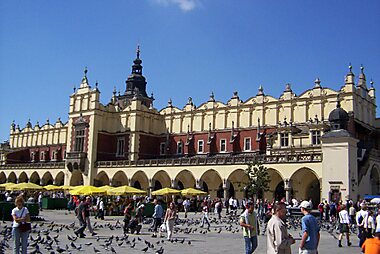
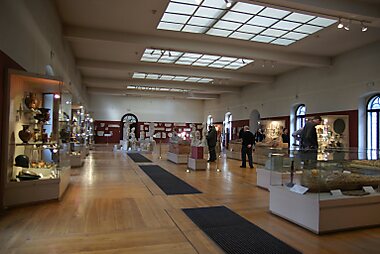
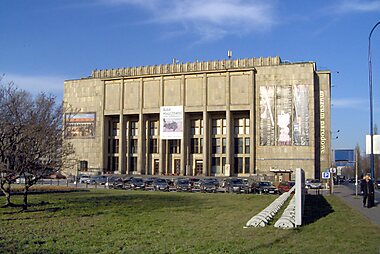
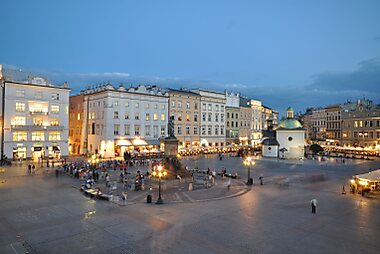
Main Market Square is the natural starting point: a 13th-century square so large it swallows crowds easily, ringed by cafés and dominated by two landmarks. Cloth Hall splits the square in two, its Renaissance arcades still selling amber and souvenirs on the ground floor and a 19th-century Polish art collection upstairs.
St. Mary's Basilica rises beside it, a brick Gothic church famous for its carved wooden altarpiece and the trumpet call sounded from its tower every hour, historically cut short mid-note.
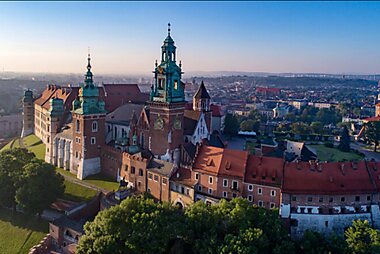
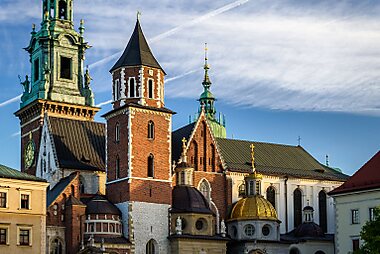
A short walk south, Wawel Castle was the residence and coronation site of Polish kings for centuries, and its state rooms and treasury are still open to visitors. Next to it, Royal Archcathedral Basilica of Saints Stanislaus and Wenceslaus holds the tombs of Polish monarchs and national heroes and remains the country's most important church.
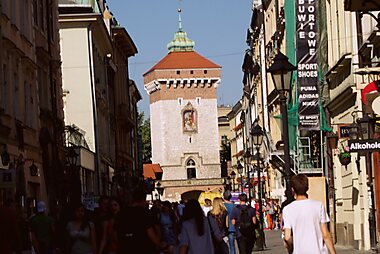
At the northern edge of the Old Town, Saint Florian's Gate is the last surviving gate of the medieval city walls, marking the start of the Royal Route that kings once processed along toward Wawel.
Below the square itself, Rynek Underground is an archaeological museum built around the remains of the medieval marketplace, discovered during a renovation in 2005.
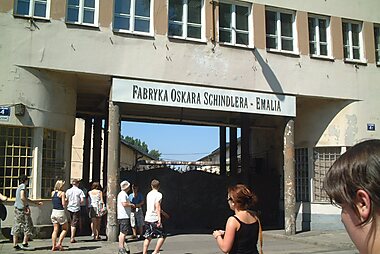
Across the river in the former industrial district of Zabłocie, Schindler's Factory tells the story of Kraków under Nazi occupation through the factory where Oskar Schindler sheltered over a thousand Jewish workers.
Listas destacadas


Hidden Gems of Kraków
This collection highlights Kraków’s significant landmarks away from the central crowds. It features the medieval history of the Planty Park gardens near the Barbican and the equestrian Grunwald Monument at Matejko Square. Further east, the list includes the 13th-century Cistercian Abbey in Mogiła and the legendary Wanda Mound, an ancient burial site. The Nowa Huta Museum provides insight into the city's socialist-realist architecture and history, while the historic St. Florian’s Church stands as a key religious site in the Kleparz district.
6 lugares


Memorials & Monuments
This collection showcases Kraków’s significant memorials and monuments, including sites reflecting the Holocaust such as Schindler's Factory and the Płaszów Concentration Camp. It also features historic mounds like Kościuszko and Piłsudski’s Mounds, iconic statues including the Grunwald Monument and Wawel Dragon, and remnants of Jewish heritage like the Fragment of Jewish Ghetto Wall.
10 lugares
Audioguías – Cracovia
Explora a pie con una visita autoguiada con audio que describe cada punto conforme llegas a él.

Lo mejor de Cracovia
110 min2.8 km10 paradas
Recorra el Camino Real de Cracovia desde su puerta medieval hasta la fortaleza real en la colina de Wawel. Este recorrido por lo más destacado cruza la inmensa Plaza del Mercado, visita uno de los mejores museos de arte de Polonia, entra en las iglesias góticas y barrocas más grandiosas de la ciudad y pasa por la universidad más antigua del país antes de subir al castillo y a la catedral donde eran coronados los reyes polacos. Comience en la Puerta de San Florián, en el extremo norte del casco antiguo, a un corto paseo de la estación central de trenes.

Cracovia con niños: Leyendas del dragón de Wawel
110 min2.9 km9 paradas
Un paseo en busca del tesoro para familias, desde la puerta medieval de la ciudad de Cracovia bajando por el antiguo Camino Real hasta la colina de Wawel. Sigue la pista del dragón y de las leyendas fundacionales de la ciudad: la puerta de una fortaleza construida tras una gran invasión, el toque de corneta interrumpido de un trompetero, el milagro de un santo, el rey que construyó su castillo en la colina, los huesos gigantes que custodian la puerta de la catedral y el astuto truco que finalmente venció al terrible dragón. Cada parada tiene un acertijo para resolver en el lugar. Comienza en la Barbacana y la Puerta de San Florián.

Escucha las visitas en audio de Cracovia
2 rutas a pie en Audioguías de Tripomatic


Qué experimentar
Kraków's rituals are as much about atmosphere as sights — a few things to build a day around.
- Listen for the hejnał mariacki, the trumpet call played live from St. Mary's tower on the hour, every hour, cut off mid-note in memory of a medieval trumpeter struck by an arrow.
- Take an evening walk along the Vistula boulevards below Wawel Hill, where the Wawel Dragon statue breathes real fire every few minutes after dark, a small ritual that draws a crowd of kids and adults alike.
- Spend an evening in Kazimierz, Kraków's former Jewish quarter, browsing the vintage shops and courtyard bars around Plac Nowy, where a late-night zapiekanka (open-faced baguette pizza) from one of the square's kiosks is a local rite of passage.
- Take a boat trip on the Vistula River in summer, gliding past Wawel Hill for a different angle on the castle skyline.
- Browse the flower stalls and antique-book stands that fill the Main Market Square outside festival season, a low-key counterpart to the winter Christmas market.
Tours y actividades
Cracovia — Mapa

 Abrir el mapa interactivo
 Excursiones de un día
Kraków makes an easy base for day trips, from a quick underground detour to one of the most important historical sites in Europe.
- Wieliczka Salt Mine (≈20–30 min by train or minibus) — Wieliczka Salt Mine sits just outside the city. Its UNESCO-listed chambers have chapels, statues, and a chandelier carved entirely from salt, worked continuously since the 13th century.
- Ojców National Park (≈40 min by car, ≈1 hour by bus) — the park around Ojców is Poland's smallest national park, a limestone valley dotted with cave systems and the ruined Pieskowa Skała castle; a good half-day escape into nature.
- Auschwitz-Birkenau Memorial and Museum (≈1.5 hours by bus or train) — Auschwitz-Birkenau State Museum preserves the site of the former Nazi concentration and extermination camp as a memorial and museum. It is a heavy but widely considered essential visit; booking an entry slot in advance is strongly recommended.
- Zakopane and the Tatra Mountains (≈2 hours by car, bus, or train) — Zakopane, Poland's mountain resort town, sits at the foot of the Tatra Mountains, with wooden highlander architecture, hiking trails, and a cable car up Kasprowy Wierch; worth the longer trip in clear weather.
Cómo llegar
- By air: John Paul II International Airport Kraków–Balice is the gateway, about 15 km west of the center. A direct train (Kraków Airport – Kraków Główny line) runs to the main station in around 20 minutes; taxis and ride-hailing take about 25–30 minutes depending on traffic.
- By train: Kraków Główny station has frequent connections to Warsaw (around 2.5 hours by express train) and other major Polish cities, plus international links toward Vienna and Prague.
- By bus: The main bus terminal sits next to Kraków Główny station and serves long-distance domestic and international coach routes, a useful budget alternative to the train.
Cómo desplazarse
- Public transit: An extensive tram and bus network covers the city; trams are usually the fastest way to cross town. Tickets can be bought with a contactless bank card or phone tap directly on board at the validator, so there is no need to plan ahead or find a kiosk.
- Taxi / ride-hailing: Bolt and Uber both operate widely and are generally cheaper and more reliable than hailing a street taxi.
- On foot: The Old Town and Kazimierz are compact and best explored on foot; most top sights sit within a 20-minute walk of the Main Market Square.
Conducción
- Is a car worth it?: Skip it for the city itself — the Old Town is compact, largely pedestrianized, and well served by trams. A car becomes useful only if combining several day trips outside the reach of public transport.
- Parking: Paid parking zones cover the city center; pay by app or at roadside machines. Park-and-ride lots near tram terminals are a cheaper option for anyone driving in.
- Restrictions: A low-emission zone restricting older, high-emission vehicles covers the city center; check current rules before driving in if renting an older car.
Gastronomía
Kraków's food culture mixes hearty Polish classics with a strong café tradition. Look for pierogi (dumplings, sweet or savory), żurek (sour rye soup), and obwarzanek krakowski, the braided ring-shaped bread sold from street carts across the Old Town.
For a genuinely distinctive spot, Milkbar Tomasza is a long-running milk bar, a Communist-era canteen style serving cheap, home-style Polish food that both locals and travelers still queue for. For a wider spread, head to the food stalls and kiosks around Plac Nowy in Kazimierz, especially in the evening, where zapiekanka and other street food are the main draw.
Seguridad y salud
Kraków is a safe city for tourists by any reasonable standard, with violent crime against visitors rare. The main risks are pickpocketing in crowded tourist spots like the Main Market Square and on busy trams, and overpriced or unlicensed taxis waiting outside the airport and train station — use a licensed rank or a ride-hailing app instead. Tap water is safe to drink throughout the city.
Historia
Kraków was the capital of the Kingdom of Poland for over 500 years, and Wawel Castle was both royal residence and the site where most Polish monarchs were crowned and buried. The capital moved to Warsaw in 1596, but Kraków kept its role as a spiritual and academic center.
Collegium Maius is part of the Jagiellonian University, founded in 1364. It is one of the oldest universities in Central Europe, and its alumni include the astronomer Nicolaus Copernicus. Kraków's Old Town survived the Second World War with little physical destruction, unlike Warsaw. That is why so much of its historic fabric is original rather than rebuilt.
The war's darkest chapter played out in Kazimierz and the wartime Kraków Ghetto. Most of the city's Jewish population, once a large and integral part of Kraków's life, was deported from there to camps including nearby Auschwitz-Birkenau. Schindler's Factory and the synagogues of Kazimierz, including Remuh Synagogue and Cemetery, preserve that history today.
Datos del país
Quick practical facts for Poland at a glance:
- Moneda
- esloti polaco PLN zł · Pago con tarjeta · Ampliamente aceptado
- Teléfonos de emergencia
- 112
- Electricidad
- 230 V · 50 HzTipo C / Tipo E
- Idiomas
- polaco
- Agua del grifo
- Potable
- Sentido de la circulación
- Derecha
- Prefijo telefónico
- +48


Cracovia – Planifica tus días
Convierte los lugares de esta guía en un itinerario real, con rutas inteligentes, estimaciones de tiempo y todo lo que necesitas para un viaje perfecto.




