


Krakau
Kraków was the royal capital of Poland for over 500 years, and it still looks the part. The Old Town survived the Second World War largely intact, so its medieval streets, Gothic churches, and Renaissance courtyards are the real thing, not reconstructions. It rewards a few unhurried days. Wander the largest medieval square in Europe. Climb the hill where Polish kings were crowned. Cross the river into a quarter that was Kraków's Jewish heart for five centuries.
The city suits travelers who want dense, walkable history alongside a lively student and café culture. Kraków is home to one of Europe's oldest universities. Its Old Town squares and Kazimierz district stay busy well into the evening. It also works well as a base for day trips: a UNESCO salt mine and the Auschwitz-Birkenau memorial are both within easy reach.

Krakau – Planst du eine Reise?
Erstelle deine Reiseroute Tag für Tag in der Tripomatic-App.
Beste Reisezeit
Spring and autumn are mild and good for walking, summer is warm with occasional storms, and winter is cold with a real chance of snow. Christmas is a highlight: the Main Market Square hosts one of Poland's best Christmas markets from late November through December, with wooden stalls, mulled wine, and the city's famous illuminated nativity scenes (szopki) on display.
Beste Reisezeit: August, September
July and August are the warmest and busiest months; June and September offer similar sightseeing weather with smaller crowds.
Top-Sehenswürdigkeiten


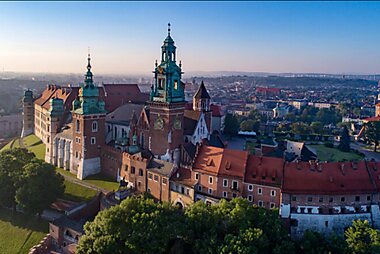
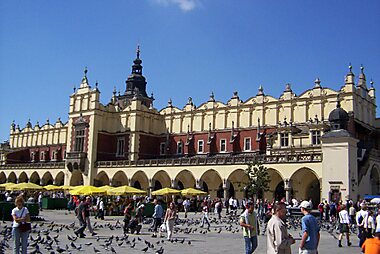
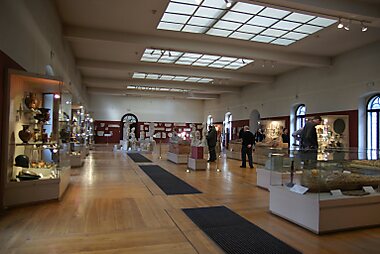
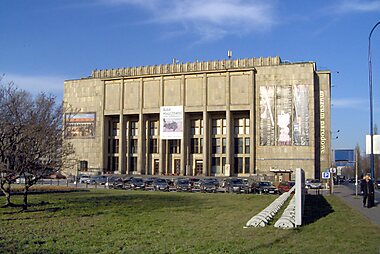
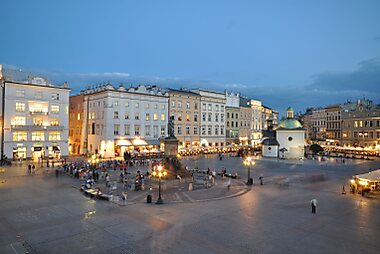
Main Market Square is the natural starting point: a 13th-century square so large it swallows crowds easily, ringed by cafés and dominated by two landmarks. Cloth Hall splits the square in two, its Renaissance arcades still selling amber and souvenirs on the ground floor and a 19th-century Polish art collection upstairs.
St. Mary's Basilica rises beside it, a brick Gothic church famous for its carved wooden altarpiece and the trumpet call sounded from its tower every hour, historically cut short mid-note.
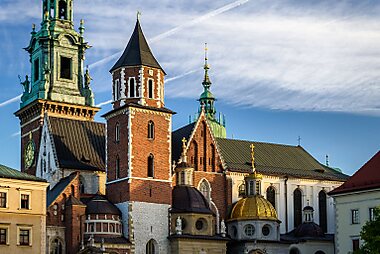
A short walk south, Wawel Castle was the residence and coronation site of Polish kings for centuries, and its state rooms and treasury are still open to visitors. Next to it, Royal Archcathedral Basilica of Saints Stanislaus and Wenceslaus holds the tombs of Polish monarchs and national heroes and remains the country's most important church.
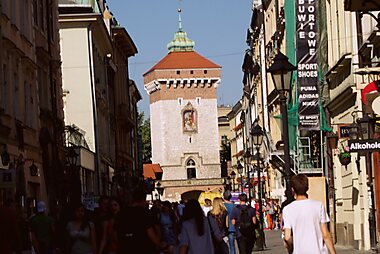
At the northern edge of the Old Town, Saint Florian's Gate is the last surviving gate of the medieval city walls, marking the start of the Royal Route that kings once processed along toward Wawel.
Below the square itself, Rynek Underground is an archaeological museum built around the remains of the medieval marketplace, discovered during a renovation in 2005.
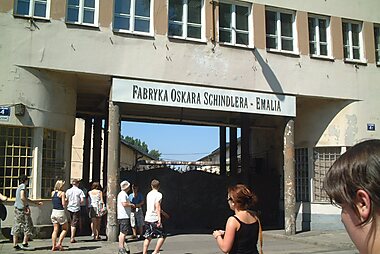
Across the river in the former industrial district of Zabłocie, Schindler's Factory tells the story of Kraków under Nazi occupation through the factory where Oskar Schindler sheltered over a thousand Jewish workers.
Empfohlene Listen


Versteckte Juwelen von Krakau
Diese Sammlung hebt bedeutende Krakauer Sehenswürdigkeiten abseits der Touristenmassen hervor. Sie umfasst die mittelalterliche Geschichte der Parkanlagen Planty in der Nähe der Barbakane und das Reiterstandbild des Grunwald-Denkmals am Matejko-Platz. Weiter östlich beinhaltet die Liste die Zisterzienserabtei Mogiła aus dem 13. Jahrhundert und den legendären Wanda-Hügel, eine antike Grabstätte. Das Museum Nowa Huta bietet Einblicke in die sozialistisch-realistische Architektur und Geschichte der Stadt, während die historische St.-Florians-Kirche als bedeutende religiöse Stätte im Stadtviertel Kleparz gilt.
6 Orte


Memorials & Monuments
This collection showcases Kraków’s significant memorials and monuments, including sites reflecting the Holocaust such as Schindler's Factory and the Płaszów Concentration Camp. It also features historic mounds like Kościuszko and Piłsudski’s Mounds, iconic statues including the Grunwald Monument and Wawel Dragon, and remnants of Jewish heritage like the Fragment of Jewish Ghetto Wall.
10 Orte
Audioguides – Krakau
Erkunde die Stadt zu Fuß mit einer selbstgeführten Audiotour, die dir jeden Ort erklärt, sobald du ihn erreichst.

Das Beste von Krakau
110 Min.2.8 km10 Stopps
Gehen Sie Krakaus Königsweg von seinem mittelalterlichen Stadttor bis zur königlichen Festung auf dem Wawelhügel entlang. Diese Best-of-Tour überquert den riesigen Hauptmarkt, besucht eines der bedeutendsten Kunstmuseen Polens, führt in die prächtigsten gotischen und barocken Kirchen der Stadt und vorbei an der ältesten Universität des Landes, bevor es hinauf zur Burg und zur Kathedrale geht, in der polnische Könige gekrönt wurden. Beginnen Sie am Florianstor am nördlichen Rand der Altstadt, nur einen kurzen Spaziergang vom Hauptbahnhof entfernt.

Krakau mit Kindern: Drachenlegenden des Wawel
110 Min.2.9 km9 Stopps
Ein Schnitzeljagd-Spaziergang für Familien, vom mittelalterlichen Stadttor Krakaus entlang des alten Königswegs bis zum Wawel-Hügel. Folgen Sie den Spuren des Drachen und den Gründungsmythen der Stadt: ein Festungstor, das nach einer großen Invasion erbaut wurde, der abgebrochene Warnruf eines Trompeters, das Wunder eines Heiligen, der König, der seine Burg auf dem Hügel errichtete, die riesigen Knochen, die das Domportal bewachen, und die schlaue List, die das schreckliche Ungeheuer schließlich besiegte. An jeder Station gibt es vor Ort ein Rätsel zu lösen. Beginnt an der Barbakane und dem Florianstor.

Höre die Audiotouren von Krakau
2 Rundgänge in Audioguides von Tripomatic


Erlebnisse & Aktivitäten
Kraków's rituals are as much about atmosphere as sights — a few things to build a day around.
- Listen for the hejnał mariacki, the trumpet call played live from St. Mary's tower on the hour, every hour, cut off mid-note in memory of a medieval trumpeter struck by an arrow.
- Take an evening walk along the Vistula boulevards below Wawel Hill, where the Wawel Dragon statue breathes real fire every few minutes after dark, a small ritual that draws a crowd of kids and adults alike.
- Spend an evening in Kazimierz, Kraków's former Jewish quarter, browsing the vintage shops and courtyard bars around Plac Nowy, where a late-night zapiekanka (open-faced baguette pizza) from one of the square's kiosks is a local rite of passage.
- Take a boat trip on the Vistula River in summer, gliding past Wawel Hill for a different angle on the castle skyline.
- Browse the flower stalls and antique-book stands that fill the Main Market Square outside festival season, a low-key counterpart to the winter Christmas market.
Touren & Aktivitäten
Krakau — Karte

 Interaktive Karte öffnen
 Tagesausflüge
Kraków makes an easy base for day trips, from a quick underground detour to one of the most important historical sites in Europe.
- Wieliczka Salt Mine (≈20–30 min by train or minibus) — Wieliczka Salt Mine sits just outside the city. Its UNESCO-listed chambers have chapels, statues, and a chandelier carved entirely from salt, worked continuously since the 13th century.
- Ojców National Park (≈40 min by car, ≈1 hour by bus) — the park around Ojców is Poland's smallest national park, a limestone valley dotted with cave systems and the ruined Pieskowa Skała castle; a good half-day escape into nature.
- Auschwitz-Birkenau Memorial and Museum (≈1.5 hours by bus or train) — Auschwitz-Birkenau State Museum preserves the site of the former Nazi concentration and extermination camp as a memorial and museum. It is a heavy but widely considered essential visit; booking an entry slot in advance is strongly recommended.
- Zakopane and the Tatra Mountains (≈2 hours by car, bus, or train) — Zakopane, Poland's mountain resort town, sits at the foot of the Tatra Mountains, with wooden highlander architecture, hiking trails, and a cable car up Kasprowy Wierch; worth the longer trip in clear weather.
Anreise
- By air: John Paul II International Airport Kraków–Balice is the gateway, about 15 km west of the center. A direct train (Kraków Airport – Kraków Główny line) runs to the main station in around 20 minutes; taxis and ride-hailing take about 25–30 minutes depending on traffic.
- By train: Kraków Główny station has frequent connections to Warsaw (around 2.5 hours by express train) and other major Polish cities, plus international links toward Vienna and Prague.
- By bus: The main bus terminal sits next to Kraków Główny station and serves long-distance domestic and international coach routes, a useful budget alternative to the train.
Unterwegs vor Ort
- Public transit: An extensive tram and bus network covers the city; trams are usually the fastest way to cross town. Tickets can be bought with a contactless bank card or phone tap directly on board at the validator, so there is no need to plan ahead or find a kiosk.
- Taxi / ride-hailing: Bolt and Uber both operate widely and are generally cheaper and more reliable than hailing a street taxi.
- On foot: The Old Town and Kazimierz are compact and best explored on foot; most top sights sit within a 20-minute walk of the Main Market Square.
Autofahren
- Is a car worth it?: Skip it for the city itself — the Old Town is compact, largely pedestrianized, and well served by trams. A car becomes useful only if combining several day trips outside the reach of public transport.
- Parking: Paid parking zones cover the city center; pay by app or at roadside machines. Park-and-ride lots near tram terminals are a cheaper option for anyone driving in.
- Restrictions: A low-emission zone restricting older, high-emission vehicles covers the city center; check current rules before driving in if renting an older car.
Essen & Trinken
Kraków's food culture mixes hearty Polish classics with a strong café tradition. Look for pierogi (dumplings, sweet or savory), żurek (sour rye soup), and obwarzanek krakowski, the braided ring-shaped bread sold from street carts across the Old Town.
For a genuinely distinctive spot, Milkbar Tomasza is a long-running milk bar, a Communist-era canteen style serving cheap, home-style Polish food that both locals and travelers still queue for. For a wider spread, head to the food stalls and kiosks around Plac Nowy in Kazimierz, especially in the evening, where zapiekanka and other street food are the main draw.
Sicherheit & Gesundheit
Kraków is a safe city for tourists by any reasonable standard, with violent crime against visitors rare. The main risks are pickpocketing in crowded tourist spots like the Main Market Square and on busy trams, and overpriced or unlicensed taxis waiting outside the airport and train station — use a licensed rank or a ride-hailing app instead. Tap water is safe to drink throughout the city.
Geschichte
Kraków was the capital of the Kingdom of Poland for over 500 years, and Wawel Castle was both royal residence and the site where most Polish monarchs were crowned and buried. The capital moved to Warsaw in 1596, but Kraków kept its role as a spiritual and academic center.
Collegium Maius is part of the Jagiellonian University, founded in 1364. It is one of the oldest universities in Central Europe, and its alumni include the astronomer Nicolaus Copernicus. Kraków's Old Town survived the Second World War with little physical destruction, unlike Warsaw. That is why so much of its historic fabric is original rather than rebuilt.
The war's darkest chapter played out in Kazimierz and the wartime Kraków Ghetto. Most of the city's Jewish population, once a large and integral part of Kraków's life, was deported from there to camps including nearby Auschwitz-Birkenau. Schindler's Factory and the synagogues of Kazimierz, including Remuh Synagogue and Cemetery, preserve that history today.
Länderfakten
Quick practical facts for Poland at a glance:
- Währung
- Polnischer Złoty PLN zł · Kartenzahlung · Weitgehend akzeptiert
- Notrufnummern
- 112
- Stromnetz
- 230 V · 50 HzSteckertyp C / Steckertyp E
- Sprachen
- Polnisch
- Leitungswasser
- Trinkbar
- Fahrseite
- Rechtsverkehr
- Telefonvorwahl
- +48


Krakau – Plane deine Tage
Verwandle die Orte aus diesem Reiseführer in eine echte Reiseroute mit intelligenter Routenführung, Zeitschätzungen und allem für eine perfekte Reise.




