



Horvátország
Croatia stretches along the eastern Adriatic coast, known for walled medieval towns, over a thousand islands, and turquoise water. The capital, Zagreb, sits inland with a Central European feel, while the coast — from Istria in the north to Dubrovnik in the south — is where most visitors spend their time.
Croatia suits travelers who want a mix of history, island-hopping, and beach time, and works well as a self-drive trip or a base-and-explore coastal stay. Summers are hot, dry, and crowded along the coast; spring and early autumn are quieter and still warm enough to swim.




Horvátország – Utazást tervezel?
Állítsd össze a napi útvonalad a Tripomatic alkalmazásban.


Pénz és fizetés
Croatia uses the euro, having adopted it in 2023 and joined the Schengen Area the same year.
Card and phone payment work almost everywhere, including small konobas (taverns) and ferries. A little cash is still useful on some islands and at informal roadside stalls.
Kiemelt listák


Editor's Choice
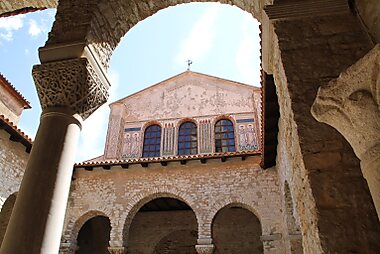
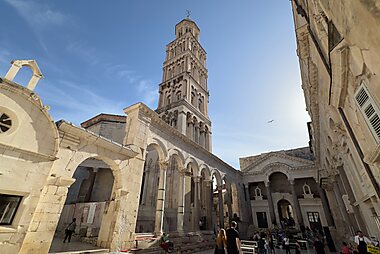
This selection spans thousands of years of Croatian history, from the Bronze Age hill fort of Monkodonja to the contemporary solar installations of Zadar’s Greeting to the Sun. It highlights major UNESCO World Heritage sites, including the Roman ruins of Diocletian’s Palace and the 6th-century Byzantine mosaics of the Euphrasian Basilica. The list also features the Cathedral of Saint Domnius, which repurposes an ancient imperial mausoleum, and the Ivan Meštrović Gallery, showcasing the monumental works of Croatia’s premier 20th-century sculptor.
6 hely


Historic Religious Sites
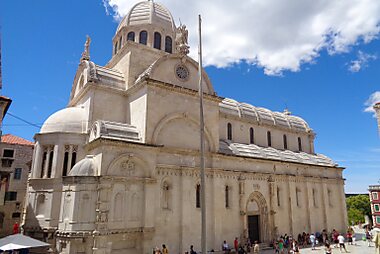
Croatia’s religious architecture spans nearly two millennia, reflecting Byzantine, Romanesque, and Baroque influences. This collection features the UNESCO-listed Euphrasian Basilica with its 6th-century mosaics, the 9th-century Pre-Romanesque Church of the Holy Cross in Nin, and one of the world’s oldest Sephardic synagogues in Dubrovnik. From the massive Romanesque Cathedral of St. Anastasia in Zadar to the 14th-century silver shrine in St. Simon’s, these sites document the country’s diverse Catholic, Orthodox, Jewish, and Islamic heritage.
15 hely
Authentic Local Flavors
This collection explores Croatia’s coastal culinary heritage, spanning from the Istrian peninsula to the Dalmatian coast. It features historic venues like Zadar’s Kavana Lovre, set within a 12th-century church, and Poreč’s Torre Rotonda, housed in a 15th-century Venetian tower. The selection highlights traditional konobas in Primošten and Rovinj, seafood-focused dining at Zadar’s Foša harbor, and unique natural settings like Cape Kamenjak’s Safari Bar. These establishments focus on regional specialties including fresh Adriatic fish, Istrian pasta, and locally sourced Mediterranean ingredients.
15 helyTúrák és tevékenységek
Horvátország — Térkép

 Interaktív térkép megnyitása
 Borravaló
Tipping is not mandatory in Croatia, since prices are already final and no service charge is added. Around 10% in a restaurant is a common gesture for good service, rising to 15% at a nicer place, while a konoba or pizzeria usually gets less, around 5-10%. Card machines increasingly prompt for a tip at checkout, a newer habit alongside the older custom of rounding up in cash.
10%, kiváló kiszolgálás esetén akár 15%
5-10%
a viteldíj felkerekítése
kis összegű készpénzes borravaló a szobaasszonyoknak/hordároknak
Elektromos hálózat
Croatia uses Type C and Type F plugs (the standard two-round-pin sockets used across most of continental Europe) at 230 V / 50 Hz.
Nyelv
Croatian is the official language. English is widely spoken in coastal tourist areas and among younger people; Italian is also common in Istria, and German is understood in many tourist-facing businesses.
Kapcsolattartás és internet
Prepaid SIM and eSIM plans from A1, Telemach, or Hrvatski Telekom are easy to buy at the airport or phone shops. Mobile coverage is strong along the coast and on the larger islands, with some drop-off on smaller islands and in mountainous inland areas.
Biztonság és segélyhívás
Croatia is a safe country for tourists, with low rates of violent crime. The main risks are practical: pickpocketing in busy coastal old towns, sunburn and heat in peak summer, and strong currents or rocky entry points at some beaches. Croatia completed a decades-long demining program in 2026, so the remaining risk from the 1990s conflict, once a real concern in a few rural inland counties, is no longer a factor for travelers.
Egészségügy
Tap water is safe to drink throughout the country. Pharmacies (ljekarna) are common in towns and cities, with at least one open late in most larger towns. No special vaccinations are required for entry.
Vízum és beutazás
Croatia is part of the Schengen Area. Citizens of the EU/EEA, the United States, Canada, Australia, and many other countries can enter for tourism without a visa for stays of up to 90 days within a 180-day period. Travelers from countries without a visa-waiver agreement need a Schengen visa, applied for through a Croatian embassy or consulate before travel.
Visa and entry requirements change frequently. Verify current requirements with the official immigration authority or your country's embassy before travel.
Etikett és szokások
Croatians are generally warm but not overly formal with strangers; a casual greeting ('dobar dan' — good day) when entering a shop or café is appreciated. Coffee culture runs deep — a coffee is meant to be lingered over, not rushed. Modest dress (covered shoulders and knees) is expected when visiting churches and cathedrals, many of which are still active places of worship.
Ünnepnapok és nyitvatartás
Public holidays can affect opening hours more in smaller towns and inland areas than on the tourist coast. Many family-run coastal businesses close for a few weeks in the off-season (typically November-March), so it's worth checking ahead outside peak summer.
Közlekedés
- By bus: An extensive intercity coach network connects almost every town, and is often faster and more frequent than trains, especially along the coast.
- By ferry: Jadrolinija and other operators run regular car and passenger ferries linking the mainland with the islands; book ahead in summer for car spots.
- By train: Rail mainly serves the inland and northern parts of the country; the coast south of Split has no rail line at all.
- By air: Domestic flights and coastal airports (Split, Dubrovnik, Zadar) cut down on long summer drive times from the north.
Vezetés
- Tolls: Most motorways use a ticket-and-barrier system — take a ticket entering, pay by cash or card when exiting, priced by distance traveled. A free-flow electronic system is planned to replace this from 2027.
- Winter tires: Required on designated "winter sections" of roads from mid-November to mid-April, regardless of actual weather.
- Speed limits: 50 km/h in towns, 90 km/h on open roads, 110-130 km/h on motorways.
- Coastal roads: The scenic Adriatic Highway (Jadranska magistrala) is narrow and winding in places, with heavy summer traffic; allow extra time.
- Fuel: Stations are self-service, with card payment standard at the pump.
Ételek és italok
Seafood, olive oil, and Mediterranean vegetables define coastal cooking, while inland dishes lean heartier and more Central European. Pašticada, slow-braised beef in a rich wine-and-prune sauce, is a classic celebration dish, and black risotto (crni rižot), colored with cuttlefish ink, is a Dalmatian staple.
Ćevapi (grilled minced-meat sausages) and burek (flaky meat or cheese pastry) are common everyday food, especially inland. Istria is known for truffles and its own olive oil and wine, and Pelješac and other coastal regions produce well-regarded reds. Rakija, a strong fruit brandy, is a common welcome drink, and fritule (small fried doughnuts) are a festive sweet.
Mit érdemes felfedezni
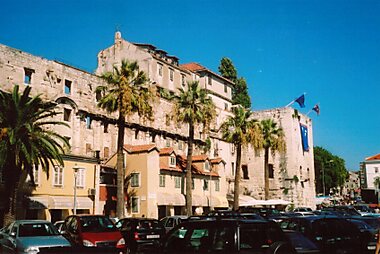
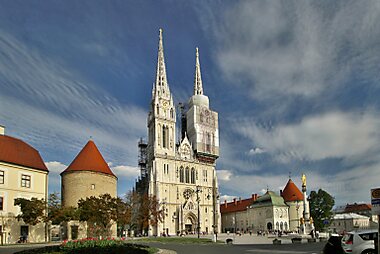
Zagreb is the capital, with an Austro-Hungarian old town, a lively café culture, and museums including the well-known Museum of Broken Relationships. Split, on the Dalmatian coast, is built around the Roman-era Diocletian's Palace, still a living neighborhood of shops and homes.
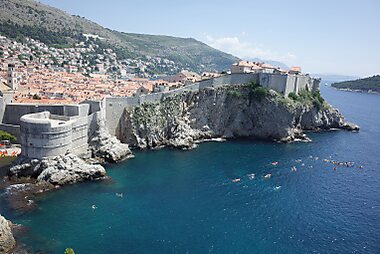
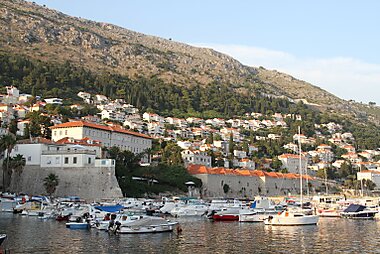
Dubrovnik, at the southern tip of the coast, is famous for its intact medieval walls and Old Town, a major (and often very crowded) draw in peak summer. Rovinj, in Istria, is a smaller, pastel-colored port town with a strong Italian influence. Hvar is one of Croatia's most popular islands, known for lavender fields, nightlife, and Venetian-era architecture, and inland, Plitvice Lakes National Park protects a chain of terraced turquoise lakes and waterfalls connected by boardwalks.
Horvátország – Tervezd meg az utazásod
Válaszd ki a meglátogatni kívánt helyeket, és a Tripomatic napokra lebontott útvonalat készít belőlük okos útvonaltervezéssel, időbecslésekkel és mindennel, ami a tökéletes utazáshoz kell.




