



Osaka
Osaka is Japan's third-largest city, built where the Yodo River meets Osaka Bay. It grew for centuries as the country's trading and merchant capital, and it still feels less formal and more food-focused than Tokyo.
A few days here mix a real castle, dense shopping streets, and a canal-side entertainment district that never fully quiets down. The 16th-century warlord Toyotomi Hideyoshi built his base of power here, and Osaka Castle still marks the spot. Osaka suits travelers who want a big city with an easy, informal feel, and who plan to eat as much as they sightsee.

Osaka – A planear uma viagem?
Cria o teu itinerário dia a dia na app Tripomatic.


Quando visitar
Spring (March–May) and autumn (October–November) are mild and the best times to visit. Summer is hot and humid, with occasional typhoons in September. Winter is cold but rarely freezing, and stays dry.
Plan around the cherry blossoms in late March and early April, when parks across the city fill with visitors for hanami season. Days get long and busy, so book accommodation well ahead.
Melhor altura para visitar: maio, outubro
Principais atrações
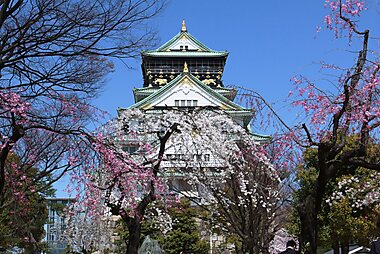
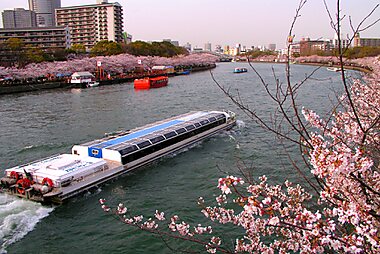
Osaka Castle is Osaka's most recognizable landmark, rebuilt in concrete in the 1930s on the site of Toyotomi Hideyoshi's 16th-century fortress. The surrounding park is one of the best spots in the city for cherry blossoms.
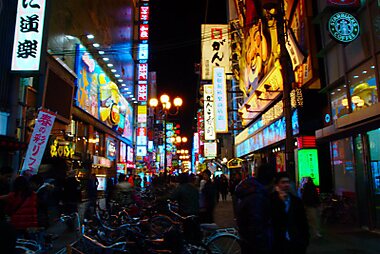
Dotonbori is the canal-side district that defines Osaka's nightlife, lined with neon signs, street food stalls, and the giant Glico running-man billboard.
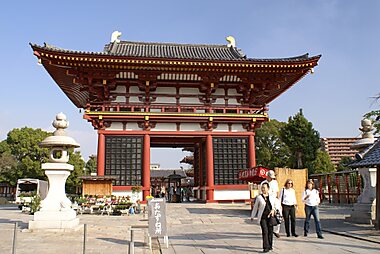
Shitennoji is one of Japan's oldest Buddhist temples, first built in 593 by Prince Shotoku. Its five-story pagoda and gates have been rebuilt several times but follow the original 6th-century layout.
Sumiyoshi Taisha is a Shinto shrine dating back over 1,800 years, known for architecture that predates Buddhist influence on Japanese shrine design.
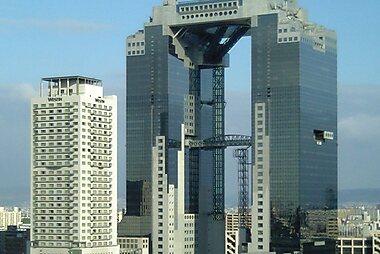
Floating Garden Observatory, the observation deck atop the Umeda Sky Building, connects two towers with a glass walkway 170 meters up, with wide views over the city.
Harukas 300, the observation deck near the top of Abeno Harukas — Japan's tallest building until 2023 — gives a similar view from the south side of the city.
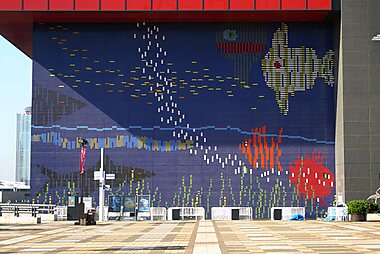
Osaka Aquarium Kaiyukan is one of the world's largest aquariums, built around a central tank that recreates the Pacific Ocean, with whale sharks as the main draw.
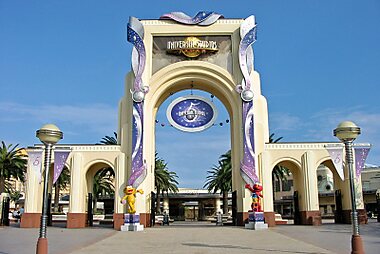
Universal Studios Japan is a full-day theme park built around Hollywood franchises, with dedicated lands for Harry Potter, Super Nintendo World, and Minions.
Listas em destaque


Osaka's Sacred Temples & Shrines
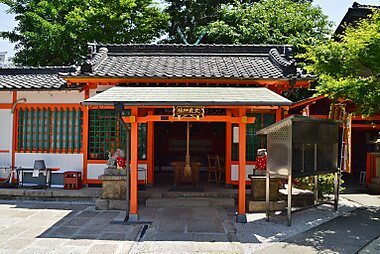
Osaka’s spiritual landscape spans nearly two millennia, from the 3rd-century Sumiyoshi Taisha, showcasing rare Sumiyoshi-zukuri architecture, to Shitennoji, one of Japan’s first Buddhist foundations. This selection includes the iconic lion-headed Namba Yasaka Shrine, the moss-clad Mizukake Fudo at Hozen-ji, and Sukunahikona-jinja, the center of medicine worship. These sites reflect the city's history through imperial connections, merchant traditions, and unique rituals like the creation of bone-ash Buddha statues at Isshin-ji.
14 lugares
Osaka Museums & Theatres
Osaka's cultural scene spans from the subterranean National Museum of Art on Nakanoshima to the traditional Kabuki stages of Dotonbori. The city features the Osaka Museum of Housing and Living, which recreates Edo-period streetscapes, and the Museum of Oriental Ceramics, housing one of the world's finest collections. Specialized institutions include the Osaka Science Museum and Peace Osaka, while theaters like Namba Grand Kagetsu and Yamamoto Noh Theater showcase Japan’s performing arts, from classical Noh to modern comedy.
16 lugares


Osaka Food & Drink
Osaka is defined by 'kuidaore'—the culture of eating until you drop. This selection centers on the neon-lit Dotonbori district, home to the mechanical crab of Kanidoraku and the savory okonomiyaki of Chibo. It explores specialized food destinations like the Takoyaki Museum and Naniwa Kuishinbo Yokocho, alongside 24-hour ramen stalls and traditional udon houses. From pufferfish specialists to local sushi spots in Ura-Namba, these venues represent the essential flavors and dining traditions of Japan's culinary capital.
10 lugaresO que experienciar
- Take an evening cruise on the Tombori River Cruise to see the Dotonbori canal's neon signs from the water.
- Join the crowds for hanami (cherry blossom viewing) along the Okawa River at Kema Sakuranomiya Park in late March and early April.
- Soak in the themed baths at Spa World, a bathhouse complex with pools styled after different countries.
- Catch a Grand Sumo Tournament, held at Osaka's EDION Arena every March — one of only six such tournaments held nationwide each year.
Excursões e atividades
Osaka — Mapa

 Abrir o mapa interativo
 Passeios de um dia
Osaka sits close to several of Japan's most famous historic destinations, so day trips are easy by train.
- Kyoto — Japan's former imperial capital, about 15 minutes away by Shinkansen or 30 minutes by regular train. Come for temples, shrines, and the geisha district of Gion.
- Sakai — a quieter city about 30 minutes away by train, home to the Mozu-Furuichi kofun tomb cluster, a UNESCO World Heritage Site that includes the largest keyhole-shaped tomb in Japan.
- Kobe — a port city about 30 minutes away, known for Kobe beef, a compact Chinatown, and views from Mount Rokko.
- Nara — Japan's first permanent capital, about 40 minutes away by train, with a park full of free-roaming deer and a giant bronze Buddha at Todai-ji temple.
- Himeji — home to Himeji Castle, Japan's best-preserved original castle and a UNESCO World Heritage Site, about 50 minutes away by direct train.
Como chegar
- By air: Kansai International Airport (KIX) is the main gateway for international flights, on an artificial island in Osaka Bay about 40 km from the city center. The Nankai and JR airport express trains reach central Osaka in 35–45 minutes; a limousine bus takes about an hour. Osaka Itami Airport, closer to the center, handles domestic flights only.
- By train: Shin-Osaka Station is the city's Shinkansen (bullet train) hub, with frequent high-speed connections to Tokyo (about 2.5 hours), Kyoto (15 minutes), and Hiroshima (about 1.5 hours).
- By bus: Long-distance highway buses connect Osaka to most major Japanese cities. They are usually cheaper than the train but slower, and most arrive at or near Osaka Station or Namba.
Como se deslocar
- Public transit: A dense subway and JR loop-line network covers the city. Buy a rechargeable ICOCA card, or tap in with a contactless credit card or phone at most gates — this is far easier than buying individual tickets. Osaka Metro
- Taxi: Widely available and metered, but expensive for longer distances. Useful late at night once trains stop running.
- On foot: Central districts like Dotonbori, Shinsaibashi, and Umeda are dense and walkable. Cycling is possible on flat ground but less common among visitors, since traffic and narrow streets make it less comfortable than in other Japanese cities.
Conduzir
- Is a car worth it?: No. Japan drives on the left, and Osaka's public transit covers the city better than a car could. Save a rental for day trips into rural Kansai.
- Parking: Multi-story car parks near stations charge by the hour and fill up fast; look for blue "P" signs. Street parking is scarce.
- Restrictions: None specific to tourists, but many older central streets are too narrow for comfortable driving.
Comida e bebida
Osaka is known across Japan as the city of "kuidaore" — roughly, "eat until you drop." Street food and casual dining are taken as seriously here as fine dining is elsewhere.
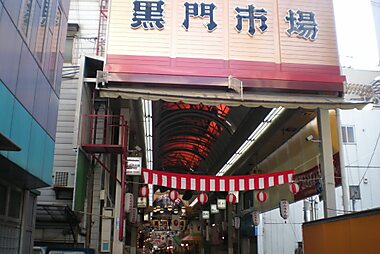
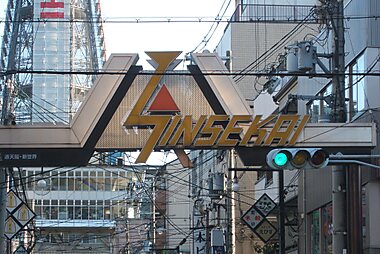
This is the birthplace of takoyaki, battered octopus balls, and okonomiyaki, a savory grilled pancake. For a concentrated taste of local food culture, browse the stalls at Kuromon Ichiba Market, a covered market known for fresh seafood and quick bites. For deep-fried kushikatsu skewers, head to the old-fashioned streets of Shinsekai.
Segurança e saúde
Osaka is very safe for tourists, including at night. Violent crime is rare, and it's common to see people leave bags or laptops to reserve seats in cafes.
The main risks are petty: pickpocketing in crowds like Dotonbori on weekend nights, and touts in Shinsekai and parts of Namba trying to lead tourists to overpriced bars. Politely decline and keep walking.
História
Osaka's history starts with its water. It sat at the mouth of the Yodo River, and briefly served as Japan's imperial capital in the 7th century. It later grew into the country's main trading port, moving rice, sake, and goods from across Japan.
The city's turning point came in 1583, when the warlord Toyotomi Hideyoshi built Osaka Castle as his base for unifying Japan. After his death, the Tokugawa shogunate besieged and destroyed the castle in 1615, ending the Toyotomi line. Rebuilt over the centuries, today's structure dates mostly from a 1931 reconstruction.
Osaka's merchant class thrived under Tokugawa rule, even without high social status, and shaped the city's food-first, informal culture that still defines it. Shitennoji, founded in 593, and the ancient shrine Sumiyoshi Taisha predate all of this, tying the city to Japan's earliest recorded history.
Factos sobre o país
Here are the essentials for traveling in Japan:
- Moeda
- Iene japonês JPY ¥ · Pagamentos com cartão · Geralmente aceite
- Números de emergência
- 118
- Eletricidade
- 100 V · 60 HzTipo A / Tipo B
- Idiomas
- japonês
- Água da torneira
- Própria para beber
- Sentido de condução
- Esquerda
- Indicativo telefónico
- +81


Osaka – Planeia os teus dias
Transforma os lugares deste guia num verdadeiro itinerário, com rotas inteligentes, estimativas de tempo e tudo o que precisas para uma viagem perfeita.




