



Sizilien
Sicily is the largest island in the Mediterranean. It has Greek temples, Arab-Norman churches, baroque towns and an active volcano. Many cultures ruled the island and each left buildings and food you can still enjoy.
It suits travelers who like history, food and varied landscapes. A week gives you a few cities, a few ancient sites and some coast. Distances are bigger than they look on the map, so most trips focus on one or two parts of the island: the west and north, or the east and south-east.

Sizilien – Planst du eine Reise?
Erstelle deine Reiseroute Tag für Tag in der Tripomatic-App.


Beste Reisezeit
Spring and autumn are the best seasons. Days are warm, the sea is pleasant by late spring, and the ancient sites are comfortable to walk. Summer is hot and busy on the coast, and inland areas get much hotter than the shore. Winter is mild but wet, and some seaside businesses and island ferries run a reduced schedule. Mount Etna is cold at the top all year.
The classical Greek drama season at the Greek theatre in Syracuse runs from May into July. Plays are performed at sunset in the ancient theatre. Book early if you want a seat.
Beste Reisezeit: Mai
Top-Sehenswürdigkeiten
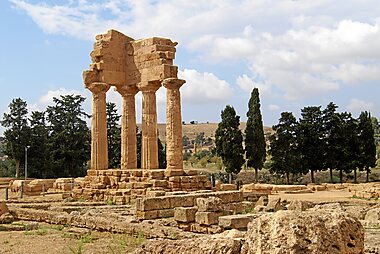
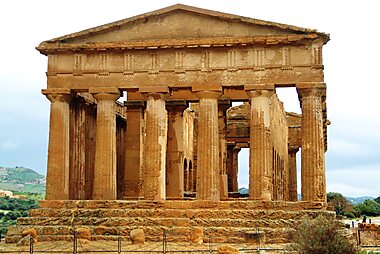
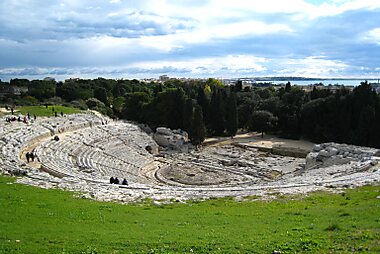
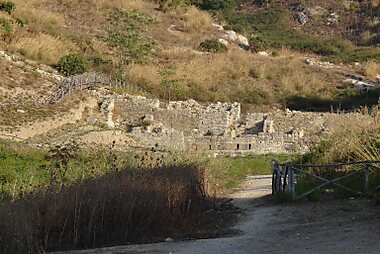
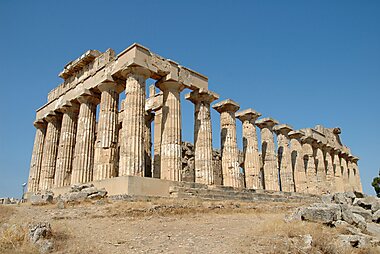

- Valley of the Temples is a ridge of Greek temples near Agrigento, on the south coast. The Doric temples are about 2,500 years old, and Temple of Concordia is among the best preserved in the Greek world.
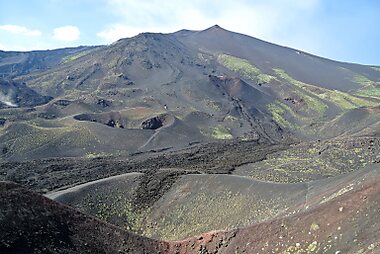
- Etna is one of Europe's tallest active volcanoes. A cable car and guided walks reach the upper slopes. Access near the summit craters depends on volcanic activity.
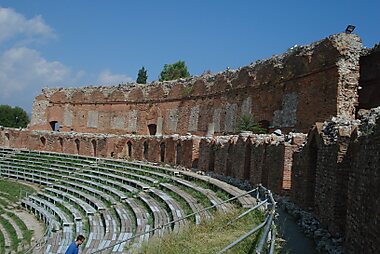
- Greek theatre in Taormina is an ancient theatre with views of Etna and the sea.
- Ortigia is the old island core of Syracuse, with narrow lanes and the sea on all sides. The Greek Theatre and Ear of Dionysius are a short ride away in the archaeological area.
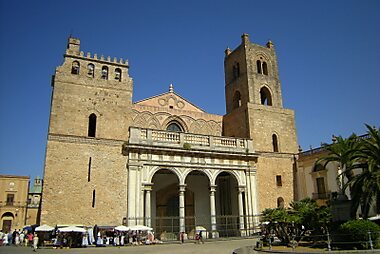
- Palatine Chapel and Monreale Cathedral in and near Palermo are covered in gold mosaics. They are the best examples of Arab-Norman art on the island.
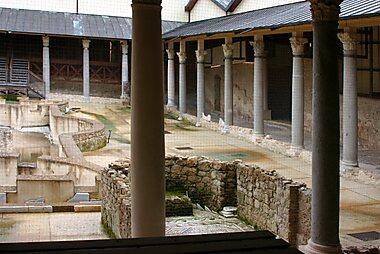
- Villa Romana del Casale is a Roman country villa in the interior. Its large floors of mosaics show hunts, athletes and daily life.
- Sito Archeologico di Segesta in the north-west has an unfinished Doric temple and a hillside theatre. Farther south, Parco Archeologico di Selinunte is a large ruined Greek city beside the sea.
- Cefalù Cathedral stands above a beach town on the north coast. Its 12th-century mosaics are among the finest in Sicily.
Empfohlene Listen


Erlebnisse & Aktivitäten
- A guided walk on Etna. Join a guided walk on the upper slopes. Wear warm layers and sturdy shoes, even in summer.
- Greek drama in Syracuse. See the season dates under when to visit. In summer, other ancient theatres also host concerts and shows.
- A night walk on Stromboli. Go with an authorised guide to see small eruptions after dark. Check the volcano's activity and walking rules before you go.
- Island hopping on the Aeolian Islands. Take hydrofoils between islands, swim near the fumaroles at Vulcano and walk on Salina.
- A coastal hike at the Zingaro nature reserve. A trail follows the sea cliffs and leads to small coves for swimming. It lies on the north-west coast, between Scopello and San Vito lo Capo.
- Sunset at the Trapani salt pans. The flat pans and old windmills are good for photos in the evening light.
- A boat trip to Mozia. A short ferry crosses a lagoon to Mozia, a former Phoenician island town.
Touren & Aktivitäten
Sizilien — Karte

 Interaktive Karte öffnen
 Tagesausflüge
Most visitors base themselves in one city and use day trips to see the rest. These are the common options.
- From Palermo: Cefalù is about 1 hour by train. It has a cathedral and a town beach.
- From Catania: Mount Etna is about 1.5 hours by car or tour. Taormina is about 1 hour by train or bus. The river gorge Gole dell'Alcantara is near Taormina and is a cool place to walk in summer.
- From Agrigento: Scala dei Turchi is a white marl cliff by the sea, about 30 minutes by car.
- From Syracuse: Noto is about 1 hour by bus or car. The baroque town was rebuilt after an earthquake in 1693. Ragusa and Modica are farther along the same road.
- From Trapani or Palermo: Erice is a medieval hill town above Trapani, reached by cable car. The Trapani and Paceco Salt Pans are a short drive from the city. The Isole Egadi are a short boat ride from Trapani.
- By boat from Milazzo: the Aeolian Islands are volcanic islands with hot springs, beaches and the active volcano on Stromboli. A day trip is possible from the north-east, but plan at least one night to see more than one island.
Orte zum Entdecken
Sicily is easiest to explore in regions.
- North coast and the west: Palermo is the capital and the main arrival point. Cefalù is the nearest beach town. The Greek ruins of Selinunte lie on the south-west coast.
- East coast: Catania is the busiest airport city and the base for Mount Etna. Taormina is the classic resort town above the sea.
- South-east: Syracuse, Noto and Ragusa form a good baroque and Greek route.
- Islands: the Aeolian Islands are the best-known island group. The Isole Egadi, Pantelleria and Lampedusa are other options for beach and boat trips.
Anreise
- By air: Catania (CTA) is the busiest airport on the island and is the best gateway for the east, Etna and Syracuse. Palermo (PMO) serves the north and west. Trapani-Birgi in the west and Comiso in the south-east have fewer flights, many of them low-cost. Catania is about 4 km from the centre and has an Alibus shuttle. Palermo is about 35 km from the centre and has a train and buses.
- By train: Long-distance trains from the Italian mainland reach Sicily by crossing the Strait of Messina on a ferry. Trains arrive in Messina, Catania and Palermo. Book on the Trenitalia site.
- By ferry: Ferries run from the mainland to Palermo, Catania and other ports, including overnight ferries from Naples to Palermo. Fast boats link the smaller islands to Milazzo, Trapani and Palermo.
- Information: the official Sicily tourism guide to reaching the island has more detail.
Unterwegs vor Ort
- Train: Regional trains link Palermo, Messina, Catania and Syracuse, and also north-coast towns such as Cefalù. Services are slower and less frequent than on the mainland, and many inland towns have no station. Buy tickets at the station or on the Trenitalia site.
- Bus: Several private bus companies connect the main cities and many towns, often faster than the train between Palermo, Agrigento and Catania. Buy tickets at the bus office or from the driver.
- Cities: Palermo, Catania and Syracuse have local buses. Historic centres are best seen on foot.
- Boat: Hydrofoils and ferries serve the Aeolian, Egadi and other islands. Boats are busy in summer and may be cancelled in bad weather.
- Car: A car is the easiest way to reach the interior, the south coast and small ancient sites. See the driving section.
Autofahren
- Is a car worth it? Yes, if you want to see the interior, the south coast, small ancient sites or villages. In Palermo, Catania and Syracuse a car is a burden, so rent one only when you leave the city.
- Roads: Main motorways connect the big cities. Inland roads are narrow, winding and slow, so plan more time than the map suggests. Some motorways have tolls and others are free.
- Parking: Use car parks at the edge of historic centres. Pay at machines or park-and-pay meters. Do not leave luggage visible in the car.
- Restrictions: Many historic centres have ZTL zones with camera enforcement. Ask your hotel before you drive into one, or you may receive a fine by mail.
Essen & Trinken
Sicilian food mixes Arab, Greek and Spanish influences. Look for arancini (fried rice balls), pasta with sardines in Palermo, pasta alla Norma (aubergine and ricotta) in Catania, fresh swordfish, and couscous with fish near Trapani. For sweets, try cannoli, cassata, and granita with a brioche for breakfast in summer. Local wine includes Marsala, and wines grown on the slopes of Etna.
In Palermo, street food clusters in the old markets such as Ballarò. In Catania, the fish market behind the cathedral square is a good place for lunch. In Ortigia, Syracuse, eat around the market and the lanes near the sea. Many restaurants add a small cover charge (coperto) to the bill.
Sicherheit & Gesundheit
Sicily is generally safe for visitors. The main risk is petty crime in busy places. Watch for pickpockets in markets, on buses and near stations in Palermo and Catania. Do not leave bags in parked cars. Scooter bag-snatching happens in some cities, so carry bags on the side away from the road.
- Heat and sun: Summer is very hot. Drink water, avoid midday walks at open archaeological sites, and use sun protection. Wildfires can happen in dry summers.
- Volcano: Etna and Stromboli are active. Follow local rules and guide advice. Ash from Etna can sometimes disrupt flights at Catania.
- Sea: Currents and waves can be strong at some beaches. Follow flag signs where lifeguards are present.
- Emergency: Call 112 from any phone.
Geschichte
Sicily lies at the crossing of the Mediterranean, so many peoples have ruled it. Greek colonists founded Syracuse and other cities from the 8th century BC. Their great temples still stand at Valley of the Temples and Parco Archeologico di Selinunte. Phoenicians settled the west, and Mozia was one of their island towns.
Rome took the island and used it as a granary. The mosaics of Villa Romana del Casale date from late Roman times. Arab rulers came in the 9th century and made Palermo a rich city. The Normans took over in the 11th century and built the mosaic-covered churches of Palatine Chapel and Monreale Cathedral, mixing Arab, Byzantine and Norman styles.
Later rulers included the Spanish and the Bourbons. A strong earthquake in 1693 destroyed much of the south-east, and towns such as Noto were rebuilt in the baroque style. Sicily joined the new Italian state in 1861 after Garibaldi's campaign of 1860.
Länderfakten
Quick practical facts for Italy at a glance:
- Währung
- Euro EUR € · Kartenzahlung · Weitgehend akzeptiert
- Notrufnummern
- 112
- Stromnetz
- 230 V · 50 HzSteckertyp C / Steckertyp F / Steckertyp L
- Sprachen
- Italienisch
- Leitungswasser
- Trinkbar
- Fahrseite
- Rechtsverkehr
- Telefonvorwahl
- +39
Sizilien – Plane deine Reise
Wähle die Orte aus, die du sehen möchtest, und Tripomatic erstellt daraus eine Route Tag für Tag – mit intelligenter Wegführung, Zeitschätzungen und allem für die perfekte Reise.




